• F2
  • F4
  • F3
  • F1

Over the years I have become intrigued with some ‘strange’ items in the TRC collection, but I never expected to become interested in that everyday item, the press stud! I am currently cataloguing various forms of fastenings, such as press studs, hooks and eyes, and buttons, that were given to the TRC by Hennie Stevan-Bathoorn and Sjoerd Stevan of the former Museum voor Naaldkunst, Winschoten, here in the Netherlands.

The donation includes a folder with various sheets of press studs that were produced by different manufacturers. I have never really looked in detail at these small, but useful items before, but I started to wonder about the history of these items as well as looking again at the press studs in the collection, and at a range of garments that are fastened with such studs.

Fig. 1.Card with Waldes press studs with spring , c. 1910 (TRC 2026.2091).Fig. 1.Card with Waldes press studs with spring , c. 1910 (TRC 2026.2091).

Well, to start with, the press studs (UK) have different names in the (English-speaking) world. In the US, for example, they are called snap fasteners, snaps, or snap buttons. Elsewhere they are sometimes called poppers, tich buttons or dome fasteners.

A typical press stud is made up of two basic elements, namely a circular disc with a protrusion or knob that fits into a well or groove on a second, corresponding disc. These two discs are sometimes called the male and female parts, stud and well, stud and disc, or knob and well.

Fig. 2. Card with 6x 6 black press studs. Germany, early 20th century (TRC 2026.2018).Fig. 2. Card with 6x 6 black press studs. Germany, early 20th century (TRC 2026.2018).


Different sizes of press studs are made, for example, for a baby’s garment (very small), bras (small) or jackets (large). They were originally produced in black or silver coloured metals, but by the end of the 20th century a range of coloured metal versions, or even transparent and opaque plastic examples became available, as well as stylised floral forms and a range of ornate geometric shapes.

It would appear that press studs were first patented in March 1885 by an inventor from Pforzheim in southwestern Germany, called Heribert Bauer. The patent describes them as “Federknopf-Verschluss” ('spring-button-closure'). The Bauer studs were regarded as an interesting device but with some basic problems, such as rusting and opening at inconvenient moments.

Over the next few years various other patents were applied for, including one by a French engineer called Albert-Pierre Raymond. In 1886 he designed a version that was specifically intended for glove makers.

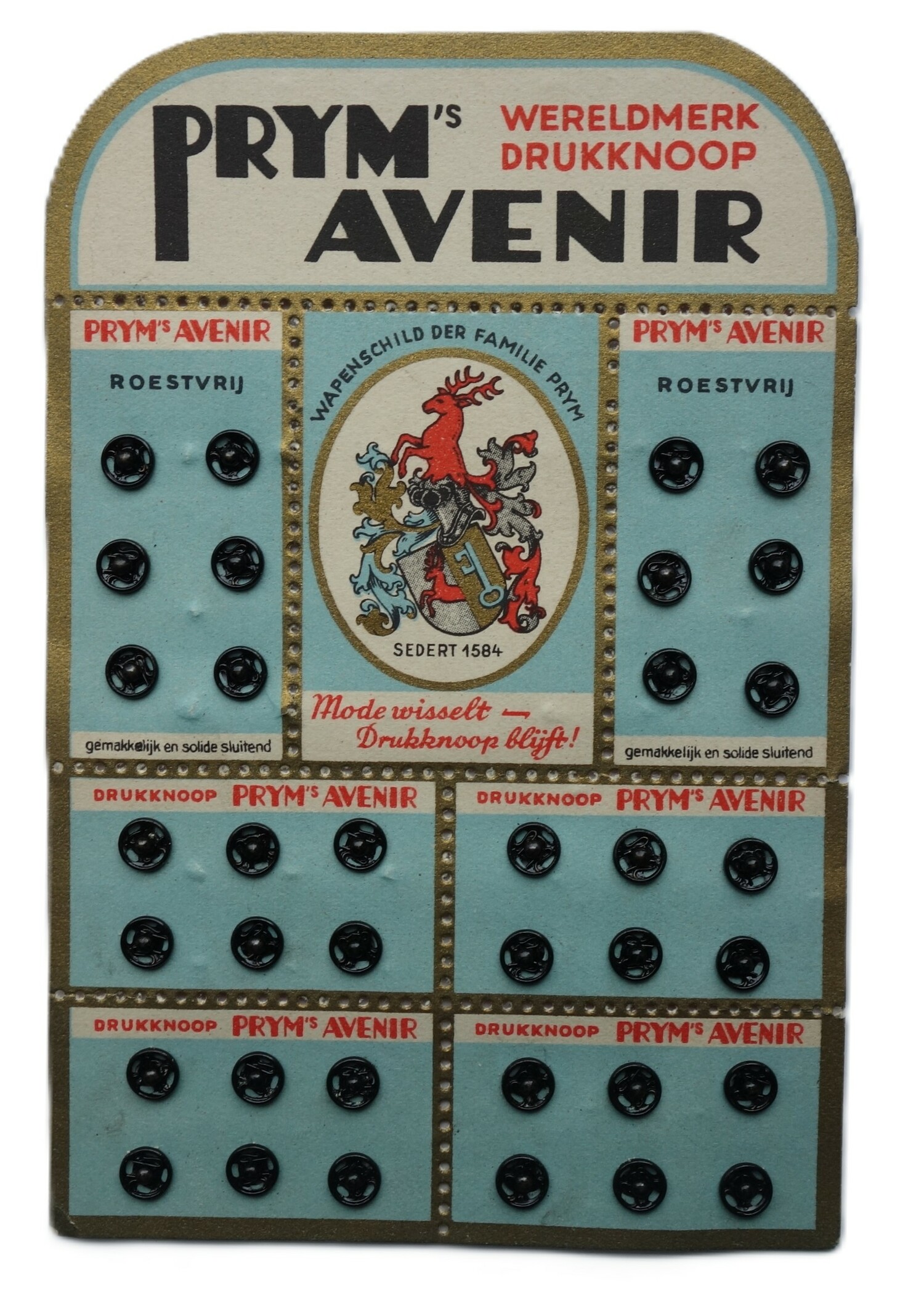
In 1893 a German haberdasher, called Hans Prym, devised a press stud with a small spring in it (see below), and this has become a standard feature for many press studs ever since. In 1903 a German haberdasher called Hans Prym solved the problem of press studs opening up by accident by inserting a rust-proof S-shaped bronze wire into the fastener. It is this form that is used for many press studs to the present day and which is sold all over the world

Card with 6x 6 black press studs. There is a printed text that states: "PRYM'S AVENIR WERELDMERK DRUKKNOOP", Germany, produced for the Dutch market, early 20th century (TRC 2026.2008).Card with 6x 6 black press studs. There is a printed text that states: "PRYM'S AVENIR WERELDMERK DRUKKNOOP", Germany, produced for the Dutch market, early 20th century (TRC 2026.2008).

Fig. 1. Card with Waldes press studs with spring, c. 1910 (TRC 2026.2091).

The moderrn ‘male’ part of press studs usually has a small, ring-shaped spring that creates tension around the knob when the two halves of the stud are pressed together. Nowadays, some press studs have such springs, while others have a groove instead. Some press studs are sewn to a ground material via holes cut into the discs, while others are attached to a cloth, felt or leather ground with a form of rivet (the rivet form will be the subject of a blog in due course).

Based on the advertisements for early press studs, people were concerned about springs and studs rusting as a result of washing garments, etc. They also were aware of the metal sewing holes cutting and fraying the sewing thread, and the edges of the discs tearing the ground material.

The ‘fact’ that press studs are rust-resident is a feature of many sheets used to sell press studs (see figure Xxx). Presenting/selling press studs


TRC 2026.2027  guaranteed rustless

Numerous companies started to produce press studs in the early 20th century and in some cases they were sold in small paper packages, while others were in small boxes. Most companies produced a card sheet that was divided into six sections

Fig. 2. TRC 2026.2018 sold on a card sheet

A feature of these sheets is that the press studs were often sold in groups of six, which suggests a British influence (based on groups of 12), rather than the continental system based on 10.

Card with 6x six black press studs and the printed text: "WALDERS Koh-i-noor. Paris (TRC 2026.2090).Card with 6x six black press studs and the printed text: "WALDERS Koh-i-noor. Paris (TRC 2026.2090).

Miss KIN and a press stud monocle

The press studs recently added to the TRC catalogue include some examples from the Koh-i-nor series. They were made by the Czech company of Waldes, which was set up by engineer Hynek Puc and salesman, Jindřich Waldes, and based in Prague. It started producing press studs in the 1890s, under the trade name of Koh-i-noor (KIN) after the famous diamond that is now part of the British crown jewels.

Prior to c. 1912 Koh-i-noor press studs had no specific logo. From 1912, however, a feature of Koh-i-nor press studs was the inclusion of a motif featuring a young girl (Miss KIN) whose left eye was a press stud.

TRC 2026.XXXX - A sheet of Koh-i-nor press studs without the classic logo of a girl with a press stud eye (pre-1912). TRC 2026.2007 - A sheet of Koh-i-nor press studs with a logo of a girl with a press stud eye.

Prior to the Second World War (1939-1945) the Waldes company produced press studs for many European and American countries, including France (KIN Paris), Germany, the Netherlands, Spain (KIN Barcelona) , and the USA. The various sheets were produced in the relevant languages, with different versions of Miss KIN.

Koh-i-noor Paris produced for the French market

Fig. 3. TRC 2026.2090

Uses

Press studs are often used instead of buttons ito fasten various items including soft furnishings as well as a wide range of garments from underwear, blouses, aprons, trousers, coats and skirts, headwear, gloves and footwear. They are a hidden form of fasteniung, and easy to use. There are different grades of press studs, from those suitable for a child to military grade forms used for parachute harnesses, etc. Press studs are also sometimes used to decorate items. In the TRC Collection, for example, there is a child’s embroidered cap from Pakistan that is embellished with buttons, coins and press studs.

Fig. 4. Cap with back panel decorated with bands of embroidered geometric motifs, zig-zag lines, V-shapes, etc., as well as applied press studs and other objects. Pakistan, mid-20th century (TRC 2026.1897).Fig. 4. Cap with back panel decorated with bands of embroidered geometric motifs, zig-zag lines, V-shapes, etc., as well as applied press studs and other objects. Pakistan, mid-20th century (TRC 2026.1897).

Fig. 4. TRC 2026.1897

Due to circumstances we unfortunately have to remain closed to the public on Friday 11th September. But please feel welcome during the weekend, when we open for the Open Monumentendagen, Saturday from 12.00 - 17.00, and Sunday from 10.00 to 17.00.

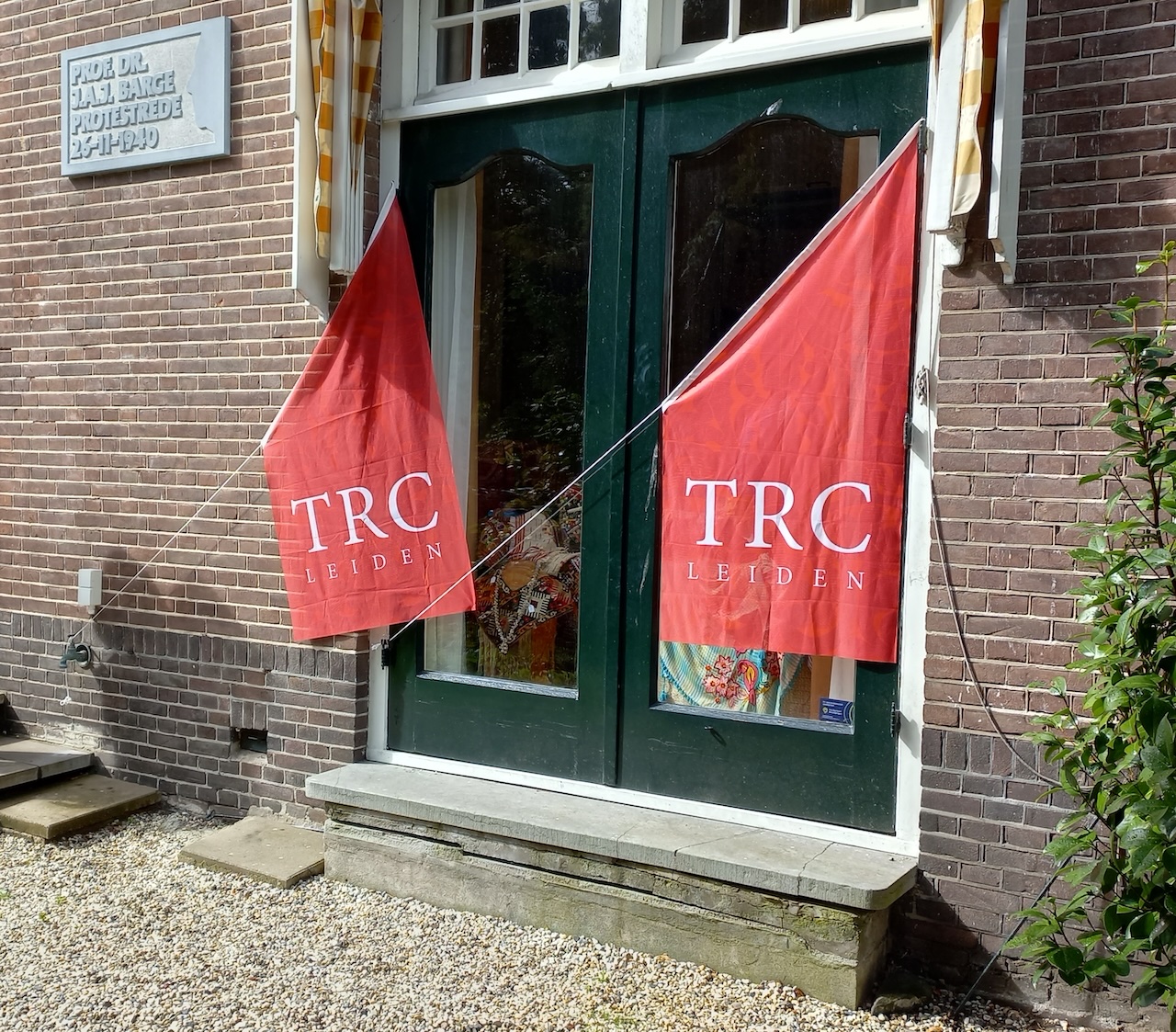
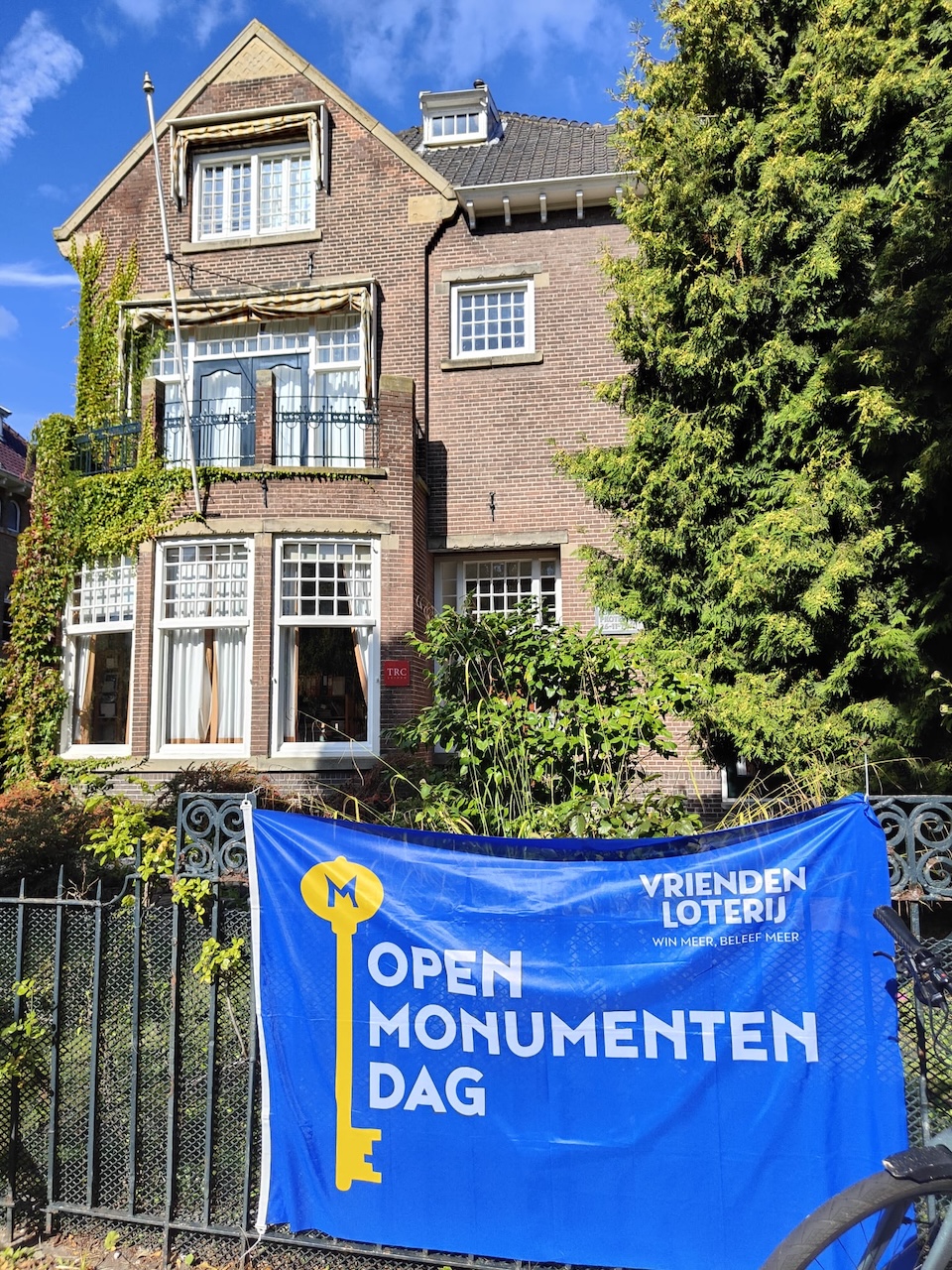
The TRC, Boerhaavelaan 6, LeidenThe TRC, Boerhaavelaan 6, LeidenDuring the weekend of 12 and 13 September 2026, thirty-five monuments in Leiden open their doors to the public. This is a unique opportunity to visit old sites rich in history, ancient homes and university buildings. Many monuments host small exhibitions as well as performances by choirs and music societies from Leiden. This year’s theme is Resilient Heritage. Take a look behind the scenes of the restoration of buildings – discover how Leiden’s heritage is alive and kicking.

One of the monuments open to the public is the home of the Textile Research Centre, Boerhaavelaan 6. On Saturday we are open between 12.00 and 17.00, on Sunday between 10.00 and 17.00. A special TRC blog about the house and the family that occupied it since the 1920s can be downloaded here. The blog tells more about Prof. Barge, a former Chancellor of Leiden University, who lived here until his death in 1952, but also about the wartime years when the house was confiscated by the German occupying forces and made into their Ortskommandantur.

The TRC moved into the building, now owned by the Stichting Monumentenbezit, in  April 2026, and this weekend visitors can see the inside the building and enjoy a small exhibition about the paisley motif, its origins and use throughout the world.

Information about the building on the official Monumentendag website can be downloaded here.

The TRC would love to welcome you this weekend.

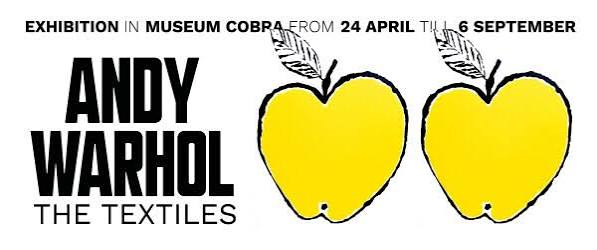
Poster for the Andy Warhol exhibition, now extended until 8 November. Museum Cobra, Sandbergplein 1, Amstelveen.Poster for the Andy Warhol exhibition, now extended until 8 November. Museum Cobra, Sandbergplein 1, Amstelveen.Until Sunday, 8 November 2026, Museum Cobra in Amstelveen in The Netherlands presents an exhibition with the title 'Andy Warhol, The Textiles'. TRC friend and volunteer, Loren Mealey, went to see the exhibition in Amstelveen and she wrote the following blog:

When we think of Andy Warhol, we think of Campbell’s Soup Cans, Coca-Cola bottles, Marilyn Monroe and the bright, bold world of Pop Art. Before all of that, though, Warhol was illustrating something quite different: textiles.

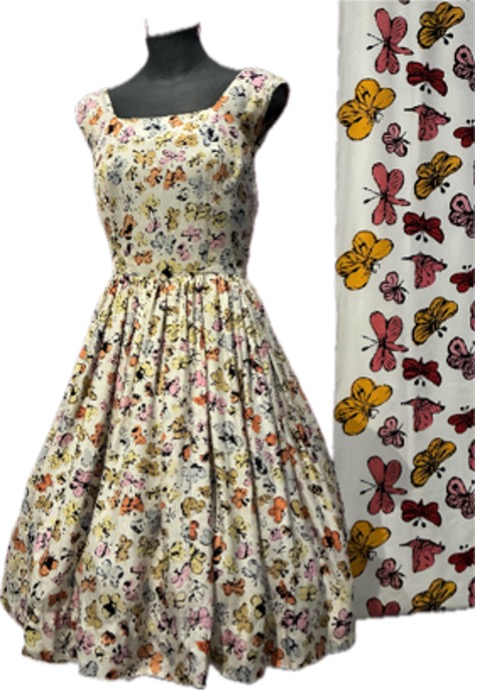
Left: “Happy Butterfly Day”. Printed silk, circa 1955-56. Manufacturer unknown; Right:  “Large Butterflies”. Printed cotton, circa 1955-56.  D. B. Fuller & Co., Inc.Left: “Happy Butterfly Day”. Printed silk, circa 1955-56. Manufacturer unknown; Right: “Large Butterflies”. Printed cotton, circa 1955-56. D. B. Fuller & Co., Inc.In the 1950s and early 1960s, long before he became one of the most recognisable artists of the twentieth century, Warhol was a successful commercial illustrator and graphic designer in New York City. He created playful textile patterns filled with ice-cream cones, candy apples, lemons, butterflies, flowers, pretzels, shoes, buttons and even circus clowns. They are cheerful, whimsical and unmistakably of their time. If observed closely, you can already see the beginnings of the Warhol we know today.

What is particularly appealing about these designs is their colourful combination of simplicity and repetition. Warhol took an ordinary object, reduced it to its essential shape, and then repeated it across the fabric. The same butterfly might appear again and again, but each one will show a tiny difference. A line shifts. A shape changes slightly. A colour lands differently.

Then there is the line. Warhol had developed his distinctive “blotted line” technique while still a student and refined it during his years as a commercial illustrator. The process was quite simple. He traced an image in ink on a non-absorbent sheet and then pressed it against another sheet of paper, transferring the ink. The result was a broken, slightly uneven line: part drawing, part print.

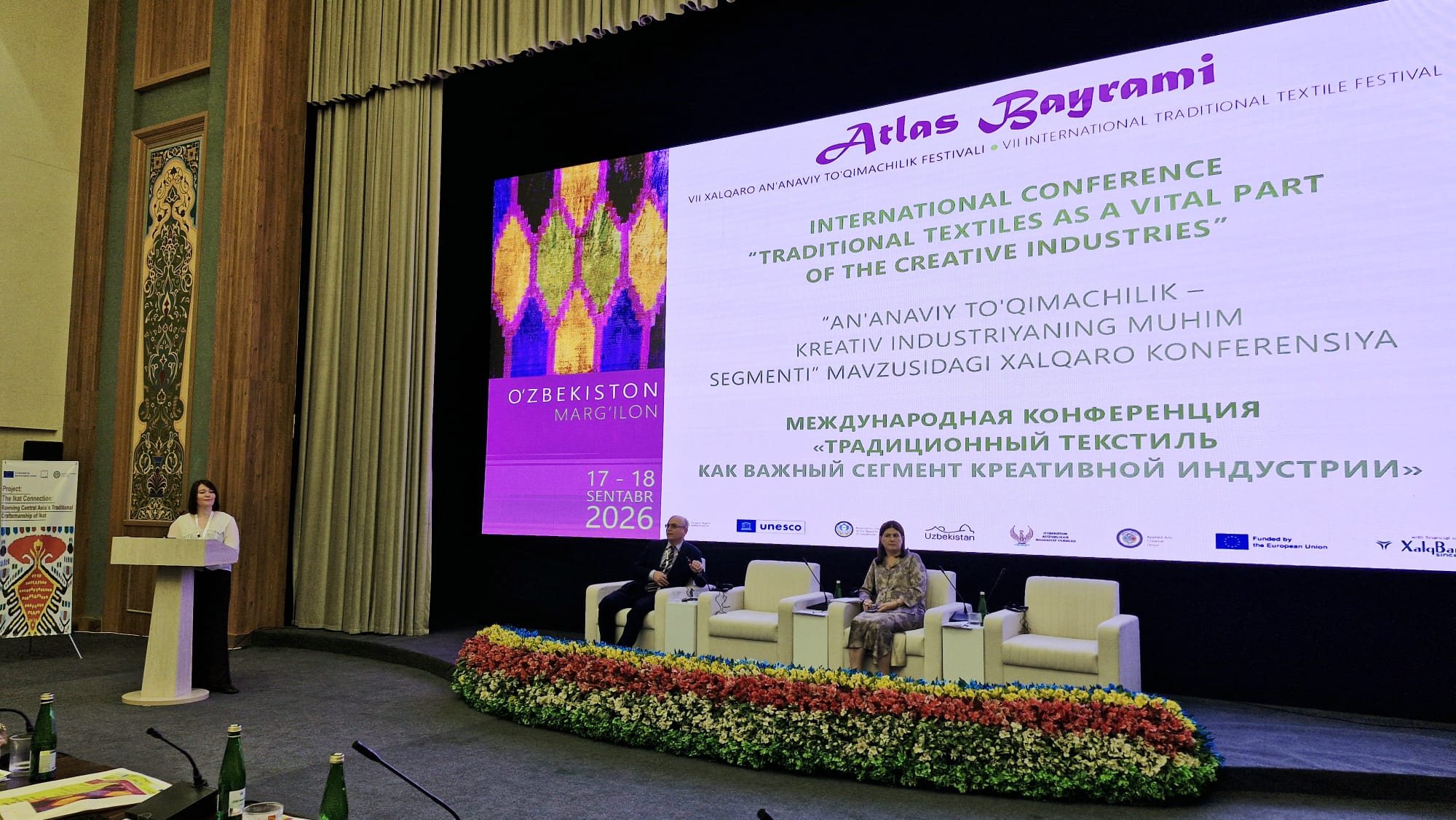
Open Monumentendagen Leiden 12-13 September 2026Open Monumentendagen Leiden 12-13 September 2026People are back from holiday and things are on the move again at the TRC. Marlies de Groot, who runs the TRC workshops, etc., is adding more and more events to the TRC Agenda. There are going to be some very interesting and inspirational workshops.

We would like to draw your attention to two upcoming, specific events!

The first is Open Monumentendagen, a national weekend whereby monumental buildings throughout the Netherlands are open to the public. The TRC and Boerhaavelaan 6 were open for the first time during Open Monumentendagen in September in 2025 and we will be open again in a few weeks time! The weekend is 12-13 September.

On the Saturday we will be open from 12.00 until 17.00, while on Sunday the TRC opens its doors from 10.00 until 17.00. You are more than welcome to come and see the building, hear about its history, as well as see the TRC’s latest exhibition that is about that well-known global icon, the paisley motif.

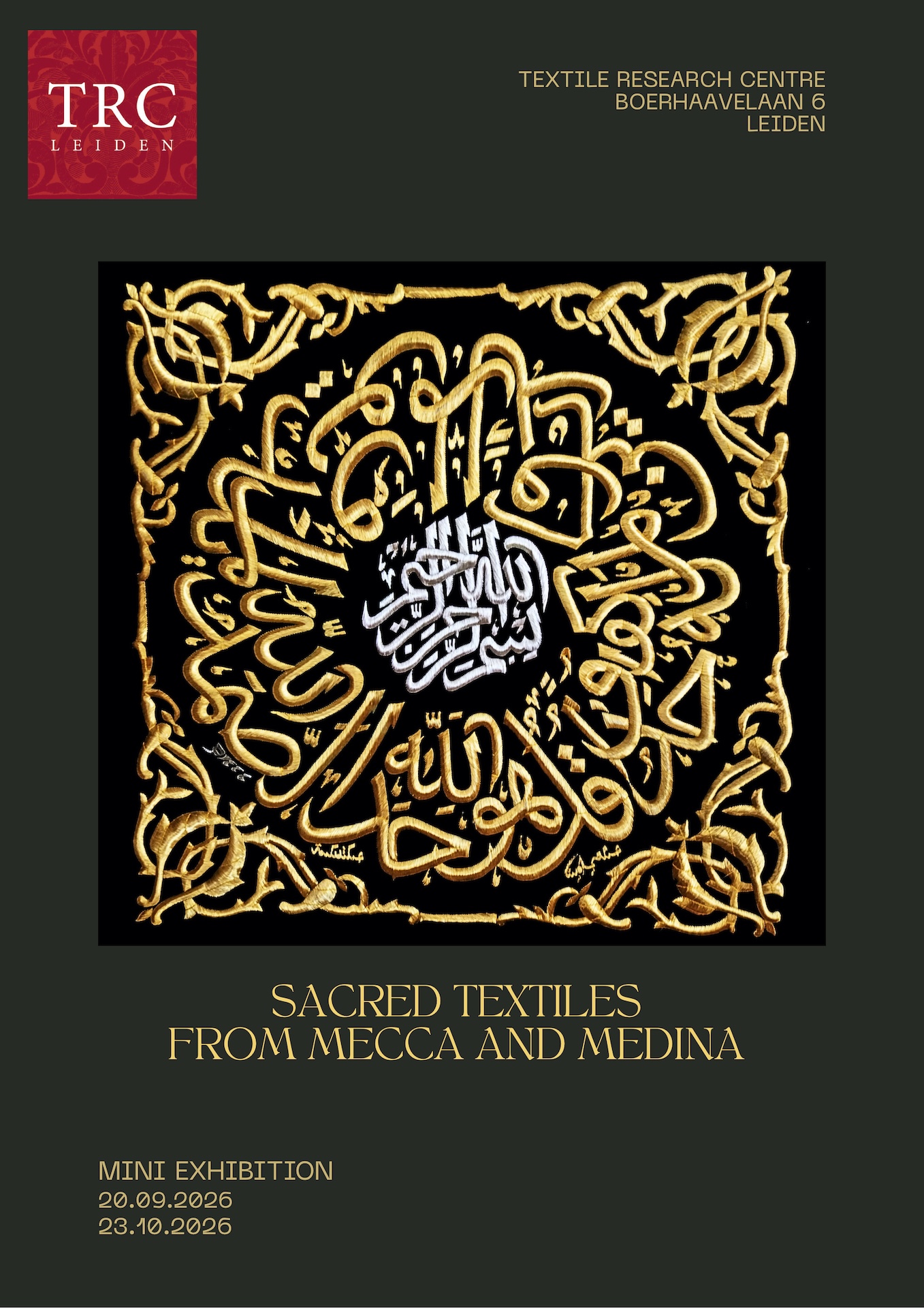
Special min-exhibition: Sacred textiles from Mecca and Medina, created with the help of the Turkish community in Leiden.Special min-exhibition: Sacred textiles from Mecca and Medina, created with the help of the Turkish community in Leiden.The other event is very special. From the 20th September the TRC is presenting a mini-exhibition about ‘Sacred Textiles from Mecca and Medina’. It will be a rare opportunity to see woven and embroidered textiles associated with the Kiswah, the silk cover of the Kaaba, in Mecca (Saudi Arabia) and one of the most holy places within the Islamic World.

There will also be on display some textiles that are placed around the tomb of the Prophet Mohammed in the Al-Masjid an-Nabawi, Medina, as well as photographs of the textiles in situ, etc.

The exhibition is being created with the help of several private collectors, as well as the local Turkish community here in Leiden. We have come together with the aim of raising funds to purchase a storage unit in the TRC’s proposed annex that will be used to house the TRC’s extensive Ottoman and regional Turkish textile and clothing collection.

Please note that this mini-exhibition is only on view for one month, and we are asking for a voluntary donation of a minimum of €5 per person that will go towards the annex fund!

On 31 August, the TRC opened its doors for a new exhibition: Paisley: The History of a Global Icon (by the curator, Augusta de Gunzbourg)

The new Paisley exhibition at the TRC. Photograph by the curator, Augusta de Gunzbourg.The new Paisley exhibition at the TRC. Photograph by the curator, Augusta de Gunzbourg.We all know the motif, that cone shape that is curved at the top, which is found on Kashmir shawls, men’s ties, 1970’s hippie prints, or even on cowboy bandanas. Paisley is everywhere !

It is so well-known that it is generally accepted as just being one of those patterns that have always been there, but we rarely think think about its origins and why it is so popular all over the world.

The TRC exhibition is a re-edited, expanded version of one of its past, and online exhibitions (interrupted by the COVID-pandemic) about the famous Paisley motif, and this time mounted in the TRC's new premises along the Boerhaavelaan (No.6) in Leiden.

The exhibition explores the history of the Paisley motif, its ancient origins and its development to the present day. It also looks at how it is currently used for a wide variety of textiles and garments all over the globe.

Click on the illustration to open the brochure.Click on the illustration to open the brochure.The TRC has made a new brochure about its background, its vision, and its intentions for the future. The brochure is especially aimed at European companies and individuals that want to support the TRC. The brochure also lists the countries where the organisation 'GivingEurope' can help the potential sponsors with information about attractive tax benefits.

These countries include Belgium, France, Germany, Great Britain, Italy, Luxembourg, Portugal, Spain, Switzerland. The brochure also gives information about sponsors from the. USA, who can direct their donations via Myrad USA, which will organise the tax benefits. Potential sponsors from The Netherlands can address the Cultuurfonds.

Joost Kolkman and Ray Raymakers produced a lovely brochure about the TRC, but also about the importance and attraction of textiles. The brochure can be downloaded here. A printed version is also available, and can be obtained from the TRC.

Tapestry fragment from Coptic Egypt, c. 4th century AD (TRC 2025.0012), Titia Huisman bequest.Tapestry fragment from Coptic Egypt, c. 4th century AD (TRC 2025.0012), Titia Huisman bequest.Are you a lover of textiles? Have you been to the TRC and enjoyed your visit? Do you want to support the future of textile and clothing studies and education, both here in the Netherlands and elsewhere?

If yes, then please think about including the Stichting Textile Research Centre (TRC Leiden) in your testament. We are a Culturele ANBI, which means any donation made within the Netherlands is exempt from inheritance tax, so 100% of your donation would come to the TRC!

Please note that a hand-written document is not allowed. This type of donation in a will needs to be drawn up by a notary. You will need the following information: Stichting Textile Research Centre, Boerhaavelaan 6, 2334 EN, Leiden, The Netherlands, registered with the Dutch Chamber of Commerce under the number 41168554.

We have already been mentioned in various wills with respect to the donation of objects, but funding is equally important to make sure that our many activities can continue!

Something to think about! For more information please do not hesitate to get in contact with me, Dr Gillian Vogelsang-Eastwood at This email address is being protected from spambots. You need JavaScript enabled to view it.

Search in the TRC website

Contact

Boerhaavelaan 6
2334 EN Leiden.
Tel. +31 (0)71 5134144 (office hours)  
office@trcleiden.org 

The TRC is open every week-day from 10.00 to 15.00

facebook 2015 logo detail 

instagram vernieuwt uiterlijk en logo


Bank account number

NL39 INGB 0002 9823 59, in the name of the Stichting Textile Research Centre.

Donations

The TRC is dependent on project support and individual donations. All of our work is being carried out by volunteers. To support the TRC activities, we therefore welcome your financial assistance: donations can be transferred to bank account number (IBAN) NL39 INGB 000 298 2359, in the name of the Stichting Textile Research Centre. BIC code is: INGBNL2A.

 You can also, very simply, if you have an iDEAL app, use the iDEAL button and fill in the amount of support you want to donate: 


Since the TRC is officially recognised as a non-profit making cultural institution (ANBI), donations are tax deductible for 125% for individuals, and 150% for commercial companies. For more information, click here