Below follows an annotated selection of new acquisitions for the TRC Library, February 2014.
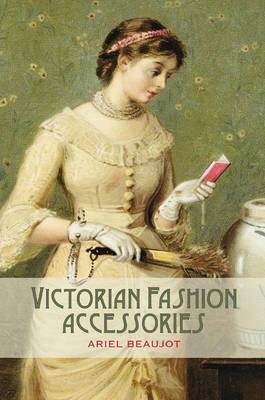 Victorian Fashion Accessories, by Ariel BEAUJOT. 2012. London: Berg. ISBN: 978-1-84788-682-8; softback, extensive footnotes, bibliography, index, list of figures, fully illustrated with b/w images, pp. 216. Price: GBP 19.99
Historian Beaujot looks at four fashion accessories from Victorian England and explores how their use helped to construct and reinforce ideas about class, gender and imperialism. The accessories explored are gloves, fans, umbrellas (and their feminine equivalent, parasols) and vanity sets.
The colour, fit and material used for these accessories were all keenly observed clues to the wearer’s status. While meant for display (usually to show off a husband’s wealth), these accessories were also used to conceal. A middle class woman only revealed her bare hands to close family and friends, and would never appear in public without gloves (one exception being a just married bride, who removed her gloves to sign the wedding register as a sign of sincerity). But gloves could also conceal signs of work on hands, to the relief of any woman who wanted to hide the fact she could not afford enough servants to do all of her housework for her.
In addition to explaining the history of how these objects were manufactured and sold, Beaujot offers interesting insights into middle class Victorian social customs, prejudices, hopes and fears.
Recommendation: This book will appeal both to academics, especially as an introductory text, and to anyone interested in the Victorian period.
*****
 The Religious Life of Dress: Global Fashion and Faith, by Lynne HUME. 2013. London: Bloomsbury, London. ISBN 978-08578-5361-5. Soft cover, extensive bibliography and list of relevant websites, pp. 176, black and white photographs. GBP 19.99
This book looks at over ten religions in various parts of the world and the garments practitioners wear to signify that they “belong” to the religion. A short, very simplified, overview is given of each religion’s main tenets. One strength of the book is the detailed account and names of different vestments (for example: the long sleeveless cloak worn by Roman Catholic priests and bishops, the chasuble, originated from the humble Roman farm workers cloak, the casula). Hume explores the sensual experience of wearing these garments and whenever possible has included eye witness accounts of how practitioners feel when wearing the garments. The accounts of nuns modernizing their dress after Vatican II, of Indian women’s relationships to saris, and of Candomblé priestesses in spotless white skirts and petticoats are valuable, given the undernarrated experiences of women’s spirituality.
The colours and accoutrements of garments (shaman’s leather drum and fringes of shamans, a Buddhist’s mala beads) are described. The book is at its most interesting when it explores the textiles symbolism, such as the Sufis’ (the word itself probably derives from suf, meaning wool) wearing of a black robe (kirqah) and tall camel hair hat to represent, respectively, the grave and the headstone. These garments are shed during the ritual dance as the dancer seeks union with God.
The religions examined include Roman Catholicism, different Protestant groups (Amish, Mennonites and Hutterites); Islam; Judaism; and garments of Hindus, Sikhs, Jains, Buddhists and Sufis; indigenous shamans and modern pagans; and lastly the transplanted West African religions of Voodoo, Santería and Candomblé developed by slaves in the Americas.
Recommendation: The book is a good introduction to either religious studies or to the importance of religious dress to personal or group identity. Well worth reading.
*****
Dyeing and Screen-Printing on Textiles, 2nd edition, Revised and Updated, by Joanna KINNERSLY-TAYLOR. 2013. London: A&C Black. ISBN: 978-1- 4081-2475-8. Softback, fully illustrated with colour images. It includes a glossary, charts, address and artist lists, bibliography and index; pp. 191. Price: GBP 19.99
A user-friendly and practical guide for professional textile designers and students by well-known printed-textile artist, Joanna Kinnersly-Taylor, who is a visiting lecturer at several colleges and universities. There is a good collection of recipes (in metric measurements) with easy-to-follow instructions for every key stage of the process, from cloth selection to finishing. The layout of the information is well structured and supported throughout by useful tips, charts and tables, and photographs of works by practitioners from around the world. Advice is also given on equipment needed when setting up a studio. It is also a good book for those desiring greater appreciation of contemporary printed textiles. Kinnesly-Taylor has succeeded in making this rather scientific subject an interesting read.
Recommendation: Textile students and those setting up their own, small scale workshops.
*****
 African dress : fashion, agency, performanceAfrican Dress: Fashion, Agency, Performance, by (eds) Karen Tranberg HANSEN and D. Soyini MADISON. 2013. London: Bloomsbury. (eds.) ISBN: 978-0-85785-381-3; softback, illustrated with both colour and b/w images; pp. 245. Price: GBP 19.99
A collection of 14 research papers by young scholars and seasoned professionals presented at two interdisciplinary academic conferences in 2008 and 2009 on Dress, Performance/Popular Culture and Social Action in Africa. The book explores from several angles the meaning of dress and fashion practices pertaining to issues such as gender, identity, status, religion and power in Africa, as well as the African diaspora. The articles, for example, range from the use of political dress and Ibgo woman’s attire (M. L. Bastian, pp. 15-29), corporate logos and images on t-shirts in Ghana (L. Androver, pp. 45-62) to the uniforms of Senegalese riflemen (Keith Rathbone, pp. 111-123). As with many Berg/Bloomsbury books there are very few illustrations and these are mainly black/white, with a group of 10 plates in colour. Most of the authors appear to be American who are looking at various African dress items, perhaps a few more articles by African authors on this subject would have been beneficial in order to present a wider range of views?
Recommendation: This book will appeal to those interested in how people in Africa use dress and fashion to engage relentlessly and innovatively with themselves and the world. Some papers, such as the one on wax-print cloths in colonial and post-colonial Togo, could be used as interesting case studies for business school students.
*****
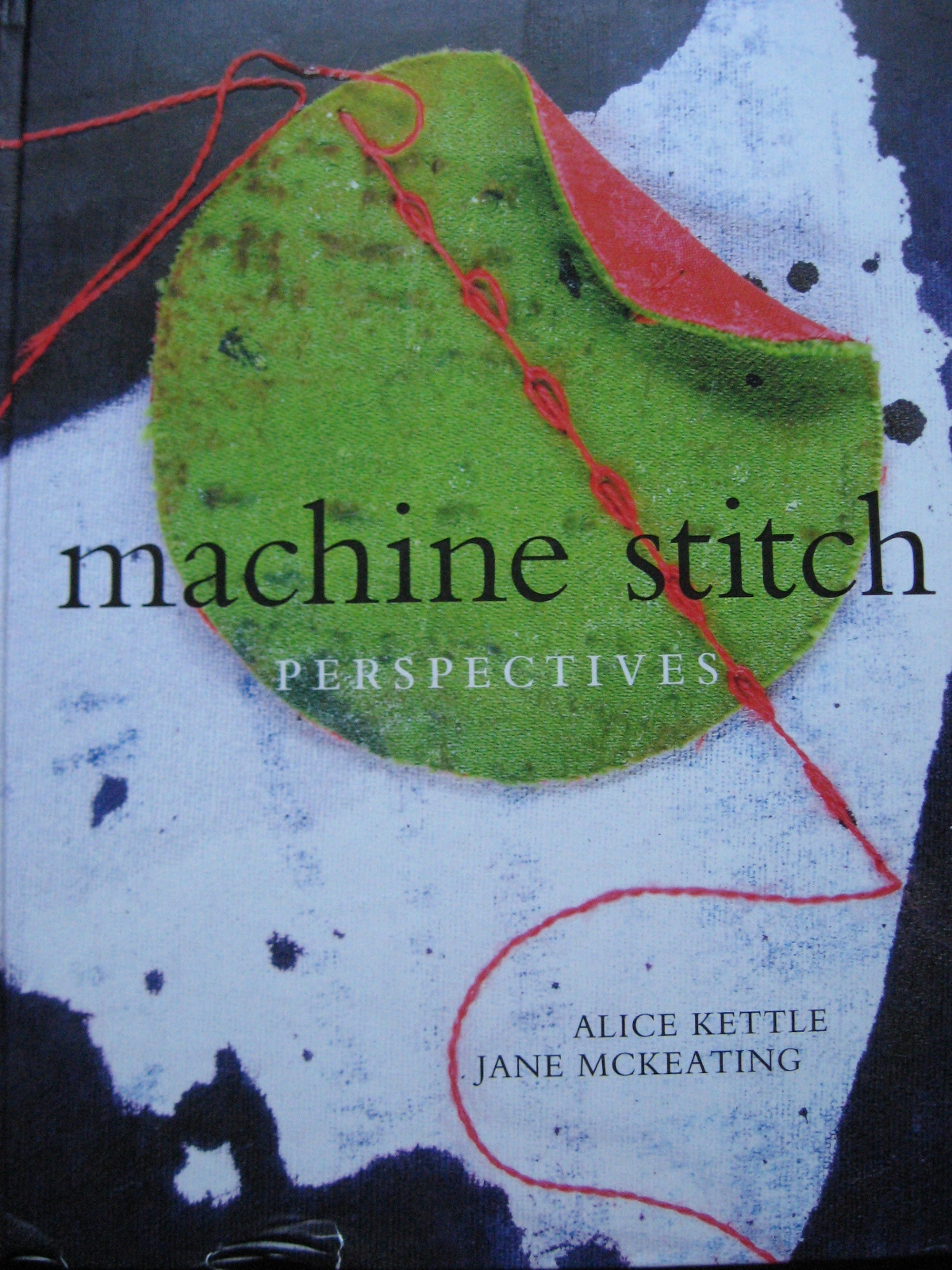 Machine Stitch: Perspectives, by Alice KETTLE and Jane MCKEATING, 2010. London: A & C Black. ISBN 978-07136-8868-9, hardback, colour and b/w illustrations, pp. 224, glossary, bibliography and index. GBP 35.
An intriguing book that looks at the historical and modern role of machine embroidery as an art form. Much of the information is based on the experience and knowledge of specialists working from the Department of Embroidery, Manchester Metropolitan University, England (MMU; the former Manchester Polytechnic, and a bastion of hand and machine embroidery). The University contains a unique archive relating to the history of both the finished products and the machines used. Over the decades the MMU has been the training ground of many embroiderers.
The book contains a range of articles that reflect individual attitudes and interests, and the articles are arranged thematically rather than, for example, historically. The themes are divided into two: ‘Looking at stitch’ and ‘Making the stitch.’
Recommendation: This book is for textile students, amateur and profession machine embroiderers, as well as anyone interested in the wider history of embroidery in general. It is well illustrated and provides a range of details, such as the different types of materials and threads, as well as embroidery machines currently available (and their differences). This book is source of inspiration and information and should be in any serious textile library.
*****
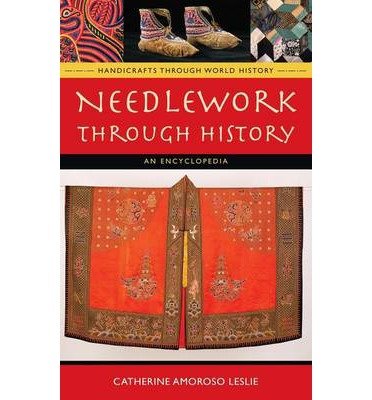 Needlework Through History: An Encyclopedia, by Catherine Amoroso LESLIE. 2007. Westport, Connecticut; Greenwood Press. ISBN 978-0-313-33548-8, both hardback and softback versions available; illustrated with some b/w images. Bibliography, index. pp. 236. Price: listed price US$55 (hardback version).
The book consists of only 75 entries, so it is not really an encyclopedia, but rather a series of entries of between 1 and 3 pages in length about various subjects, with a cross referencing system using words in bold and a short bibliography at the end of each entry. There is a heavy reliance on web information. The information presented is very general in nature and although the title of the series is Handicrafts through World History, in this volume there is an emphasis on Western and especially American forms of needlework. The subjects range from feathers and beetle wings to whitework. The author also includes various textile forms, such as bobbin lace, crochet, knitting, macramé and tatting, which technically are not made with a sewing needle of some kind.
The main drawback of this book is that all the text photographs are in black and white, which make seeing and understanding various details difficult. In addition, not every entry includes an illustration, so the lay reader may have problems in understanding what form(s) is/are being described.
Recommendation: A very general introduction to the subject, suitable for secondary school and introductory level students.
*****
 A Cultural History of Jewish Dress, by Eric SILVERMAN, 2013. London: Bloomsbury. ISBN 978-1-84788-286-8; softback. The book is illustrated with black/white images. It includes a glossary, notes, bibliography and index; pp. 259. Price: GBP 19.99.
An academic book written with much sensitivity on the role of clothing in defining Jewish identity. This captivating and well-structured book broadens and complements previous studies with contemporary sources and discussions, enticing the reader to approach the subject of fashion, history and culture from different perspectives. The various essays are varied and include studies on the outfits worn by rabbis; laws of differentiation and how these have been applied to Jewish dress over the centuries; concepts of modesty and (un)fashionability; the yarmulke and the concept of ‘Jewtillicious’, or t-shirts bearing Jewish messages of various types. The conclusion to the book discusses the use of traditional Jewish dress in modern fashion shows.
There is a helpful glossary of Jewish terms and concepts. An engaging book for those desiring greater insight to Jewish psyche and identity. Eric Silverman is Associate Professor of Anthropology in the American Studies and Human Development department, Wheelock College, Boston, and a Scholar at the Women's Studies Research Center, Brandeis University.
Recommendation: This book is suitable both for an academic and for a general audience interested in Jewish dress, religious dress in general, as well as costume and fashion historians.
*****
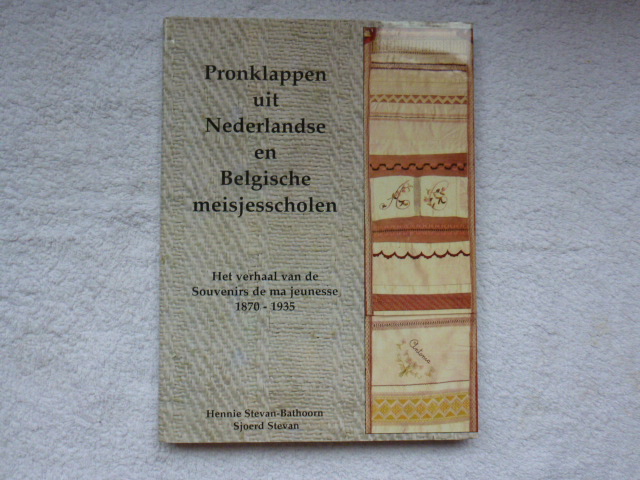 Pronklappen uit Nederlandse en Belgische meisjesscholen: Het verhaal van de Souvenirs de ma jeunesse 1870-1935, by Hennie STEVAN-BATHOORN and Sjoerd STEVAN. 2009. Winschoten: Museum voor Naaldkunst; ISBN 978-90-78543-02-2; hardback; fully illustrated with colour and b/w illustrations, index. pp. 224. Price: Euros 39.50 (including postage within the Netherlands, and Euros 46,50 for elsewhere).
An intriguing book that covers the production and use of band samplers (pronklappen), stitch samplers and related needlework items in girls’ schools in the Netherlands and Belgium. Most of the items illustrated date to the late 19th and early 20th centuries and form part of the Museum voor Naaldkunst (‘Museum for Needlework’) collection. The fully illustrated book depicts various types of structural and decorative needlework samples and samplers. The illustrations, however, are sometimes placed in a rather haphazard manner, which makes it sometimes difficult to link them to the text. But the depth in which this aspect of the history of samplers has been investigated and presented is impressive, but at times a little overwhelming!
Many of the samplers illustrated are alphabet, stitch and darning forms that are familiar to those working with historical needlework. However, there are various examples of band samplers that contain the name, date and in some cases the school of the girl who made the roll. These may be less familiar to those outside of Northern Europe. Numerous band samplers have been illustrated as case studies with background information about the school, the type of needlework course followed, details about the girl, photographs of her work and so forth. In addition, there are examples of examination pieces in the form of miniature clothing, which was sometimes sewn onto the band samplers. Part of the book also deals with the subject of needlework albums. These were similar to photograph albums, but with samples of the girl’s work stitched or glued in place. Again, the name of the girl, the school and the year(s) were written on the album cover for all to see: an intriguing aspect of the social history of girls and young women in the 19th and early 20th centuries.
Recommendation: This book should be in any library dealing with the subject of structural and decorative sewing; the social/economic role of needlework, the education of girls in the 19th and early 20th centuries, as well as collectors of samplers in general. The fact that it is written in Dutch will limit its market, but the large number of images in the book makes it worthwhile having.
*****
 The Fairchild Books: Dictionary of Textiles, byPhyllis G. TORTORA and Ingrid JOHNSON, New York and London: Fairchild Books/Bloomsbury Publishing. First edition 1967; eighth edition 2014. ISBN: 978-160901-535-0; pp. 711; a few b/w illustrations, list of institutions; suggested references (series of dictionaries and basic reference books). Price: c. GBP 108.
A standard work that is now in its 8th edition. It covers a very wide range of hand and industrial terms, especially relating to historical and modern American and European textiles. There are several thousand entries arranged in alphabetical order, which cover fibres, dyes, spinning, weaves, non-woven forms, applied decoration, printed and painted decoration, decorative needlework, as well as carpets, tapestries, abbreviations and acronyms and much more. The entries range from a few words to long descriptions of about 150 words. There is a cross referencing system using terms in capital letters. It is meant to be a dictionary, rather an encyclopedia, so bibliographical references for further research are not included.
There are very few illustrations and all of these are small and in black/white or presented as line drawings. Many of the illustrations are of little use, for example the photograph associated with crewel work, is simply too small and indistinct to be of any use.
This is a book that can be used to look up specific terms such as “Huacaya a young LLAMA” or for just dipping into – just open any page and there are interesting titbits of information.
Recommendation: This is a must for any library, group or individual, who is seriously working with textiles at all stages of production and use.
*****
Sand and Silver: Jewellery, Costume and Life in Siwa Oasis, by Margaret Mary VALE, 2011. York: Kelim Press. ISNB: 978-0-9569963-0-5; softback; illustrated with colour and b/w images; notes, bibliography and index; pp. 187. Price: GBP 14.99
An interesting book on the jewellery and clothing worn in the West Egyptian oasis of Siwa (near the border with Libya). Until comparatively recently the oasis was difficult to reach and over the centuries it developped its own culture based on Berber traditions and norms. In particular, the silver jewellery and garments worn by the girls and women were spectacular and very different from elsewhere in Egypt. The introduction of a road from Mersa Matruh at the end of the 20th century has meant that this isolation has ended and many changes are taking place at a very rapid rate.
The author has lived in the Middle East since 1975 and although not officially trained as a professional anthropologist, she has gathered and collated many interesting and useful details, starting off with Middle Eastern silver jewellery. In the 1980s, Vale spent four years in Egypt and became very interested in the Siwa oasis, its culture, jewellery and costumes, and the role of weddings in the lives of the oasis dwellers. She spent time in the oasis and learnt , among other things, to embroider in the local style and understand how the various elements of Siwan life work together. The book is the result of her experiences. It is a readable work with good illustrations, which provides many details about (women’s) life in the Siwa oasis up to the end of the 20th century.
Recommendation: This book will be useful for anyone studying North African life and Siwan culture in particular, as well as Middle Eastern silver jewellery and iconography. It is a must for anyone studying traditional Egyptian dress.
*****
 Qasr Ibrim, Between Egypt and Africa: Studies in Cultural Exchange, by (eds) Jacques VAN DER VLIET and Joost L. Hagen, 2013. Leuven: Peeters. ISBN 978-90-6258-226-6; soft cover, some b/w illustrations, pp. 191. Euros: 40.
The citadel of Qasr Ibrim in Northern Nubia was occupied for thousands of years as it was positioned at a strategic position between Egypt and the Middle Nile region, present-day Sudan. The rich archaeological and textual finds from the site document its history from the rule of the 'Black Pharaohs' of Egypt's 25th Dynasty onwards until the Ottoman period. The fort was abandoned in the early nineteenth century.
The journal contains 13 papers that were presented at the NINO Symposium, held at the National Museum of Antiquities, Leiden on the 11th – 12th December 2009. The papers focus on Qasr Ibrim’s role in the cultural interaction between Egypt and the world of the Mediterranean on the one hand, and Africa, the Sudan and beyond on the other.
The papers include archaeological, as well as text based approaches. There is one paper of particular interest for the TRC, namely Nettie K. Adams’ article (pp. 65-81) about the textile and garments found at the site during the many years of excavations. These finds date from all periods of occupation. The article, sadly only with b/w illustrations, presents a survey of the imported forms of textiles from the Roman, Medieval and Ottoman periods, including Egyptian and Eastern Mediterranean forms as well as some Central Asian ikat and resist-dyed items from India.
Recommendation: An interesting series of articles for people interested in Nubian and Egyptian history. The article by Adams is essential reading for anyone working within the field of Roman and later textiles, as it helps shed light on the vast distances that some textiles actually move, whether by accident or design.