It has been a busy international ‘networking’ period FOR the TRC. In September, for example, my colleague, Augusta de Gunzbourg, was invited to Uzbekistan for a conference on Uzbek ikat heritage. In October, I travelled to Tbilisi, Georgia, for a 3-day conference entitled Living Heritage (22-24 October 2026), which was set up to discuss Georgian textile heritage, crafts and their future. It was organised by the Ministry of Culture, the State Academy for Art, and Erasmus (EU).
It was opened by Natia Shamatava, the Deputy Minister of Culture, with, among various other speeches, a welcome by Karaman Kutateladze, Rector of the Academy. It was an interesting and delightfully exhausting three days! With numerous talks, visits to museums, such as the State Silk Museum, the Art Palace of Georgia, and the Georgian National Museum. We also went to the Samoseli Pirveli Manufacturing Facility, who make modern versions of traditional, Georgian clothing. During the visit to the Blue Tablecloth Laboratory, (see below), several of the foreign delegates, including myself, were interviewed by a local TV news company. After the conference, Willem and I spent a few extra days in Georgia, taking a bus tour and simply walking around the old city. If you get the chance to go, do. We really enjoyed the experience.
First day
During the first day of the conference there were a wide range of talks, including: ‘The origins of Georgian textile production’ (Mikheil Tsereteli, Deputy Director of the National Museum of Georgia), ‘The heritage of silk production of Georgia (Nino Kuprava, Director of the State Silk Museum), as well as lectures about textile textiles and their role in contemporary art education (Nino Kvrivishvili, State Academy of Art). One item that was of particular interest to me was ‘SEIA- the family tradition of embroidery’ (Khatuna Khundadze and Manana Khundadze-Lehmann, founder of SEIA; see below).
Second and third days
On the second day there were talks on 'The role of knitted designs and modern needs' (Prof. Giovanni Conti, head of the Fashion Design programme, Politecnico di Milano, Italy), ‘Living textile heritage in Azerbaijan’ (Prof. Asmar Babayeva), ‘Textile design and contemporary design’ (Prof. Nicole Mallek, Hof University, Germany), as well as talks by Muhayo Aliyeva, a fashion designer and founder of Bibi Hanum, a woman’s workshop in Uzbekistan, and ‘Qurama, Stories of Weaving’ (Tarana Ailiyeva, Azerbeijan National Carpet Museum).
I gave a talk on the second day about the nature of embroidery and the Bloomsbury World Encyclopedia of Embroidery, and more specifically about volume 6 that is about Central, East European and Caucasian embroidery, including work from Georgia.
As a result of my talk and subsequent meetings, it was decided to set up a project with the Ministry and the Academy to help with the relevant chapters in the Encyclopedia and to work further preserving and recording Georgian embroidery forms. We have asked Khatuna Khundadze and Manana Khundadze-Lehmann of SEIA, if they would write a snapshot chapter for the encyclopedia about the role of embroidery in four generations of the Khundadze family. Something they have very kindly agreed to do.
There were several other foreign speakers at the conference, including Giovanni Conti (Italy), Nicole Mallek (Germany), and Mohayo Aliyeva (Uzbekistan). We all stayed at the same hotel and it was very interesting getting to know them, and discussing how our various institutions and workshops can work together.
I would like to thank the Ministry, the Academy, Erasmus and in particular, Maya Kipiani, for organising the conference and for all their help looking after the delegates and participants. All their hard work was and is appreciated.
Blue tablecloths
Georgia is known for the production of indigo-blue tablecloths. During the Tbilisi conference there was the chance to visit ‘The Blue Tablecloth Laboratory', which is located next door to the Academy. Here we were given a demonstration of the use of large screens for printing blue tablecloths, as well as smaller, block-printed versions (both direct and resist versions). We also had the chance to try our own hand at block printing. It was clear who were designers in the group, and who were not!
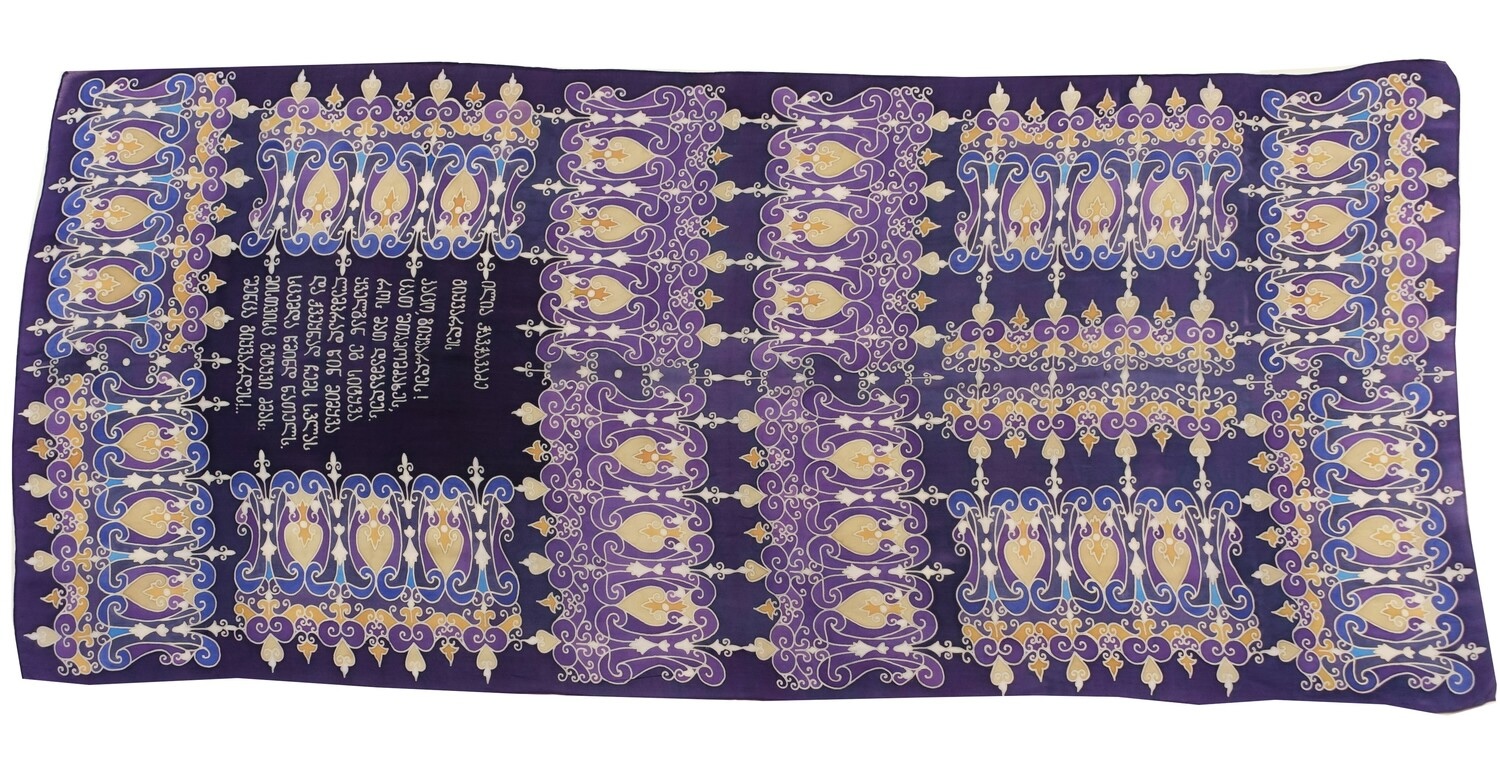 TRC 2022.2248
There are five examples of blue dyed Georgian cloths in the TRC Collection, and we are now working on the idea of a small exhibition about these pieces. The Laboratory kindly gave the participants of the conference a modern example of blue cloth (TRC 2026.2796), and because of the proposed exhibition, they also gave a printing block for the TRC (TRC 2026.2797).
During one of the conference lunches I was approached by Maia Tsinamdzgvrishvili, who is a friend of a friend (Inge Evers), and it turned out Maia had actually made one of the blue textiles now in the TRC Collection (TRC 2022.2248). It is a silk scarf with a poem from 1858 by the Georgian poet, Ilia Chavchavadze (1837-1907). Small world.
Polish group
Once back at the TRC, we were hosts to a group from Warsaw, Poland. They had been to the old TRC along the Hogewoerd and the difference in location was noted. The group included Agnieszka Jacobson-Cielecka (Dean of the Faculty of Design at SWPS University in Warsaw), Dobrochna Zielińska (Faculty of Archaeology, University of Warsaw) and Karel Innemée (Faculty of Archaeology, University of Warsaw, also the Trteasurer of tghe TRC Board). They were here for a lecture and fashion show, based on a reconstruction project of medieval Nubian outfits for kings and queens. Fascinating. The TRC had been involved in the project with the original types of cloth and colours, based on small samples from the southern Egyptian/Nubian sites of Qasr Ibrim and Gebel Adda, which were given to the TRC by Elisabeth Crowfoot and Nettie Adams, two textile archaeologist who had worked at Qasr Ibrim in the late 20th century.
The reconstructed garments had been on display in various European museums, including the Louvre (Paris), and SOAS, London, and finally at the National Museum of Antiquities, here in Leiden. The garments are archaeological reconstructions at a high level. And yes, I talked with Agnieszka Jacobson-Cielecka and put her in contact with Maya Kipiani, Tbilisi. We are going to have an online meeting shortly to see how we can work together on various embroidery and other projects!
American group
In a few days time we will be having a group of textile lovers from San Jose, USA, visiting the TRC, as part of a textile trip to Europe. They want to see and hear about the ‘new’ TRC, look at various items from the TRC Collection, as well as see our current exhibition about the paisley motif. They will also have the chance to see two TRC student displays, one by Minsook Kang, about Indonesian textiles, A language of the hands, and the other by Merel Frederiks about tea cosies, which includes items from the US, Britain, The Netherlands and Indonesia. The small exhibitions were set up within the context of the TRTC polic to encourage our students to make small exhibitions and displays in order for thjem to learn new (exhibition) skills and to highlight the diverse nature of the TRC Collection.