On Saturday, 2 May 2020, Gillian Vogelsang wrote about miniature garments, not for dolls, but as items used to teach and learn how to sew.
Recently an American auction house sold a set of two instruction books on needlework, printed in the early 19th century in Ireland, which contained various miniature garments. Such small garments are also found on a type of sampler made in Belgium, The Netherlands and parts of Germany, in the 19th and 20th centuries. Such samplers were particularly associated with Catholic schools. They were made by a school girl, sometimes over a period of two years. The TRC Collection has several examples of these samplers.
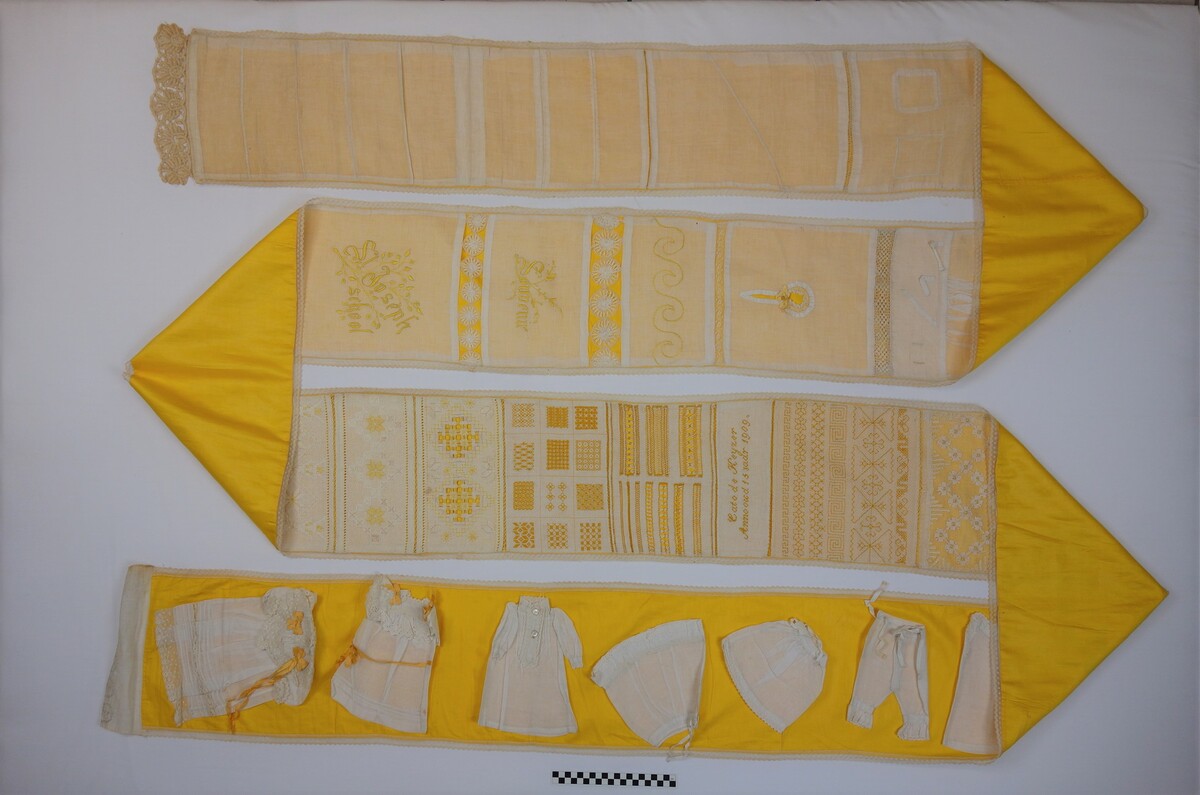 Sampler ('Pronkstuk') made in 1909 by Cato de Keijzer (TRC 2014.0938). The sampler is more than seven metres long. Below, and as part of the sampler, is a row of miniature garments.
The samplers include a series of panels used to show a progression of skills – from simple seams and hems, to a variety of different types of buttonholes, mending, embroidery techniques, knitting, crochet and even bobbin lace making. These samplers, known in Dutch as 'pronkstukken' of 'pronkrollen', were used to show a girl’s sewing abilities when looking for a job. Most of these samplers are about 30 cm wide and can be several metres long.
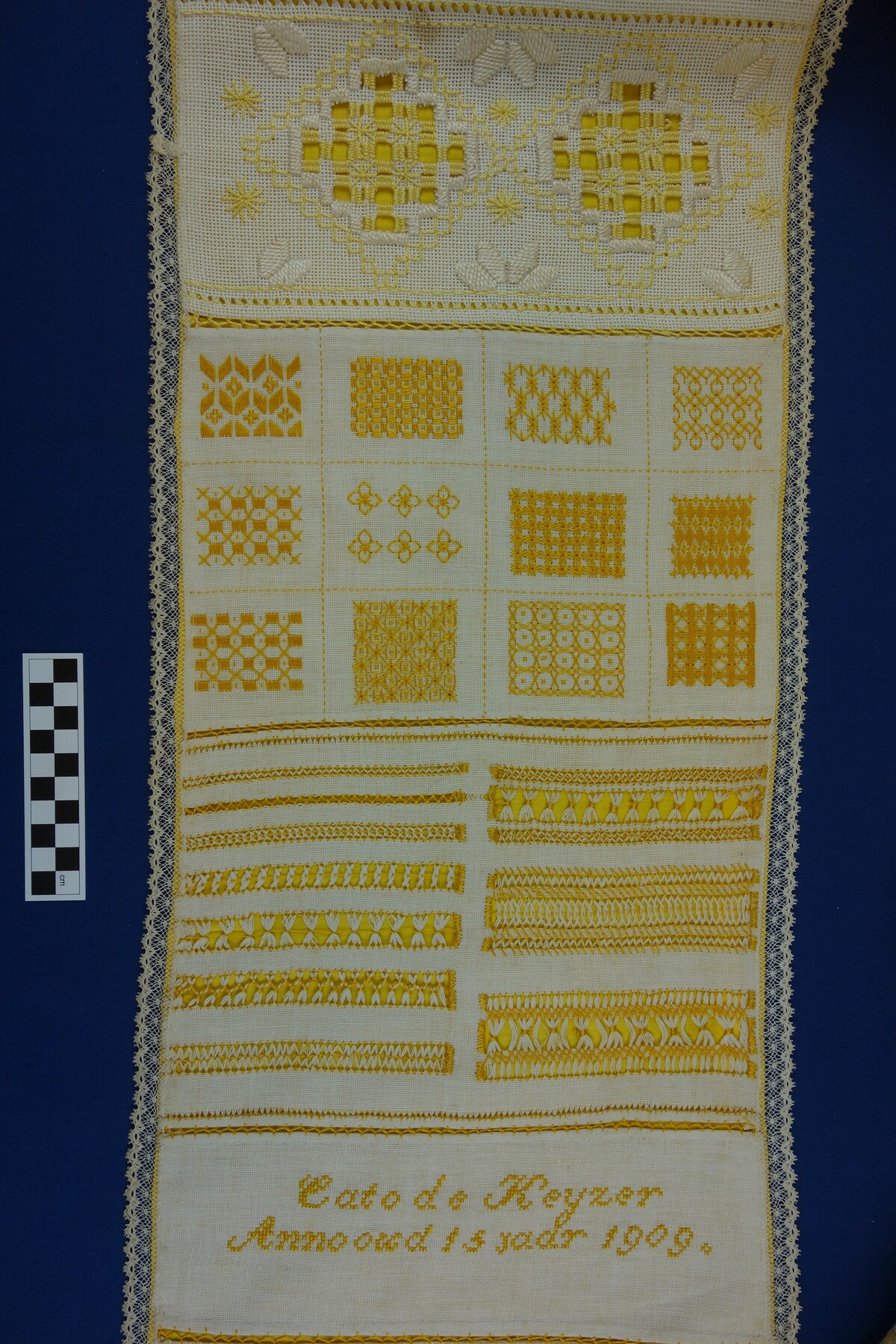 Part of a sampler ('Pronkstuk') made in 1909 by Cato de Keijzer (TRC 2014.0938). The sampler is more than seven metres long.
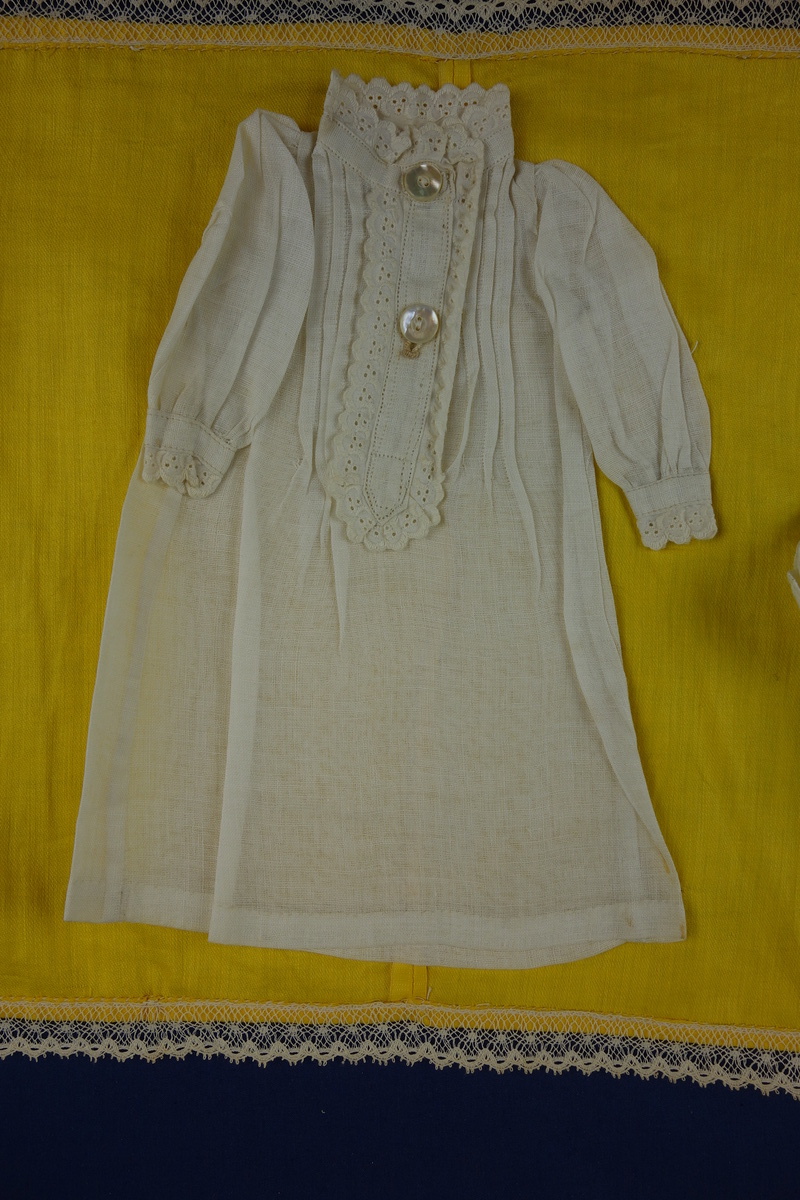 Part of a sampler ('Pronkstuk') made in 1909 by Cato de Keijzer (TRC 2014.0938). The sampler is more than seven metres long. The nightdress is a miniature garment stitched onto the sampler.
One example in the TRC Collection (TRC 2014.0938 is 740 cm long and 39 cm wide. It was made in 1909 by a girl called Cato de Keijzer when she was 15 years old. At the end of this sampler there is a section of complete, miniature garments. These start off with a pair of drawers, then via a chemise, a pinafore and a nightdress (see illustration). it ends in a finely made party dress. These garments were not made for dolls! They were made to show that a girl understood and had mastered basic dress making. After all it is far harder to make a perfect miniature than a full size garment.