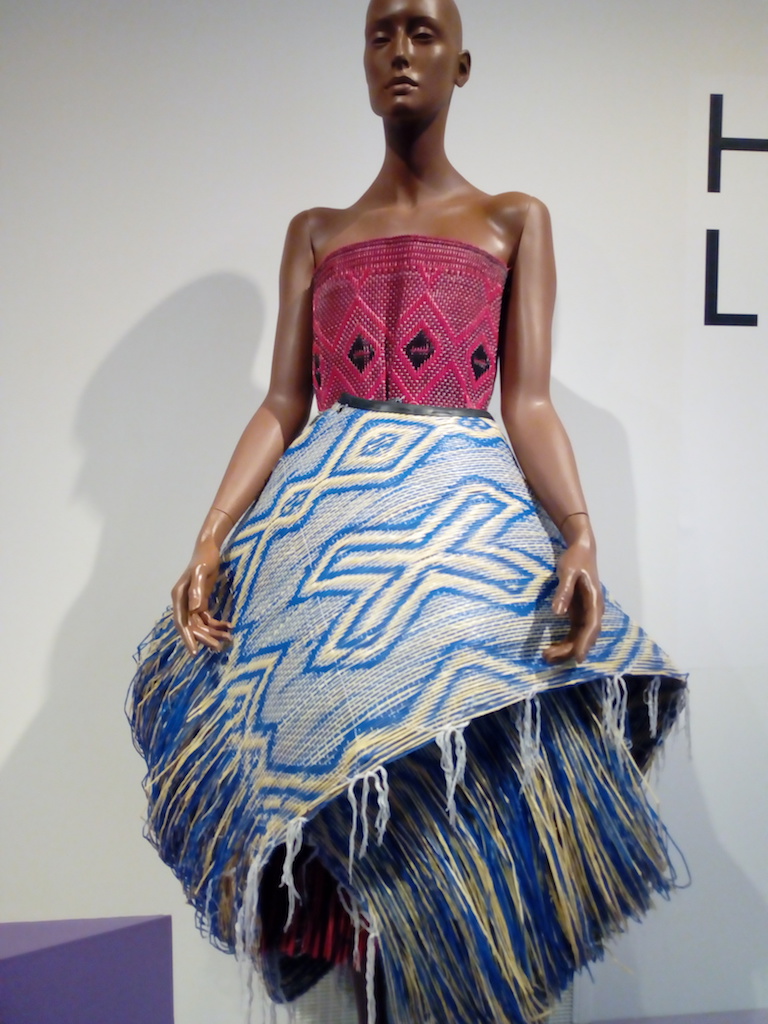
 Dress designed by Karim Adduchi. Photograph by Shelley Anderson (2019).I first heard of Karim Adduchi (1988--) last year, when I saw some of his striking dresses in a fashion exhibition at the Amsterdam Museum. The dresses incorporated traditional Berber and Moroccan materials and motifs. Born in Morocco, Adduchi moved to the Netherlands to study at the Gerrit Rietveld Academie. He graduated in 2015, when he garnered praise for his collection “She Knows Why the Caged Bird Sings” during the annual Fashion Week.
Still based in Amsterdam, Adduchi works with immigrant and refugee women, learning traditional embroidery to use in his designs. During the recent lockdown he and the World Makers Foundation started a collective embroidery project, called Project Social [Distancing] Fabric. Adduchi hand drew a design, which was sent, along with needle and floss, to participants to embroider at home and to asylum reception centres. Once finished, all the contributions will be stitched together and displayed at the Amsterdam Museum in September. The invitation to join the Project stated “Even in this period of isolation, we will have a shared memory of connection, colour and hope, a story we are all part of”.
![Hand drawn design by Karim Adduchi, for the Project Social [Distancing] Fabric (2020). Photograph by Shelley Anderson.](/trc/images/social_fabric.jpg) Hand drawn design by Karim Adduchi, for the Project Social [Distancing] Fabric (2020). Photograph by Shelley Anderson.
Hand drawn design by Karim Adduchi, for the Project Social [Distancing] Fabric (2020). Photograph by Shelley Anderson.
It also stated beginners were welcomed. That decided me. I had learned some stitches in various TRC workshops and didn’t want to forget them (especially the Bayeux stitch). I had also read Fatima Abbadi’s blog on the TRC website, on how embroidery can help you keep sane in a frightening world, so I signed up. I was lucky. Project organisers were overwhelmed: within a few days, some 400 people asked to participate, much more than the budget for materials and mailing costs had estimated.
I found the embroidering very restful and meditative. It also made me think of how needlework, once an essential survival skill, is now often seen (in the West at least) as an optional, if perhaps quirky, creative outlet. Yet in a time of a deadly pandemic, surrounded by fear and uncertainty, when museums and galleries and theatres are closed (sometimes permanently), it seems to me that creativity is essential. It is a way of keeping hope alive, of resisting fear. And a needle is one of the oldest, and most accessible, creative tools available. More on Project Social [Distancing] Fabric, click here.
Shelley Anderson, 11 May 2020