On Saturday, 16th May 2020, Beverley Bennett and Susan Cave wrote a blog about a particular American quilt in the TRC Collection (TRC 2019.2291) that testifies to a humanitarian disaster that took place almost 150 years ago.
Every now and then the TRC is fortunate enough to receive a quilt that has a provenance. Although many family quilts from the 19th century survive, the descendants have few clues unless a written account came with it. Our Rolling Star is a quilt we would describe as in ‘Fair’ condition. The back is rather ragged, the quilt has been cut down and re-bound in more recent times and it looks, well, brown, as though it has been in a river. Indeed.
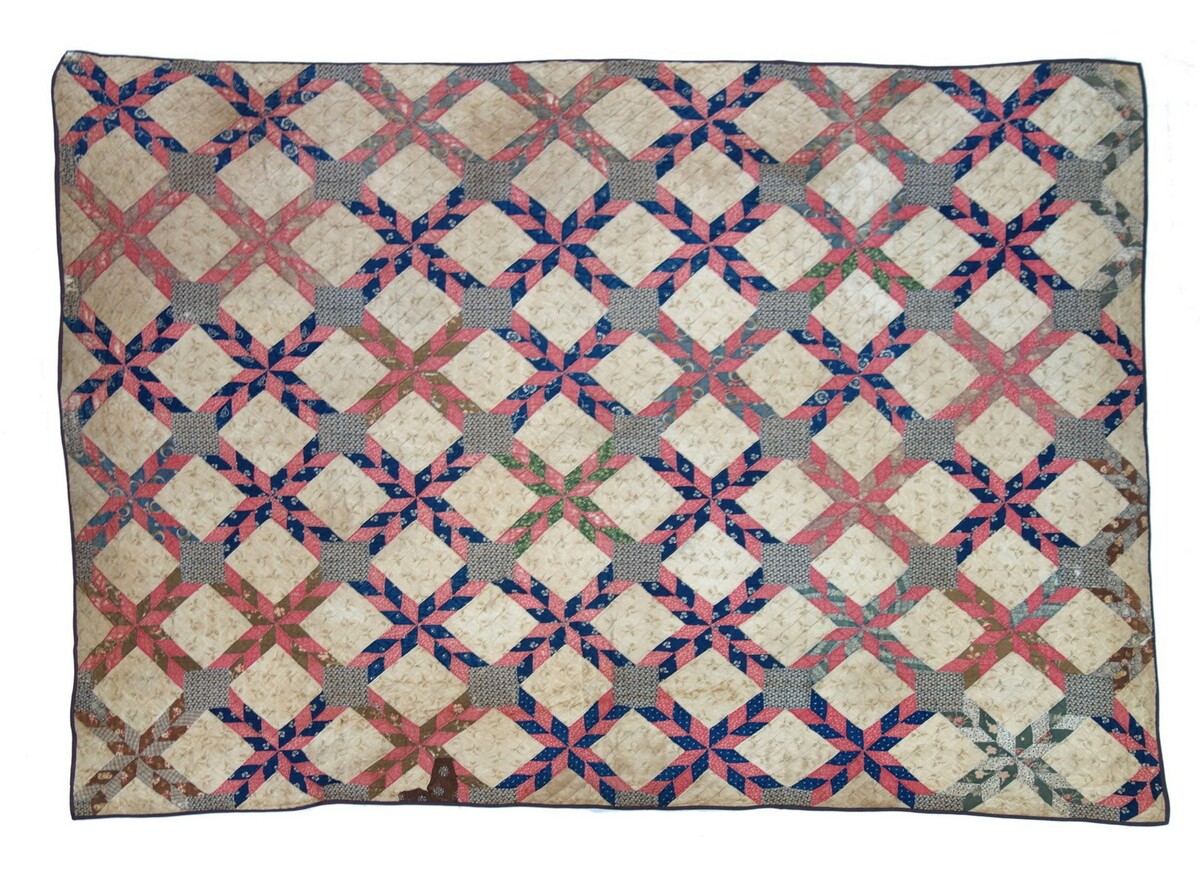 A Rolling Star quilt, USA, c. 1870, a survivor of the disaster of 17 May 1874 (TRC 2019.2291).
In May 1874, near the town of Skinnerville, western Massachusetts, it had been raining for weeks and on the 16th of that month part of the hill above the earth dam on Mill River suddenly gave way. The dam exploded upwards and a 20-foot wall of water tore downhill flattening houses, bridges, in fact everything in its path. Riders came thundering down the valley shouting warnings. Within an hour 139 souls were lost and the town of Skinnerville was no more.
Mill River ran from the Berkshires to the Connecticut River but in the summer months the water ran low. To solve the problem, the local factory owners had formed the Williamsburg Reservoir Company, which designed and built a dam to provide power for a string of cotton mills and towns spread along the river. It was said after the accixent that the dam was ‘built shoddy’. Amongst the debris from that tragedy, was the Rolling Star which, we believe, was hanging on the clothesline that fateful day.
The blocks between the Rolling Star were never brown. In 1870 there was plenty of white fabric with little sprigs of flowers, the ‘double pink’ was easy to come by, available in many shades (of pink) and the colours did not run. The indigo blue had been around for decades and the maker would have found the odd greens and fawns in a scrap bag, or swapped them at her quilting circle.
This pattern in this quilt is constructed differently from the widely seen ‘block’ format. Here the interest is in the ‘borders’ around the central (formerly) white squares. These are made up of diamond shapes that meet to form a central 8-pointed star. Anyone who has tried to make one of these will testify that this requires a great deal of accuracy to achieve and the maker of this quilt shows great skill in her piecing. She would probably have made each of the stars, with their extended ‘arms’, before joining them to the two differently sized squares to complete the quilt top. It is hand quilted with a hanging diamonds pattern in the white/brown squares and along the seams of the diamonds.
Rolling Star is only one name for this design – it was also known as ‘George B’ (Nancy Page 1938) and a very closely related design, where the squares are not on point, is known as ‘Lazy Daisy’. There is a repair clearly to be seen on the lower edge of the photo – it goes through to the reverse - and the same fabric has been used on both sides. The repair fabric is definitely from the 1880’s but we have no idea whether it was mended straight after the flood or much later. Whatever, someone thought it precious enough to save, even as a reminder of a terrible day long ago.