The TRC has just been given a group of textiles that was collected by, and in some cases made by, the Dutch textile craftswoman, Hanne Mook-Andreae. She was a specialist in woven textiles, especially card woven forms (she had lessons from Peter Collingwood). The group includes textile samples from various parts of the world including Asia and the Americas. They will all be added to the TRC Collection database during the next few weeks.
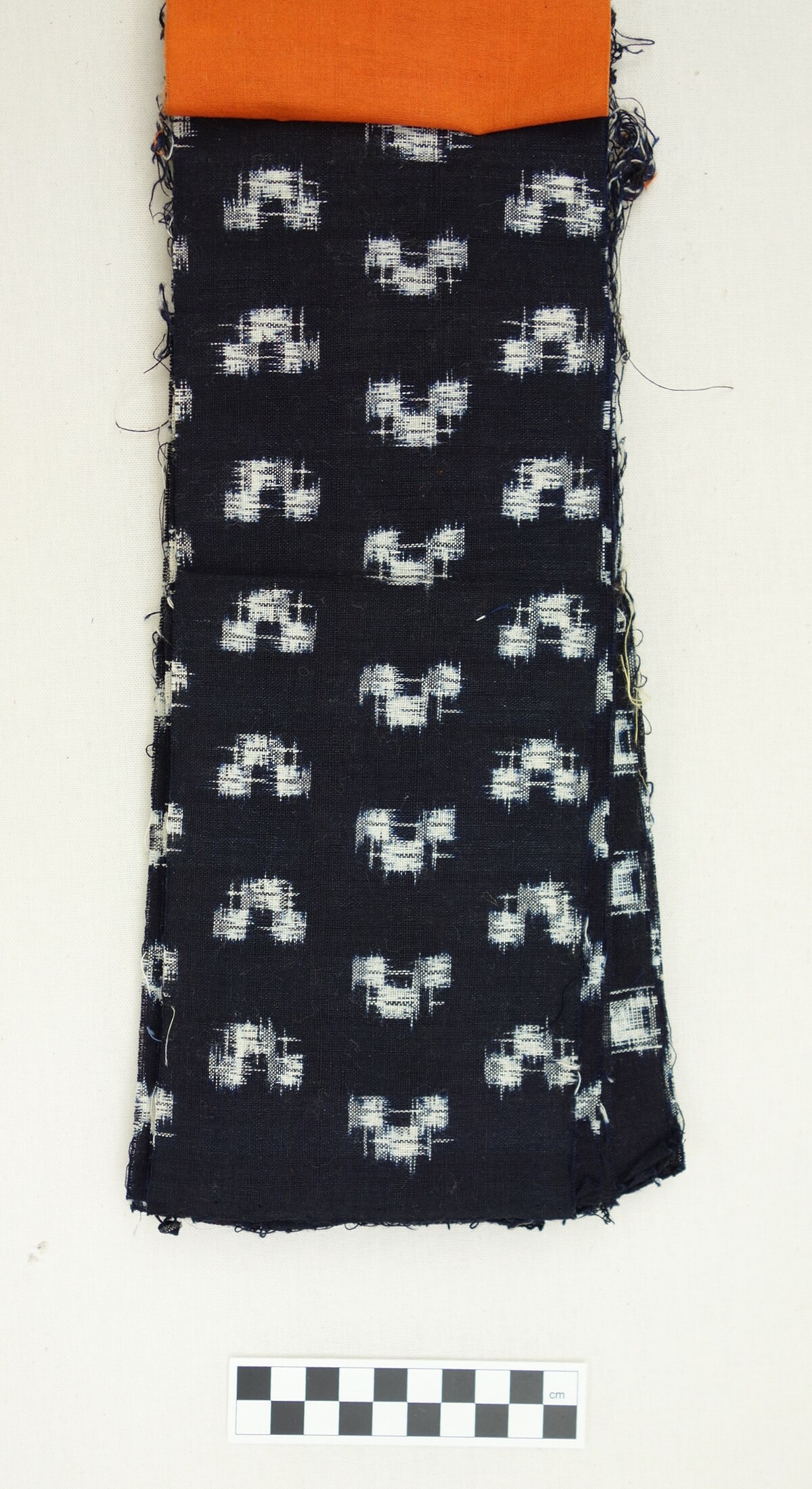
 Sample of ikat cloth from India, late 20th century (TRC 2020.2755).
One textile (TRC 2020.2755), however, caught my eye, not because of an unusual technique, a particular design or a striking colour combination, but because it looked so familiar, but at the same time was not quite ‘right’.
It is made from indigo-dyed cotton using a double ikat technique to create woven, abstract forms in white. My first inclination was to say it was a Japanese double ikat (kasuri, more specifically tate-yoko kasuri) in blue and white (kon kasuri). And yet, it still felt wrong. It simply was not 'right'.
Fortunately there was a label attached to the cloth, written by Mrs. Mook-Andreae, informing that the piece was actually made in India (she was in South Asia in the 1980’s) and intended for the Japanese market. The not ‘quite right element’ is that the design is coarser and far less precise than Japanese forms. If you compare the Indian example with a Japanese form (we have a sample booklet produced by a Japanese company in the 20th century, TRC 2017.1478), the difference becomes more apparent. I wonder whether these textiles sold well in Japan, were they regarded as cheap alternatives, or perhaps they were mainly sold to tourists there as Japanese, since the tourists would not know the difference anyhow? As normal I have more questions than answers.
 A piece from a Japanese sample book, 20th century (TRC 2017.1478).
One of the themes of a proposed conference in Leiden (Textiles in Motion and Transit) that was supposed to take place in October 2020, is the movement of textiles and textile traditions/fashion in various parts of the world. Here in Europe, for example, we are used to thinking about the trade in late-20th and early 21st century textiles from east to west (notably from China and India). Yet there was and is an equally large trade, for instance, in textiles and textile forms, including 'fake' forms, from India to East Asia.
Sadly the conference, to be organised by the International Institute for Asian Studies, has been postponed due to the corona virus crisis, but all being well it will take place in Leiden next year. I think I will make a small exhibition about these pieces and the vast story they represent.
Gillian Vogelsang, 23 May 2020.