 Bonnet for a woman of the Salvation Army, the Netherlands, 20th century (TRC 2020.3332a).We have just added two Dutch army uniforms to the TRC Collection. One of them (TRC 2020.5144a-c) was for a captain (ritmeester) in the Dutch cavalry, which was worn by Boudewijn Wilmer (1943-2019) and given to the TRC Leiden by his family. The other uniform (TRC 2020.5149a-f), for a corporal in the reserves, was worn by Kees van der Zwan, who in 1995 accompanied veteran Allied airmen when they toured Holland.
As a result of these and similar donations in the past, such as the police uniform (TRC 2007.1145a-h) worn by Paul van Musscher, a former highly placed police officer here in Leiden, or the set of army officer's uniforms (TRC 2019.0091-3), some of which worn by my husband when he served in Afghanistan, we have been asked if we are going to deliberately collect military and police uniforms?
Well, yes, we will accept uniforms because they play an important role in the concept of dress and identity, namely what people wear to say who they are or what they would like to be, especially within the context of personal and social hierarchy. But these items also lead to questions such as: do people want to wear a particular uniform or is it enforced upon them? Or is it pleasant to wear or is it deliberately very uncomfortable? Does the uniform or part of it is a reflection of an historical event?. Why do some British soldiers wear tall, very warm bearskin headwear?
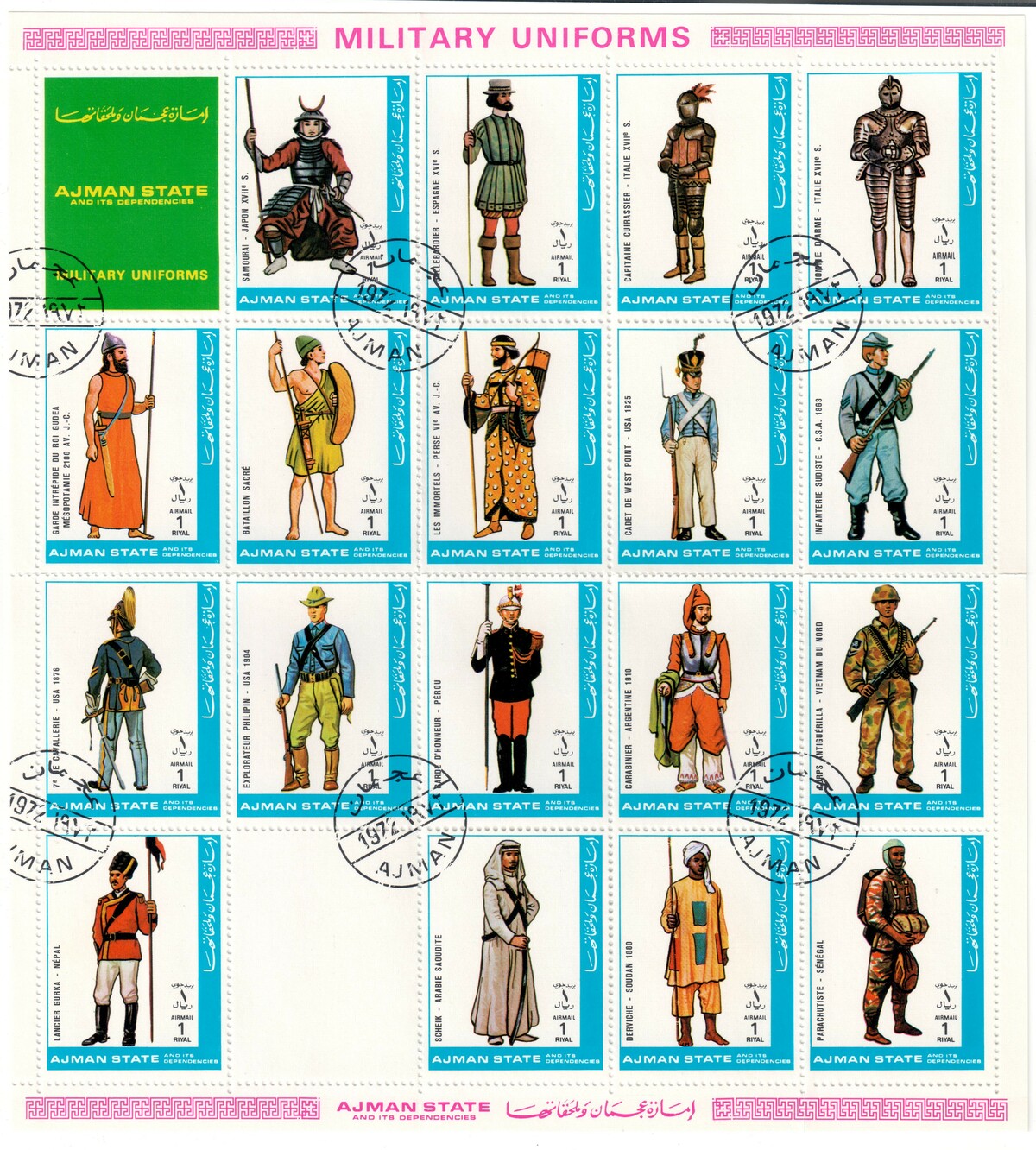 Series of stamps with military uniforms throughout the ages, United Arab Emirates, 1972 (TRC 2016.2100).So many questions. But what is a uniform? It is not quite so easy to present a definition, although everyone has their own thoughts on the matter. But basically it is an outfit, with or without accessories, which states whether a person belongs to a particular group or organisation and their position within it. The concept of a uniform extends from everything worn by the military with their emphasis on authority, power, and at times, aggression, to the (normally benign) outfits worn by nurses and nuns.
Within one situation you can have men and women wearing very different uniforms, such as a prison guard with one form, and a prisoner in another. This brings to mind the bright orange garments favoured in parts of America. One type of uniform represents authority and power, the other submission and the ‘ability’ to be quickly identified and located, all within the same setting.
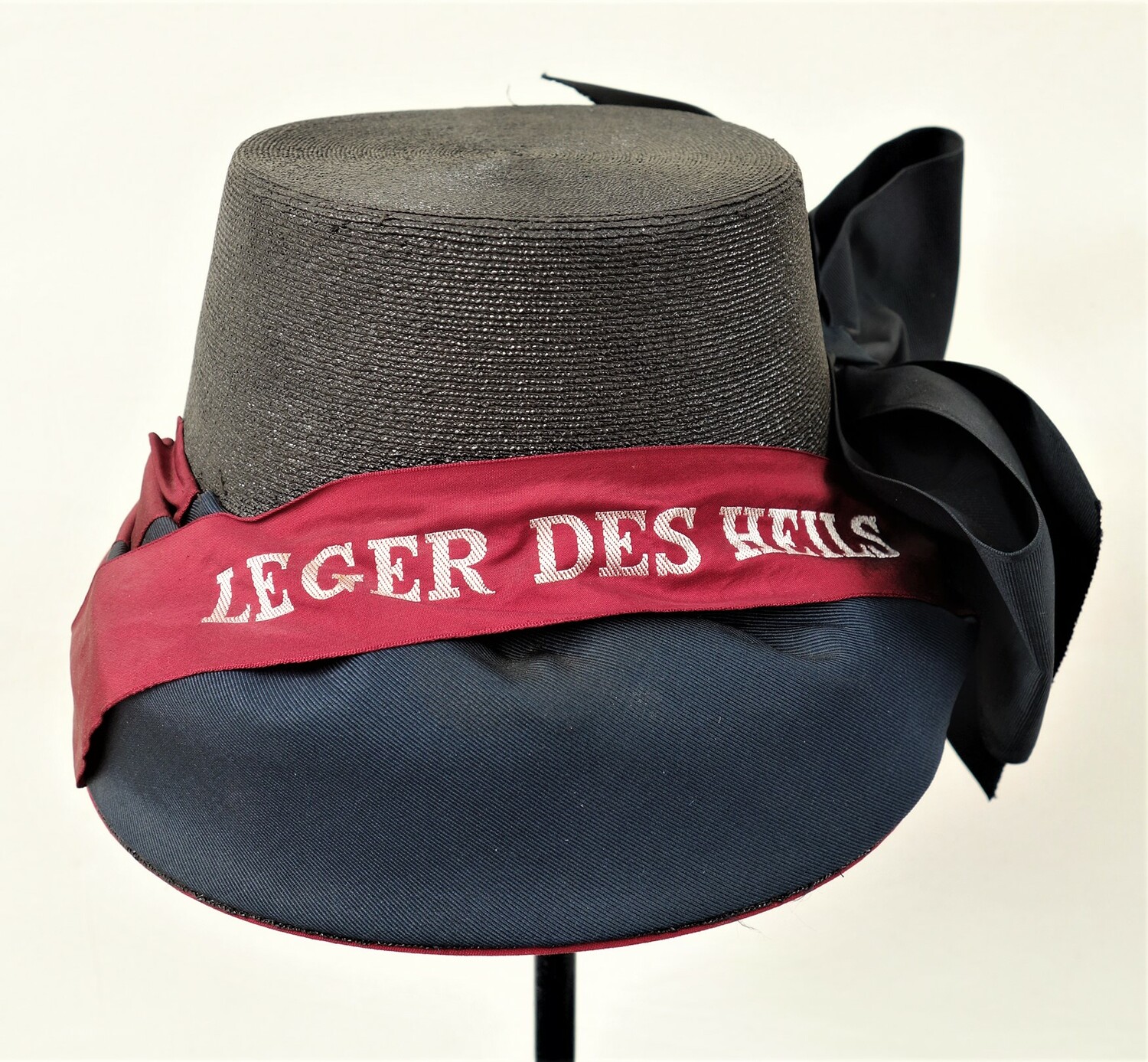
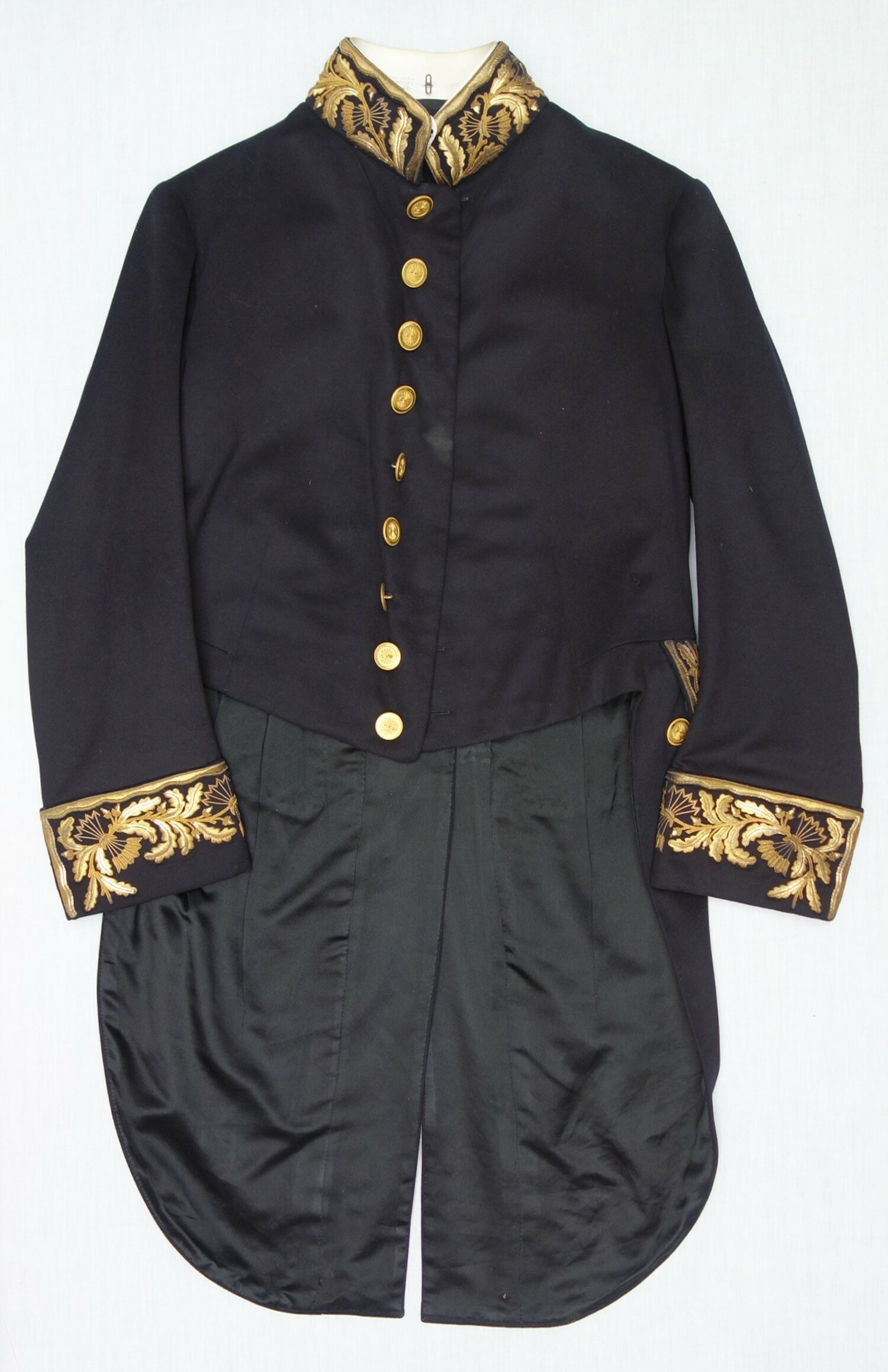 Dress coat for a member of the Dutch parliament, 1920 (TRC 2018.2133).The wearing of uniforms can apply to all age groups, genders, social situations, functions, etc. They can be worn all the time (military forms), or at specific times of the day or time of year (only while at school, for example, see also TRC 2020.3704, which is a school uniform summer dress in gingham; see a special TRC blog), on certain days (a priest’s outfit while performing a church service), or perhaps the ‘uniforms’ worn by drag queens (see a TRC online exhibition on The Rainbow People, section 15). There are also royal court, law court, diplomatic uniforms, political uniforms (see TRC 2018.2133a-g and a TRC blog on the subject). And how about the ‘uniforms’ worn by brides and grooms, or by the soldiers and officers of the Salvation Army (see the [war] bonnet in the TRC collection, TRC 2020.3332a)?
But back to the question of military uniforms. We have no intention of collecting every single type of military and related uniforms – there are enough museums and collectors throughout the world busy with this extensive and very interesting subject. However, should we be given a uniform with a name, story and a link to history, then we will seriously consider it. Mind you, this applies to a wide range of other objects as well, after all, the TRC is deliberately building up a broad based encyclopaedic collection, one with many aspects, levels and stories.
Gillian Vogelsang, 24 December 2020.