As winter is here and the weather grey and cold, I crave colour. It cheers me up to look at the molas in the TRC collection (compare TRC 2014.0458 or TRC 2013.0360), with their multi-coloured stripes against a bright red background.
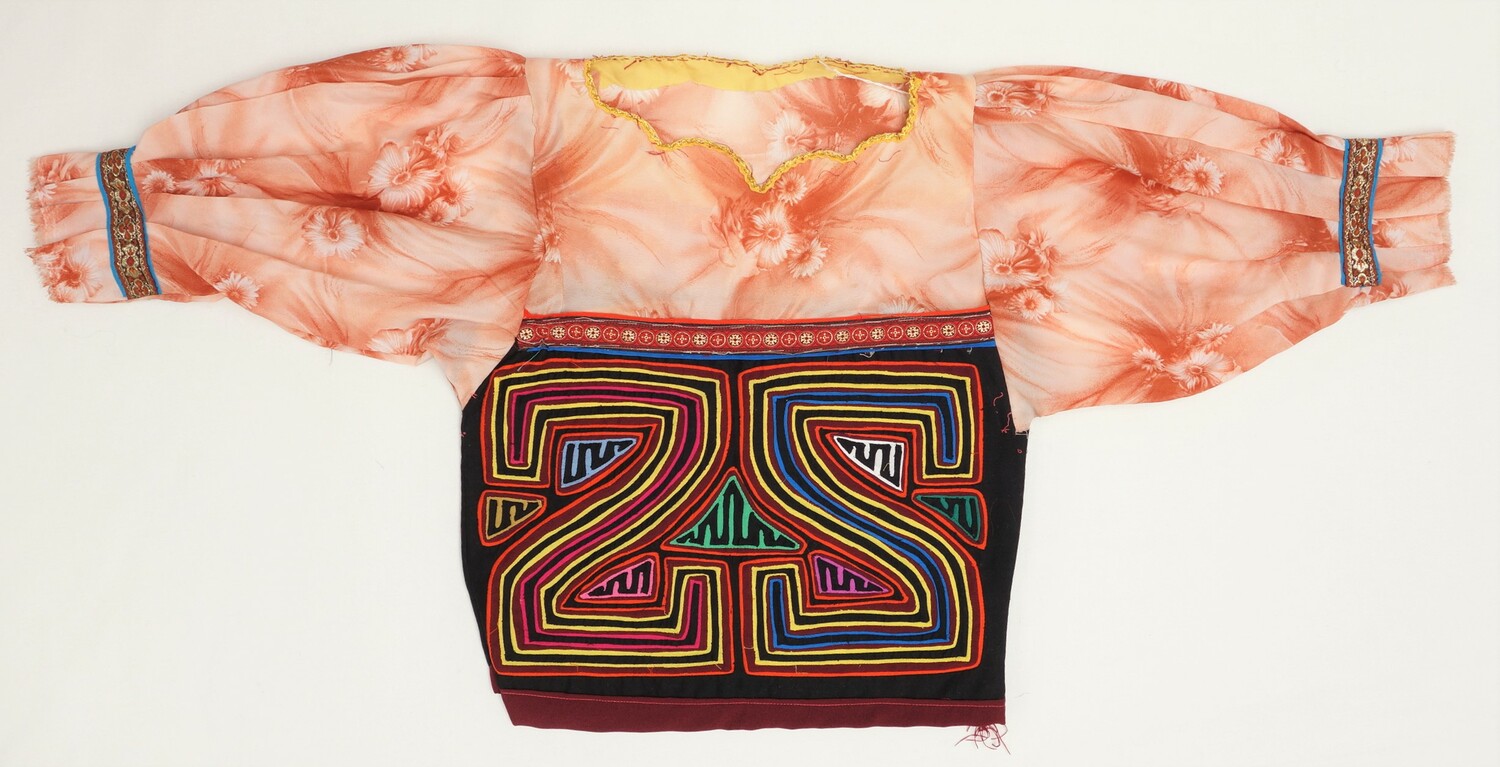 Mola for a blouse, San Blas, Panama (TRC 2014.0458).
The Kuna are an indigenous people who live on the San Blas Islands off Panama’s Atlantic coast. Molas are the blouses with hand sewn panels that Kuna women. In reverse appliqué, at least two (sometimes up to six) layers of different coloured cloth are laid on top of each other and basted together. A pattern is drawn on the top layer. Then, using small, sharp scissors, the layer is cut, revealing the colour underneath.
Next, using threads of the same colour, the edges of the cut cloth are tucked back and sewn down with many small stitches (including the blind stitch). Factory woven cotton cloth is used in order to prevent fraying. Lastly, the panel may have some details embroidered on, usually with a chain stitch. It can take anywhere from two weeks to six months for a woman (and nowadays, occasionally men) to make a mola, depending on its complexity.
 Embroidred panel from the Kuna people, San Blas, Panama (TRC 2013.0360).
Like other cultures such as the Miao (China) and the Banjara (India) who also use reverse appliqué, the Kuna have developed an instantly recognizable style that has become popular with tourists and collectors. The appliqued scenes are frequently taken from everyday life and feature stylized animals or include abstract designs that reflect Kuna beliefs and stories.
The TRC example is an ‘ibdurgan mola’—a mola with animals. It features a stylized bird surrounded by three stylized animals with long tails (lizards, perhaps?). The animals have lovely rainbow coloured vertical stripes. Such stripes are like sun beams shining through a hut’s bamboo wall, and are meant to convey protection. There are no empty spaces on a mola, as evil spirits tend to gather at empty places. Likewise, the more colours used, the stronger the mola.
Molas are still part of everyday wear for Kuna women. The custom of making and wearing molas is reportedly only 150 or so years old, with the earliest patterns based on traditional body tattoos. They are worn with pride and reflect a collective identity, as well as a woman’s creativity.
By Shelley Anderson, 2 January 2021.
Sources: World Textiles: A Visual Guide to Traditional Techniques, by John Gillow and Bryan Sentence (Thames & Hudson, 2009).