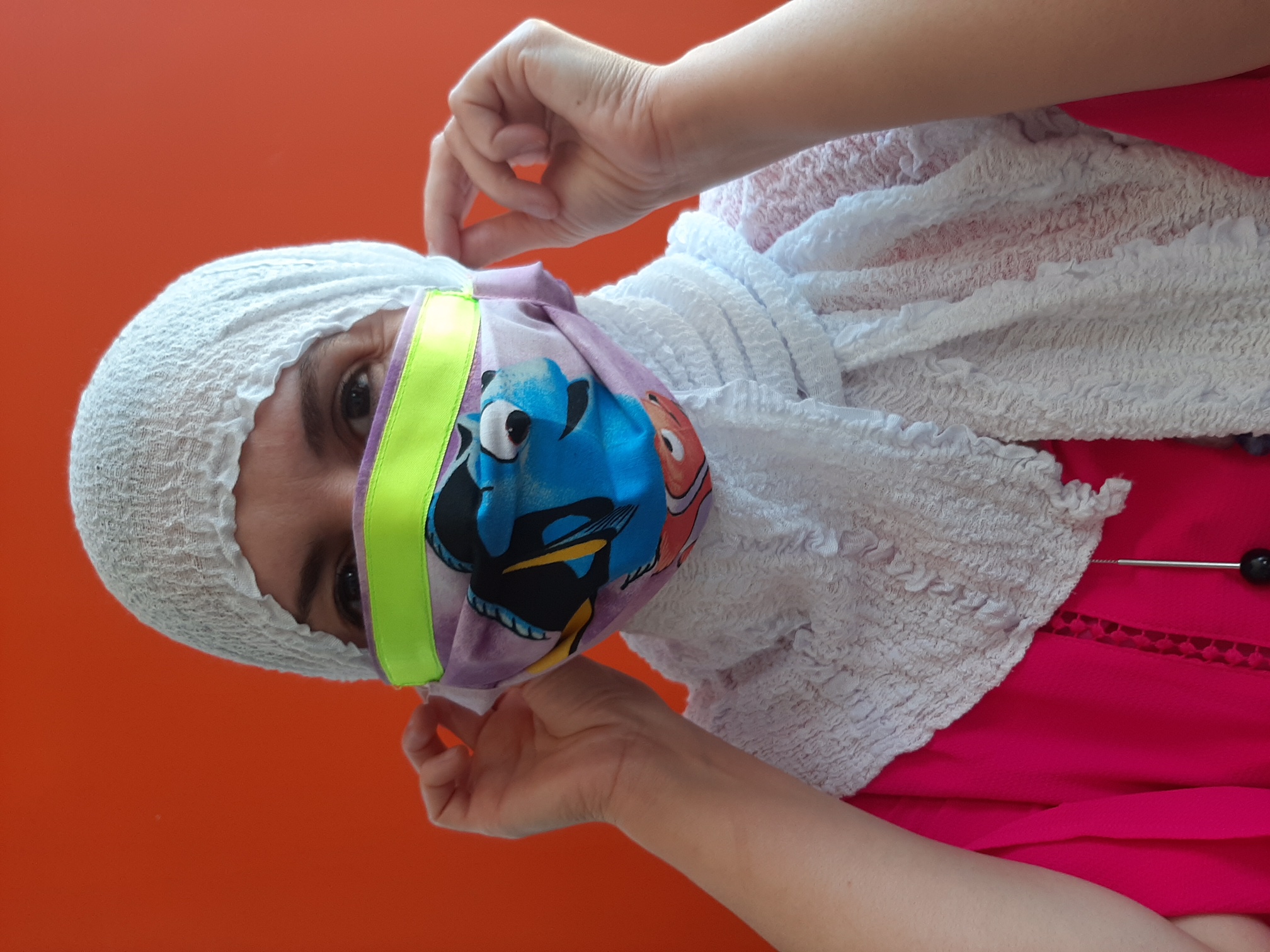
 Nahla Faray wearing her winning mask for the competition organised by The World Makers Foundation and others, Amsterdam 2020.The following blog was written by Ann Cassano, co-founder together with Karim Adduchi of The World Makers Foundation. Together they initiated the collaborative embroidery project The Social Distancing Fabric.
***
Even with the face mask on, I can see Nahla is smiling when I take her picture. The mask which she made herself is cut from fabric with little Nemo and his fellow-fish on them. She has added a fluorescent yellow strip over the nose from ear to ear. It had won her first prize, and a voucher for supplies at the local craft shop.
The occasion was a competition we had set up in Amsterdam-West for women of the neighbourhood to make their own face mask, giving it a look to their own taste. ‘We’ is Community Centre Aminah, which offers social support to vulnerable women in Amsterdam-West, often with a migrant background. It also included Truus Lieverdink from Smockwerk, who teaches a basic sewing course at the centre, and graphic designer and textile aficionada Brunette van Eijseldijk. I also helped out with our fledgling foundation The World Makers, which supports migrant and refugee artisans and makers.
Before the lock-down, all of us had provided our respective activities at the community centre, in sewing, in embroidery, in textile printing. All of it had come to a screeching halt in March 2020. I remember, a year ago, how frightened and confused I felt as the first wave of corona-cases hit the Netherlands. I remember the contradictory information left and right, and how hard it was to make sense of it. I remember also how expensive face masks had become, and how hard to find.
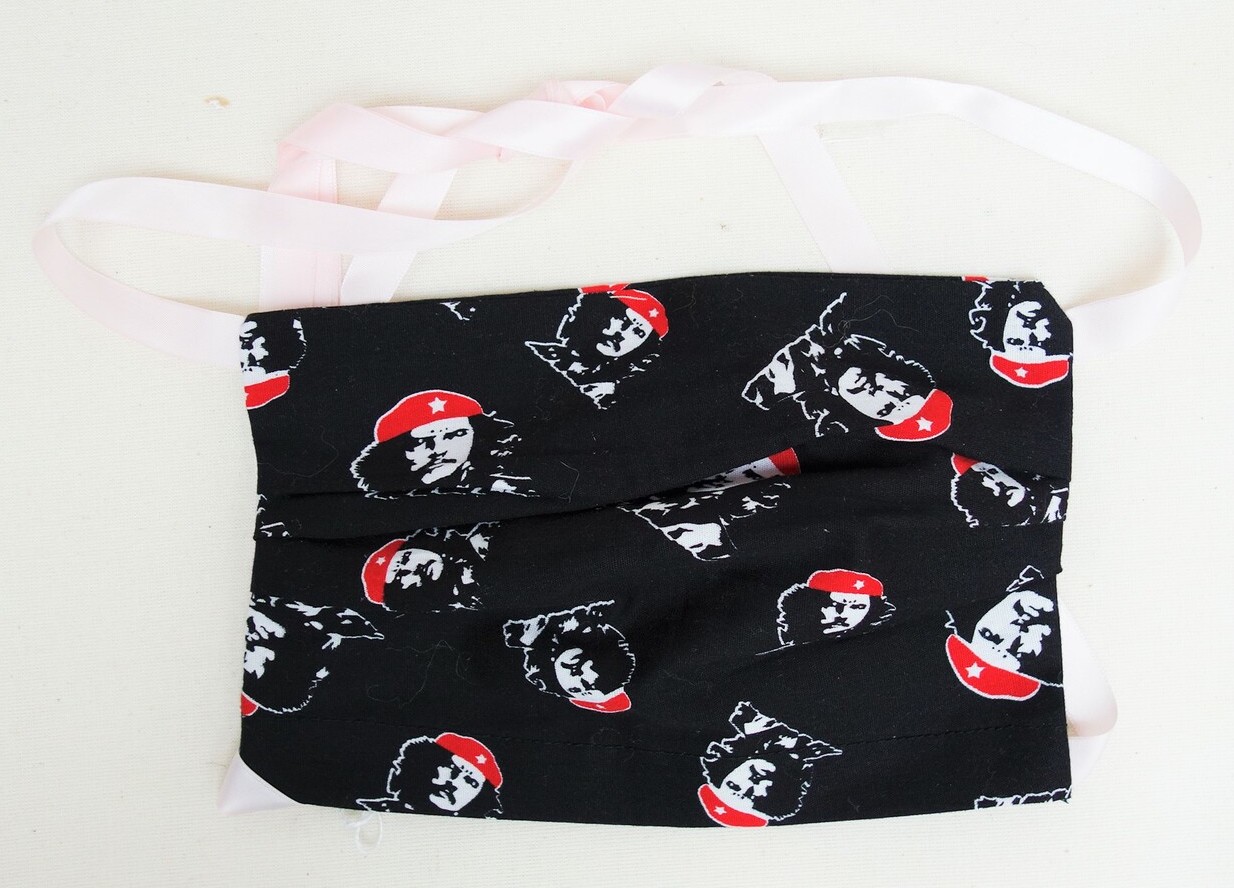 Face mask with depictions of Che Guevara, made by Truus Lieverdink, Amsterdam, for the face mask competition by The World Makers Foundation and others, Amsterdam, 2020. TRC 2021.1764.That last thing, at least, was something I could do something about. I researched the different face mask patterns online, which fabric was the most suitable, instructions on how to wash it and deal with it. I found a detailed pattern with instructions on the website of foundation De Regenboog, which was looking for volunteers to make face masks for their target group: homeless people. They would provide material and the pattern.
I got together with Truus, who tested the patterns and instructions. She then translated it all into images and instructions that she could send to her students over whatsapp, as neither she nor her students were familiar with Zoom. I set up at Aminah with a few volunteers, where we cut the materials from De Regenboog, large white cotton sheets, into strips, and made them into kits for women to pick up. In the next two weeks over thirty women learned how to make face masks, guided by Truus’s whatsapp messages. We made over 400 face masks to donate to De Regenboog.
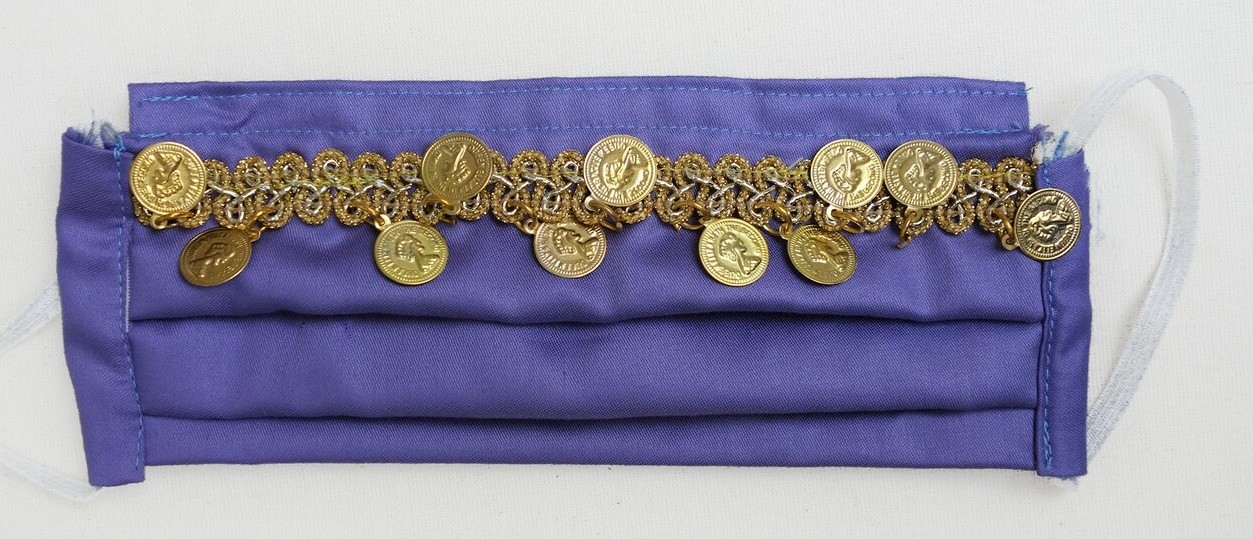 Face mask with a line of coloured spiral braid and costume coins, made by Nahla Faray, Amsterdam, for the face mask competition organised by The World Makers Foundation and others, Amsterdam, 2020. TRC 2021.1760.The next step was to motivate women to make their own masks. Hence the competition. We supplied suitable fabrics and trimmings. We asked women to put something of themselves and of their own cultural background into their work. We received about fifteen masks, decorated sometimes with Moroccan buttons, or with ribbons, golden coins, and pompoms.
Nahla had made four masks. The one with the fish was for her son, and she had added the fluorescent strip so if he’d bicycle home at night with the mask on, it would make him more visible. The neat stitching won her first prize. That, and her ingenuity as a mother to keep her son doubly safe.
Ann Cassano, 28 May 2021