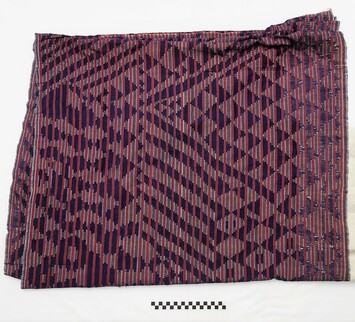
 Length of 'George' cloth from Nigeria, 20th century (TRC 2019.1361).I am coming to the final stages of writing the third volume of the Bloomsbury World Encyclopadia of Embroidery, which is about embroidery from sub-Saharan Africa. Not surprisingly there is a list of things that need to be checked, added or thrown out.
One of the items on the list is a type of cloth called ‘George’, which has been described as embroidered cloth that is used among the Igbo people of Nigeria. It would appear that during the 20th century this type of cloth became more and more popular among a much wider group in Nigeria and among Nigerians living elsewhere in the world. Most Nigerians realise the cloth comes from India, but what exactly is it?
Looking in various books, articles and online items, including Nigerian shops selling George cloth, it became clear there is no consensus concerning what exactly George cloth is. Some of it is described as ‘plain George’, other forms as ‘fancy George’. There are also checked (tartan, plaid) Georges with embroidered squares, a plain George with gold coloured thread woven into it, as well as an embroidered George with floral motifs using sequins and mirrors.
Going a little deeper, things become clearer and there is a fascinating story of international trade that dates back to the 17th century. In 1611 the British East India Company set up a factory (trading post) near the fishing village of Madraspatnam in southern India. The region around the fishing village was well-known for the quality of the cotton spinning and weaving. The British merchants encouraged weavers to produce textiles that were then traded and exported from what became known as Madras and since 1996 is known as Chenni or Chennai. This is the beginning of the huge international trade in what became generically known as Madras cloth and Madras doek in Holland. What became known as George cloth is a form of Madras cloth. But why is it called 'George'?
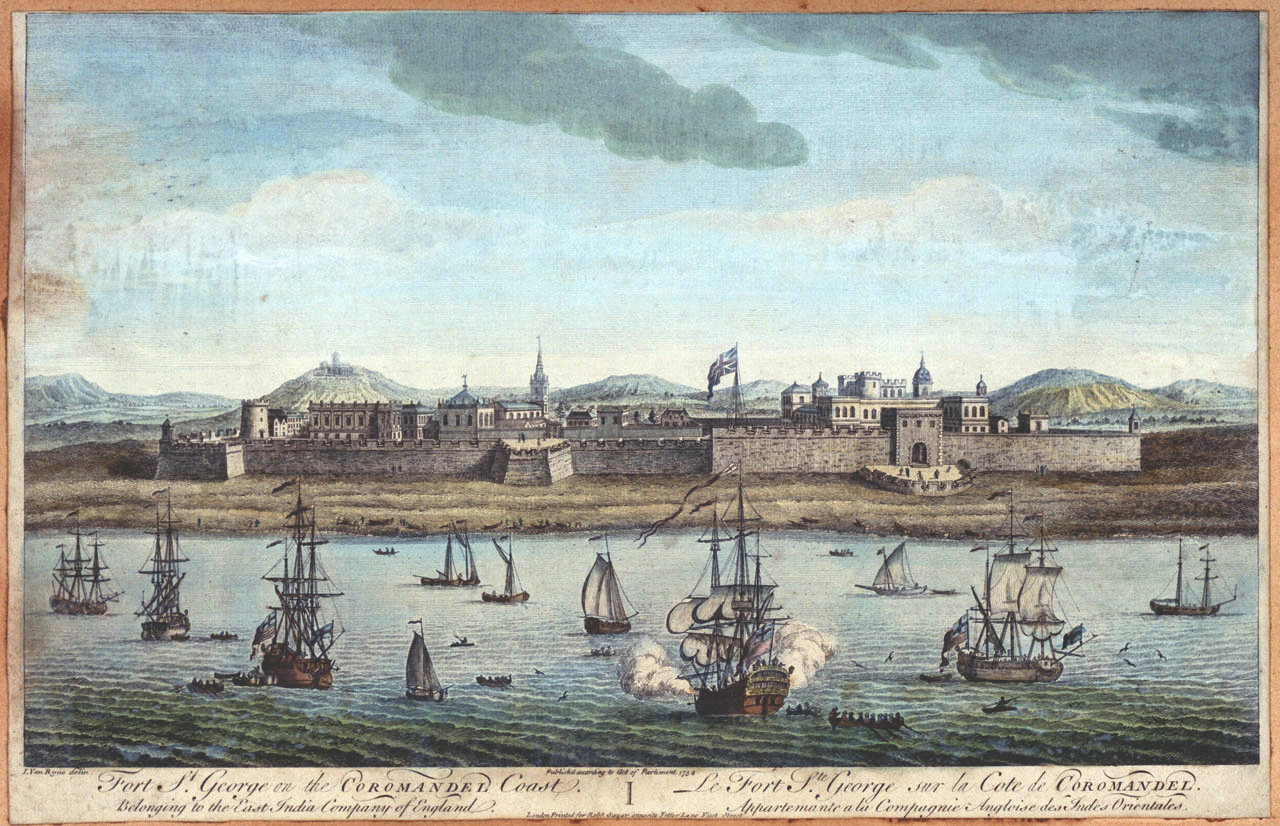 Print by Jan van Rijne of Fort St George in Madras, 1754 (Chennai), India, Open domain.
In 1639 the British were given permission by the raja of Chandragupiri to build a fort near Madraspatnam, which was called Fort St George after the English patron saint. It would appear that since at least the 18th century any cloth produced in the vicinity of Madras and traded in what is now Nigeria could be called a ‘George’. It also explains why there is no clear definition of George cloth in Nigeria, as it ‘simply’ means that it is a southern Indian woven cloth that can be plain, striped, checked, or decorated with embroidery.
Gillian Vogelsang, 7 January 2022