We have just had some very interesting visitors at the TRC, namely Keiko Okamoto and her mother, Nobuko (Tsugita) Okamoto, who are on their way from Japan to the International Textile & Garment Technology Exhibition (ITMA), in Milan, Italy, but they first wanted to come to Leiden to see what we are doing and why. They also wanted to see Leiden itself and especially the Siebold Huis, an international centre for Japanese studies, based on the famous Siebold collection of 19th century Japanese items. Both Augusta de Gunzbourg and myself were very pleased to welcome them at the TRC.
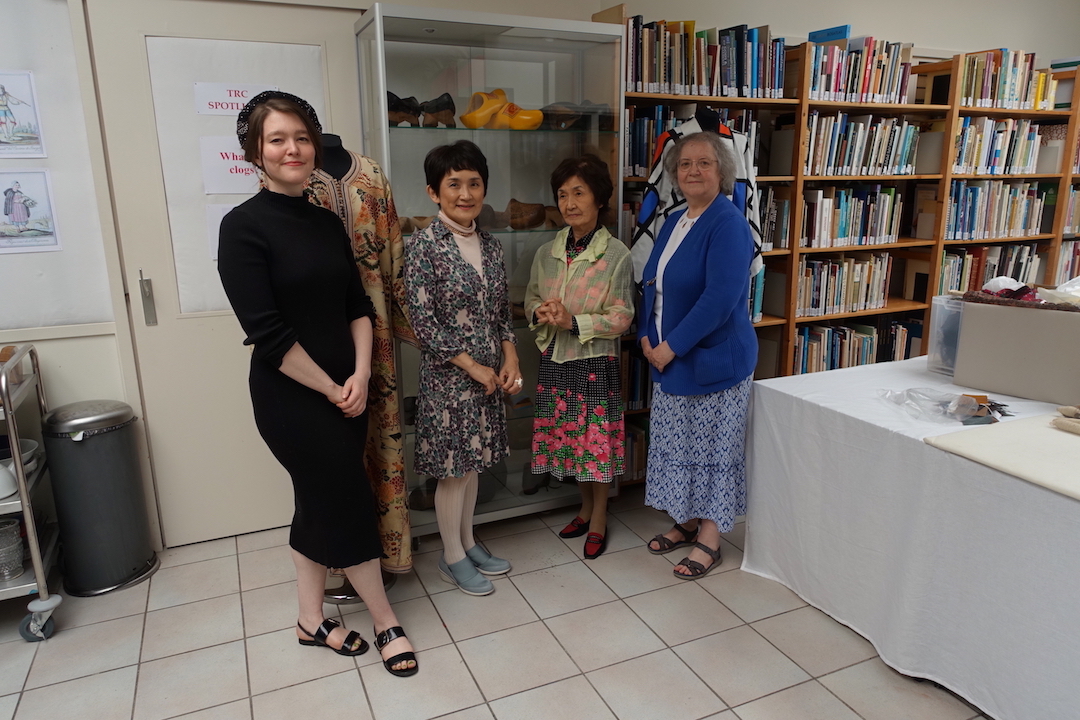 From left to right: Augusta de Gunzbourg, Keiko Okamoto, Nobuko (Tsugita) Okamoto, and the author. Monday 5 June 2023.
More specifically, Keiko and her mother wanted to come to the TRC in order to discuss the possible donation to the TRC of a collection of 1950s and later hand painted, stencil printed (kata) and a few screen printed kimono, with relevant documentation, advertisements, photographs, etc.
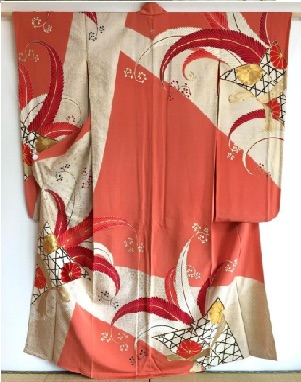 Japanese kimono, hand painted and embroidered, early 1950s. Property of Keiko Okamoto.I had previously understood these were collected as a result of Keiko Okamoto's research on 20th century Japanese kimono and its industry, especially from the 1950s onwards, at Hosei University, more specifically in the Research Center for International Japanese Studies.
But it turned out there was a much more personal story behind the collection. Keiko’s grandfather, Tsutomu Tsugita, was a merchant in Kyoto, Japan, and since 1916 he had been commissioning and financially supporting the domestic production of kimono textiles and their distribution to local retailers all around Japan.
During the Second World War (1939-1945) his business had been closed down, but it was re-opened in 1948. His two daughters (including Keiko’s mother) had many kimono that they wore on a daily basis.
Many of the family’s kimono were later given away to friends and family members, but there remained a significant number of (kata) printed and hand painted examples from the 1950s and 1960s, a period that saw many changes in the history of kimono.
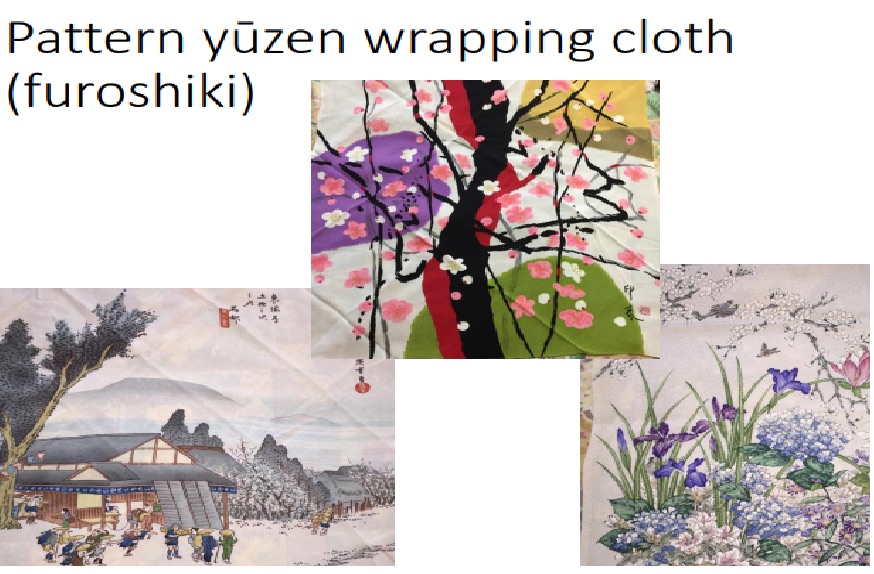 Pattern printed (yuzen) wrapping cloth (furoshiki), Japan. Property of Keiko Okamoto.Keiko initially trained as a textile designer. She also went into business management and worked for many years with various Japanese textile production centres and became a purchaser of Western style textiles produced in Asia (especially China and Vietnam).
After many years in the business world she became a lecturer, researcher and between 2017-2022 a professor at Hosei University. Here Keiko started to work on the history of her family’s kimono textile business in order to record as many details as possible about the post-war changes in textiles and fashion, and the industrialisation of the Japanese textile industry in general.
In this respect I am very pleased to be able to say that while writing this blog we heard today that Bloomsbury Publishers, London, are interested in discussing further with Keiko the publication of her research as part of their acclaimed international, academic series on textiles and dress!
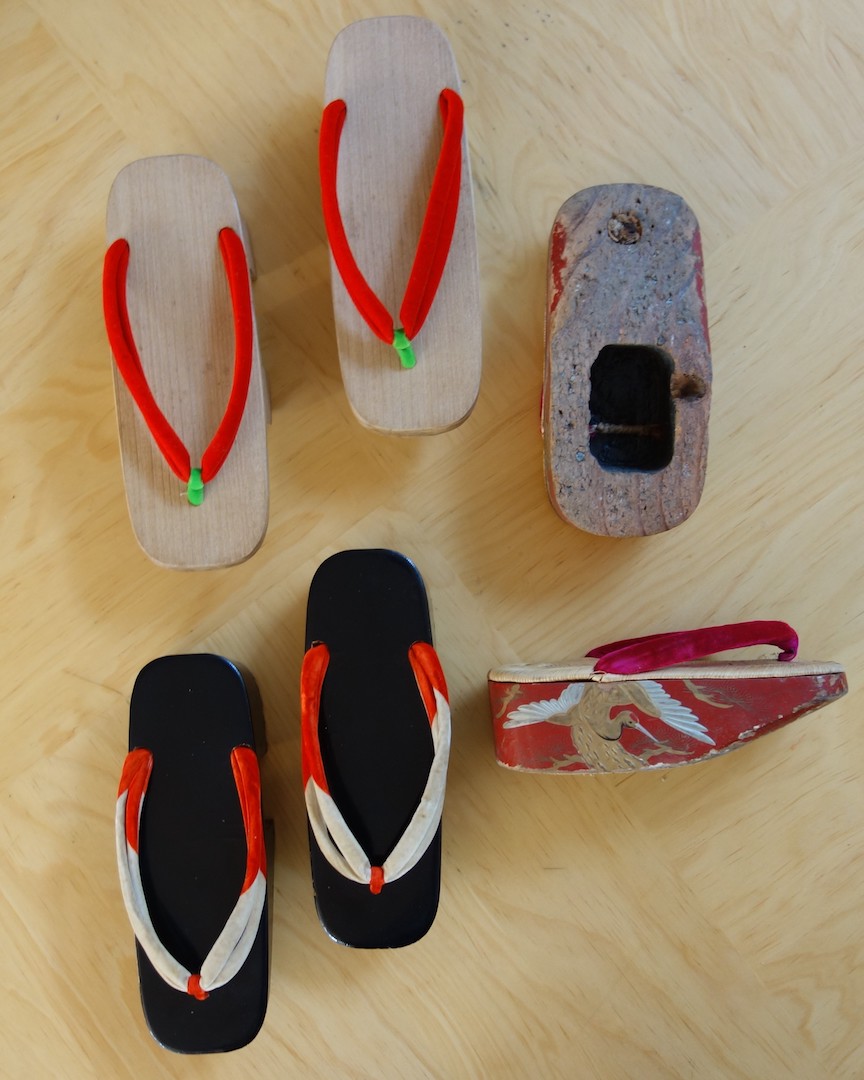 Japanese wooden shoes, recently donated to the TRC by Keiko Okamoto.All of which brings me back to her initial thoughts, namely donating the Okamoto collection to the TRC where it would be seen, used and made available to the world via the online TRC catalogue, blogs, publications, etc. Her family collection, plus the items later acquired by Keiko, include kimono owned by her grandmother, mother and herself, accessories such as shoes (zori) as well as details about production techniques, textile swatches, relevant magazines, folding screens, storage chests, and so forth. Well over one hundred items in total.
In fact Keiko had seen our blog about the TRC mini-exhibition about clogs (wooden shoes) and brought a small collection of Japanese examples with her! These include some items that were worn by family members and date to the 1940s, others are much younger. There was also one pair with holes in the soles where tiny bells could be put so that the sandals made a sound when worn. They will come online shortly.
Another point Keiko made was that Japanese textiles and their production has been well researched and details published, but mostly in Japanese, so she would like to make more and more information available for a world audience, hence such research must be published in English as well.
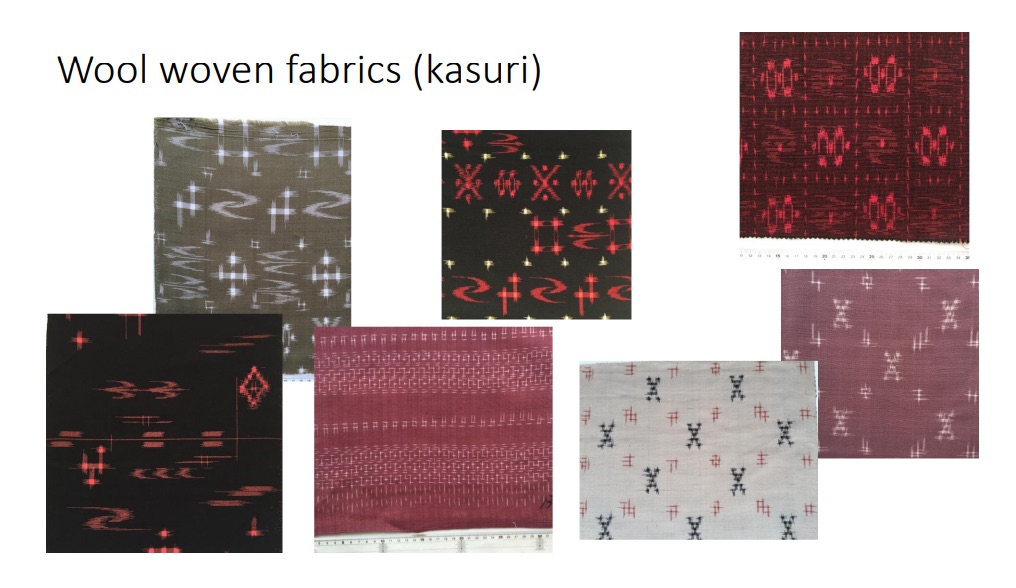 Woollen, woven fabrics, ikat (kasuri), Japan, used for (winter) kimono. Property of Keiko Okamoto.
How to do this remains to be discussed in greater detail. As part of these plans, however, we have already agreed that in addition to the online information, Keiko will make a series of TRC online exhibitions based on her collection and research that will appear in due course in both English and Japanese.
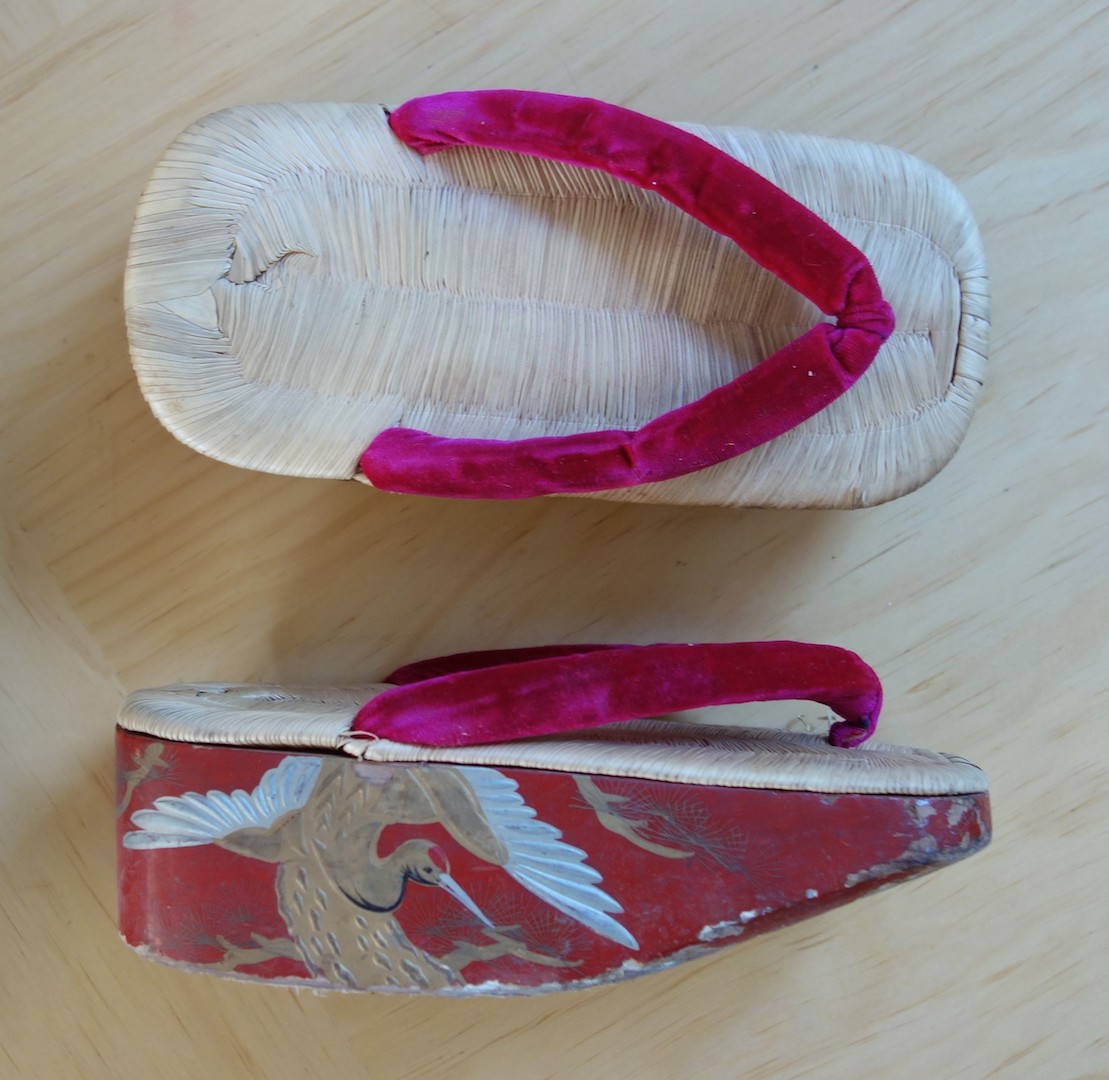 Pair of Japanese wooden shoes, 1940-1945, donated to the TRC by Keiko Okamoto.And when would all of this start taking place? It will be about a year before the collection comes to Leiden (funding needs to be found to bring the collection to Leiden, so we are thinking about starting a crowd funding event). Keiko is going to start work on an online exhibition about Japanese wooden shoes, their origins and types in order to get a feel for this type of work, and then onto several, larger online exhibitions about other aspects of painted and printed kimono.
And in the meantime she has taken a box of labels the TRC uses for accession numbers, etc., and she will start work on tagging and describing everything that will eventually come to the TRC. Very interesting days ahead!
Gillian Vogelsang-Eastwood, 6 June 2023