The TRC exhibition on haori (a Japanese garment worn as a short jacket) is a wonderful banquet of colour and design. What I find most intriguing however, are the linings of the jackets, which often display designs not meant for outsiders to see. These for-your-eyes-only designs raise tantalizing questions. What does it feel like to carry these hidden pictures? What do these designs mean to the wearer?
 Man's haori with a lining that has a woven design of Mount Fuji. Japan, 20th century (TRC 2024.1052).
These questions make the dozen or so black haori (TRC 2024.1051 to 2024.1066) in the TRC collection so interesting. The haori are mostly made for men, but there are a few for women. These garments are a monochrome black on the outside, sometimes with small, discrete family crests on the back and sleeves.
The linings, however, are another story. Inside are beautiful woven or painted pictures, like two boats sailing in front of Mount Fuji (TRC 2024.1052); or a dragon curved around a volcano (TRC 2024.1054); or a colourful mountain scene and a curled, sleeping cat (TRC 2024.1065). Why did the wearer select these scenes?
 Man's haori from Japan, 20th century, with on the lining a painted design of a volcano (TRC 2024.1054).
Many of these haori were acquired last year, when the TRC conducted a crowdfunding campaign to purchase them. TRC supporters are a generous group of people, so the campaign was a success. As a thank-you, many funders, including myself, received a lovely cotton furoshiki.
My orange coloured furoshiki had a lovely repeating fan motif. But I had never heard of a furoshiki before. What was this squarish-shaped cotton cloth used for? I looked up furoshiki in the TRC’s on-line collection to see two further examples. One had a delicate geometric pattern (TRC 2009.0421), while the other was a green cloth with a rather non-Japanese looking paisley, or buteh, pattern (TRC 2021.2150).
This latter furoshiki, dated between c. 1960 and 1970, was given to shareholders of a chemical company in Nagoya, and did indeed reflect a growing taste for different cultures during that decade’s economic boom.
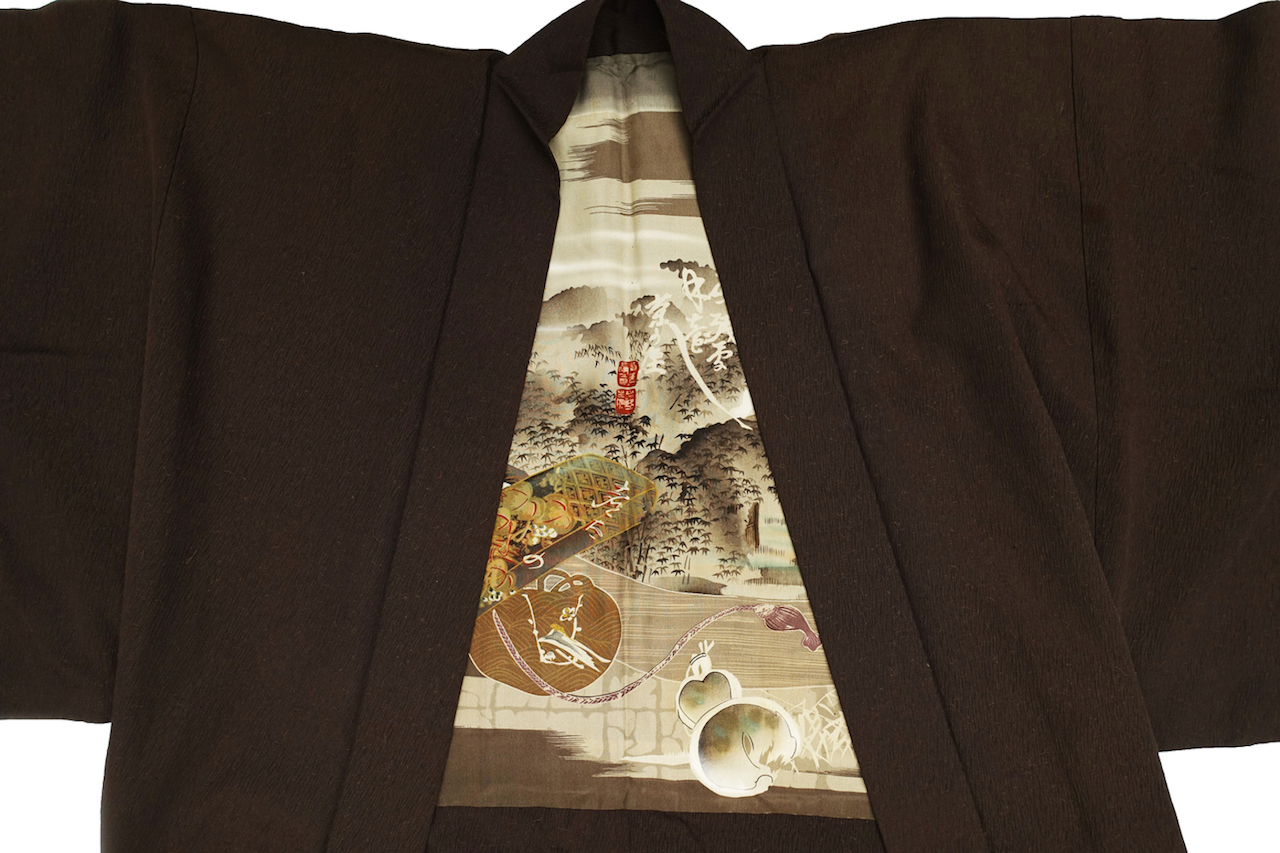 Inside of a man's haori, decorated with a painted design of a stylised landscape with various motifs, including a curled up, sleeping cat. Japan, 20th century (TRC 2024.1065).
The TRC’s on-line catalogue described the furoshiki as a wrapper. That sent me scurrying to different internet articles. Wrapping objects, from jewellery to ceremonial objects, has a long history in Japan. There is an 8th century reference to wrapping valuables in cloth, with the cloth being called “tsutsumi” (“wrapping”).
Wrapping was not only a practical way to protect or carry an object, but also a sign of respect for the object itself. By the 12th century there was a specific word to describe a cloth used to protect or carry clothing: “koromozutsumi”, from “koromo”—clothing—and “tsumi”—wrap.
One of the first written references to furoshiki is in an inventory of items left by the shogun Tokugawa Ieyasu (1543-1616). Furoshiki comes from two words: “furo”—bath—and “shiki”—spread. People would wrap their clothes in cloth while at a public bath; they would use the cloth to dry their feet after the bath and to stand on while dressing. The word gained in popularity as public baths became more widespread.
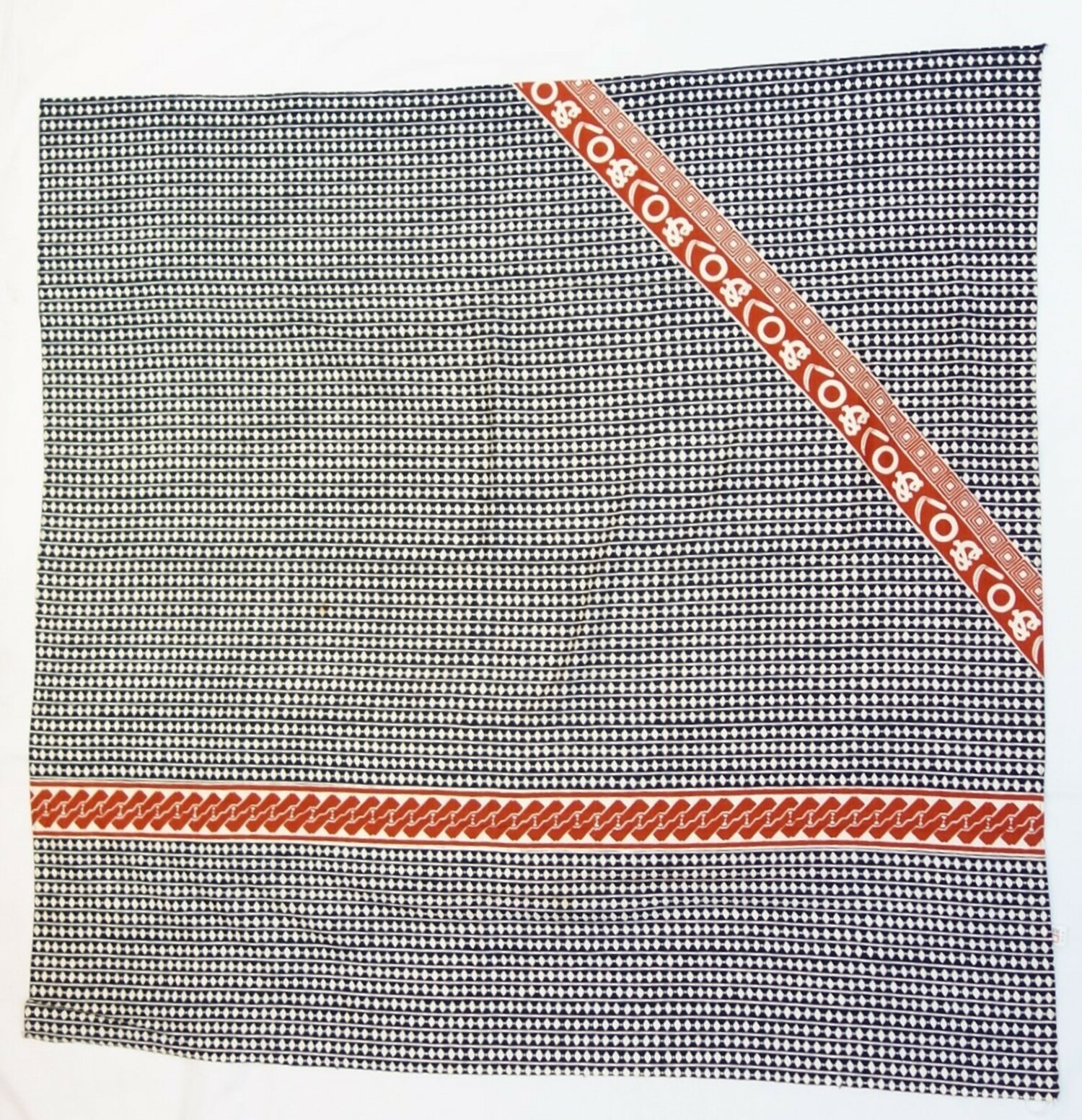 Wrapping cloth (furoshiki), Japan, 20th century (TRC 2009.0421).Gradually the word became applied to any square piece of cloth used either to wrap gifts or to carry objects. While the custom of wrapping important or formal gifts and ceremonial objects in cloth never died out, using furoshiki to carry everyday shopping items began to disappear as paper and plastic bags became more common.
Then around the 1980s interest in more sustainable living blossomed. The recyclable furoshiki suddenly became popular again (and was encouraged by the Japanese Minister of the Environment as an alternative to plastic bags). Department stores began asking customers if they wanted their purchases in a paper bag or a furoshiki.
One furoshiki manufacturer, Musubi, opened a shop in Tokyo’s trendy Harajuku area, promoting furoshiki in bright, bold designs as both eco-friendly and an enduring part of Japanese culture (for more information, click here).
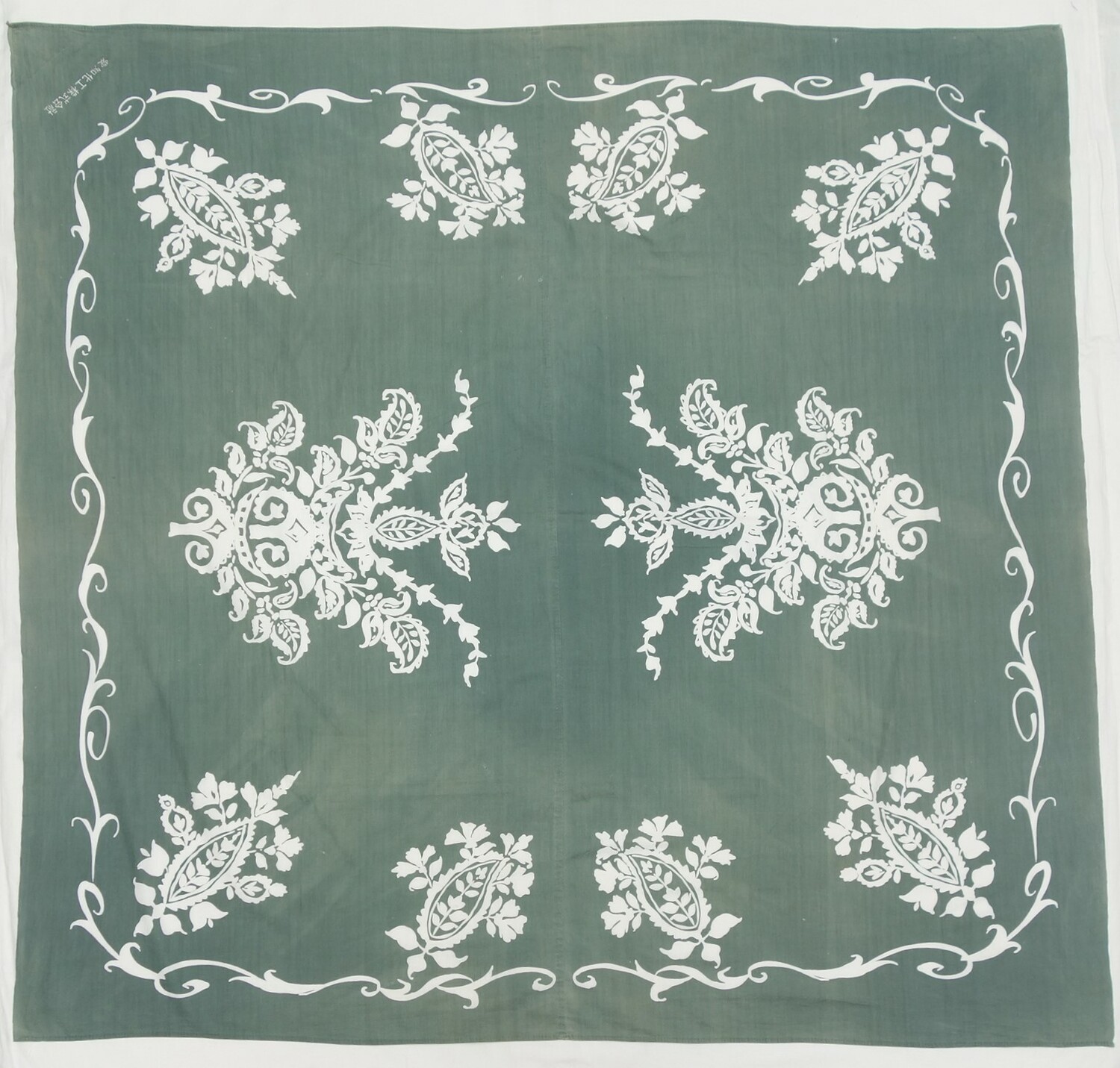 Japanese wrapping cloth (furoshiki) with a white pattern of ornate scrolls and Paisley (buteh) motifs. Japan, mid-20th century (TRC 2021.2150).
Today there are dozens of YouTube tutorials that show you how to fold furoshiki into bags to carry everything from groceries, baguettes, bento boxes, to books or bottles of wine. Essentially, the cloth is spread out, the design face-down, the item or items placed in the middle, and the cloth is folded over, then knotted so a handle is made. The most common knot is called mamusubi, or a reef knot (square knot) in English, as it is secure but easy to untie. The ties of the knot should point length-wise; pointing width-wise means the item is going to a funeral.
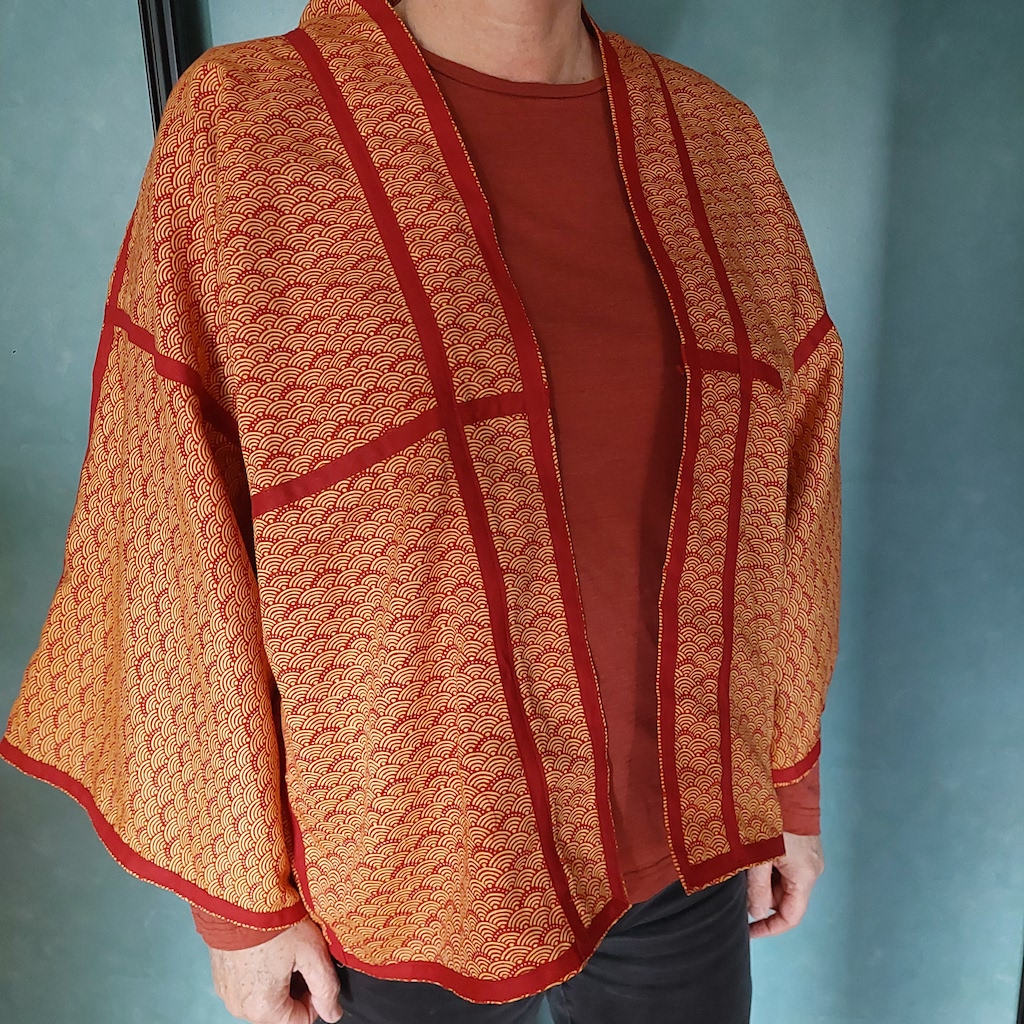 A haori-like jacket made by TRC volunteer Alice van Duijnen from furoshiki received during a TRC crowdfunding campaign. Photograph by Alice van Duijnen.
I’m not as clever as TRC volunteer Alice van Duinen, who used several furoshiki to make her own haori jacket. But I have been studying a furoshiki tutorial and intend to take my cloth with me the next time I shop for wine. You can watch this video, from ABC Australia, to see how to fold a furoshiki to carry wine bottles, or other objects:
The exhibition Japanese Haori Jackets Inside-Out is on at the TRC until 2 June 2025.
Shelley Anderson, 31 March 2025