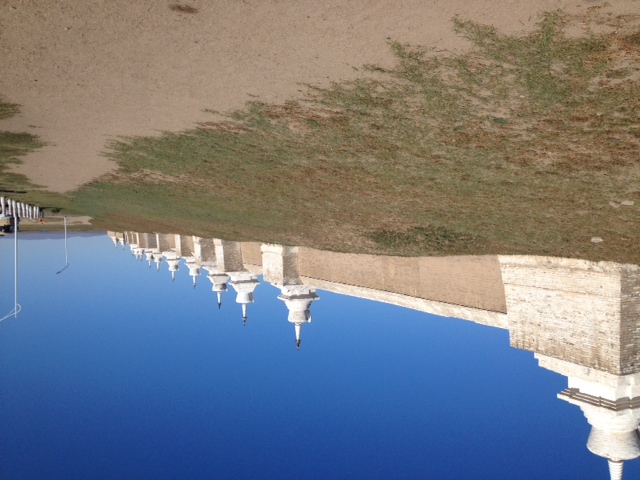
 Kharkhorin / Karakorum, with the walls of the Erdene Zuu monastic complex. Photograph: Willem VogelsangI am just back from a brief trip to Kharkhorin, or Karakorum as most people outside of Mongolia tend to know this place. It is the old capital of the Mongol Empire, founded sometime in the early thirteenth century, and destroyed, with great enthusiasm, by the Chinese in the late fourteenth. Just about nothing remains of the place, although recent excavations are bringing to light some intriguing finds. The whole area is now dominated by the huge Erdene Zuu complex, a Buddhist monastic settlement of the sixteenth century surrounded by a white-washed wall. Unfortunately, only a few buildings within the walls of the monastery remain; all the other constructions having been destroyed during the communist purges of the late 1930's (which also killed allegedly some 90000 Mongolian Buddhist monks and nuns). What is really interesting at the site is the new museum that has been built, just outside the former confines of the old city of Karakorum. Funded, and apparently built, designed, and more or less parachuted by the Japanese, it shows a wealth of material and information on the history of the Orkhon valley, of which the former city of Karakorum was only one in a series of ancient capitals. It also shows a model of how Karakorum may have looked like, together with its Buddhist temples, Christian churches and Islamic mosques.
Textile-wise I was especially intrigued by (admittedly, reproductions of) wall paintings that were recently discovered in a nearby tomb dating to the late first millennium AD and showing men wearing the beautiful flowing robes that we often tend to associate with the other Central Asian civilisations, as for instance those of the Sogdians.
A word of warning: it takes, by car, some six to eight hours to drive from Ulaan Baatar to Kharkhorin. But if you want to walk around at a historic place, where Marco Polo may (I stress the ' may') have wandered around, and where around AD 1250 the Franciscan monk William of Rubruck met a woman from Metz in France who had been captured in Hungary, and if you enjoy watching the wide landscape of the Mongolian pastures, it is certainly worth visiting. You can stay overnight in one of the camp sites that seem to have sprung up everywhere in Mongolia, and enjoy a night's sleep in a kher (or yurt). Don't be alarmed when in the early morning an old man or woman stumbles in to light the fire.
Willem Vogelsang, 20 September 2015