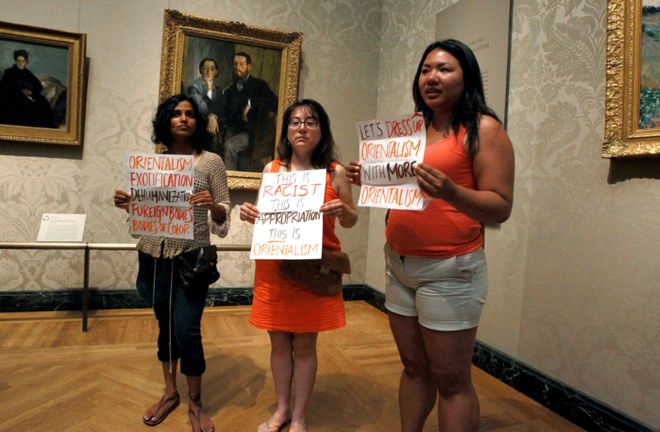
 Courtesy APThe Boston Museum of Fine Arts recently stopped visitors from trying on a kimono and posing in front of a painting by Monet of a woman wearing this characteristic Japanese garment. There was also a production of Gilbert & Sulivan's 'Mikado' that was apparently cancelled. Why were people not allowed to wear a kimono? Why was watching the Mikado considered improper? What had the organisors done wrong? Well, they committed the unforgiveable sin of what in Boston was called 'cultural appropriation'. It is about, shock horror, adopting aspects from one culture and incorporating it into your own. It is about a Westerner practising yoga, eating Chinese food, wearing a kimono, watching the Mikado, and, to cap it all, sin of all sins, wearing a sombrero at a party (I am not joking). Perhaps you should look at the photograph of three young women (I think they are Mexican, although wearing very 'Western' style clothing) protesting in the Boston museum against people wearing a kimono. Some of the words they use are Orientalism, Exotification (sic), Dehumanization. And of course, racism is also mentioned.
Actually, the term is used incorrectly. In earlier days the phrase cultural appropriation was used when a certain aspect of a culture is appropriated by another and the origins deliberately obscured or misrepresented. The term was used, for example, for Palestinian garments being sold as 'Israeli'.
But apart from the incorrect application of the word, the events in Boston remain remarkable. It is easy to make jokes about this movement and about the long words that are being used. May Mexicans or Japanese eat a pizza, and if so, are they involved in cultural appropriation? But there is much more than that. I understand that minority groups need, and have every right to fight for their position in society, and use various means to achieve this objective. These means are fortunately often symbolic. In Holland it is the saga of Zwarte Piet; in other cultures it may be a particular statue (in Oxford plans were only recently scrapped to remove the statue of Cecil Rhodes), changing a street name, or whatever. In many cases the minority groups are absolutely right in demanding these changes.
But this new wave of denouncing what is called cultural appropriation goes much further than that. It means that people in the Western world (I understand it is only the Western world that is at fault) should distance themselves from other cultures, look at them as strange, not to be touched (literally), and in fact, contrary to what the protesters in Boston want, regard these 'other' cultures as exotic. And what does it mean for those who are born in those 'other' cultures? Do they have to remain there, and retain and defend to the death their inherited culture? Are the three young women in Boston, enjoying no doubt the advantages of Western life, going to tell their Mexican (?) family that they should go on living as they always did? I think the campaign against what is called cultural appropriation leads to something else, namely folklorisation, which, as I interpret it, is the framing of other people and their culture into a romantic mould that clearly separates 'them' from 'us'.
In a recent article published by the BBC (11 March, "A point of view: When does borrowing from other cultures become ' appropriation'?"), it is clearly explained that the sharing of different aspects of culture helps towards a better understanding of other people and even to celebrate other cultures. At the TRC in Leiden, the visitors enjoy wearing a kimono, a burqa, or a Mexican sombrero, so that they can have the chance to learn about other cultures. Knowledge, and direct experiences with other cultures, stimulate understanding. Creating a distance between cultures leads to ignorance and misunderstanding.
Willem Vogelsang, 13 March 2016