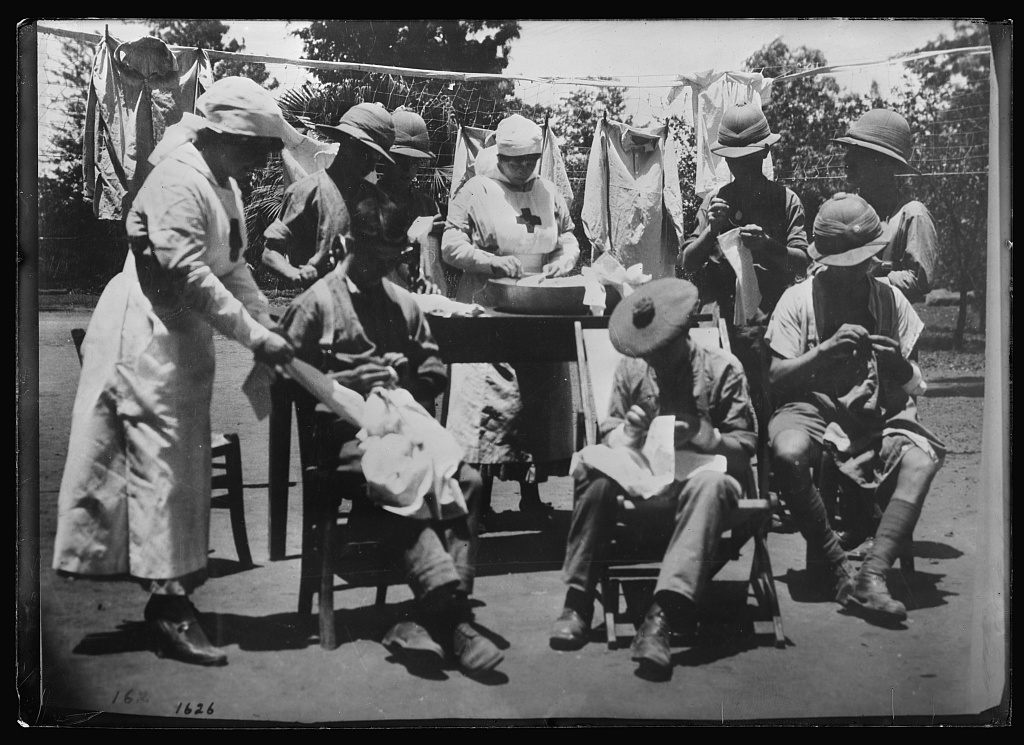
 British wounded soldiers sewing for Syrian/Palestinian refugees.We just came across a remarkable photograph housed in the Library of Congress. The photograph is particularly poignant considering the current situation in the Middle East. But it also illustrates an old relationship between sewing, embroidering, and the military.
The Red Cross caption card tells the following: "British soldiers sewing for the Syrian refugees. A favorite pastime which has excellent results is the work of the convalescent soldiers now recuperating in Egypt... The men are busily making clothes for the destitute inhabitants of Palestine." The photograph probably dates to the period 1917-1920.
Sewing and working embroidery were often used in the past to help soldiers recovering from war-time wounds and traumas. TRC Needles provides some examples. Compare for instance the Bradford Khaki Handicrafts Club, which was established in 1918 in Bradford, West Yorkshire, UK, to provide occupational therapy and employment for men returning from the First World War (1914-1918).
Another example is a piece of embroidery made by Major Alexis Casdagli during the Second World War (1939-1945). He was captured in 1941 and remained a POW until the end of the war. While in 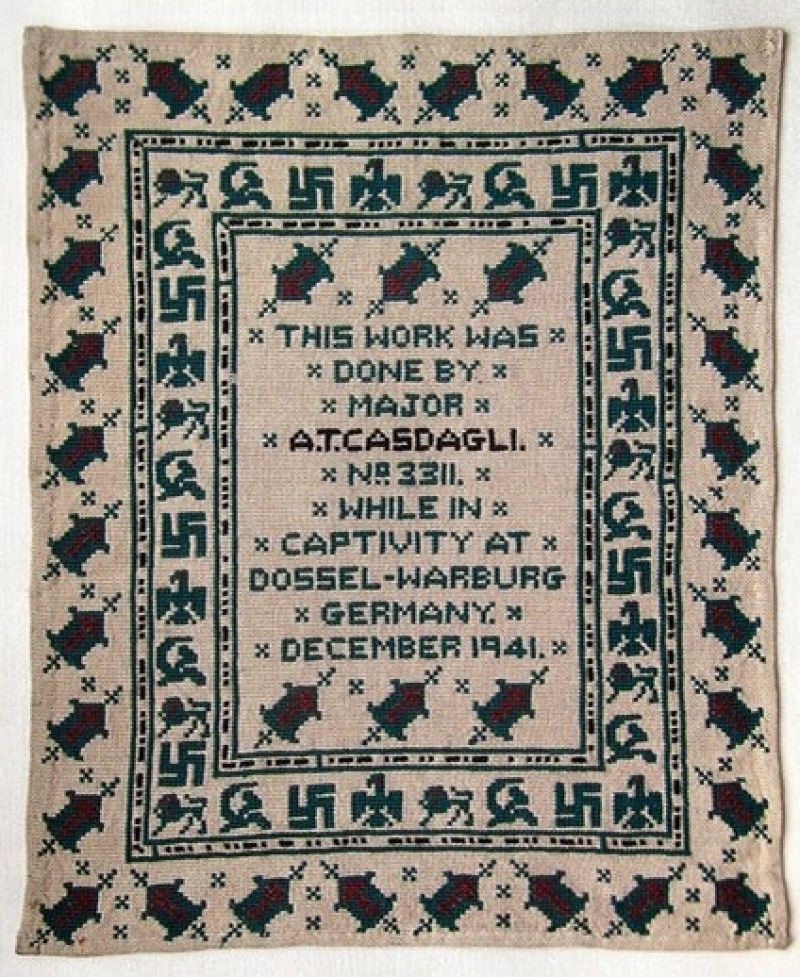 The Casdagli sampler, 1941.captivity, he worked an embroidery that contained hidden messages worked in Morse code ("God save the King", and "Fuck Hitler"). During his captivity, Casdagli also ran a needlework school for other officers in the POW camps. He later said that the Red Cross saved his life with food parcels and letters, but his embroidery saved his sanity: “If you sit down and stitch you can forget about other things, and it’s very calming.”
Finally there is private Thomas Walker, who was wounded in 1854 during the Crimean War. He was painted by Thomas Wood while sewing triangles from pieces of military uniforms. The Morning Chronicle tells us the following:
Tuesday, December 25, 1855: The Queen has forwarded to Private Thomas Walker, 95th Regiment, a present of £10. On her Majesty's last visit to Fort Pitt she was struck with a quilt brought to her notice as the work of Walker, and desired that it might be forwarded to her Majesty, which has recently been done through Colonel C. B. Phipps.
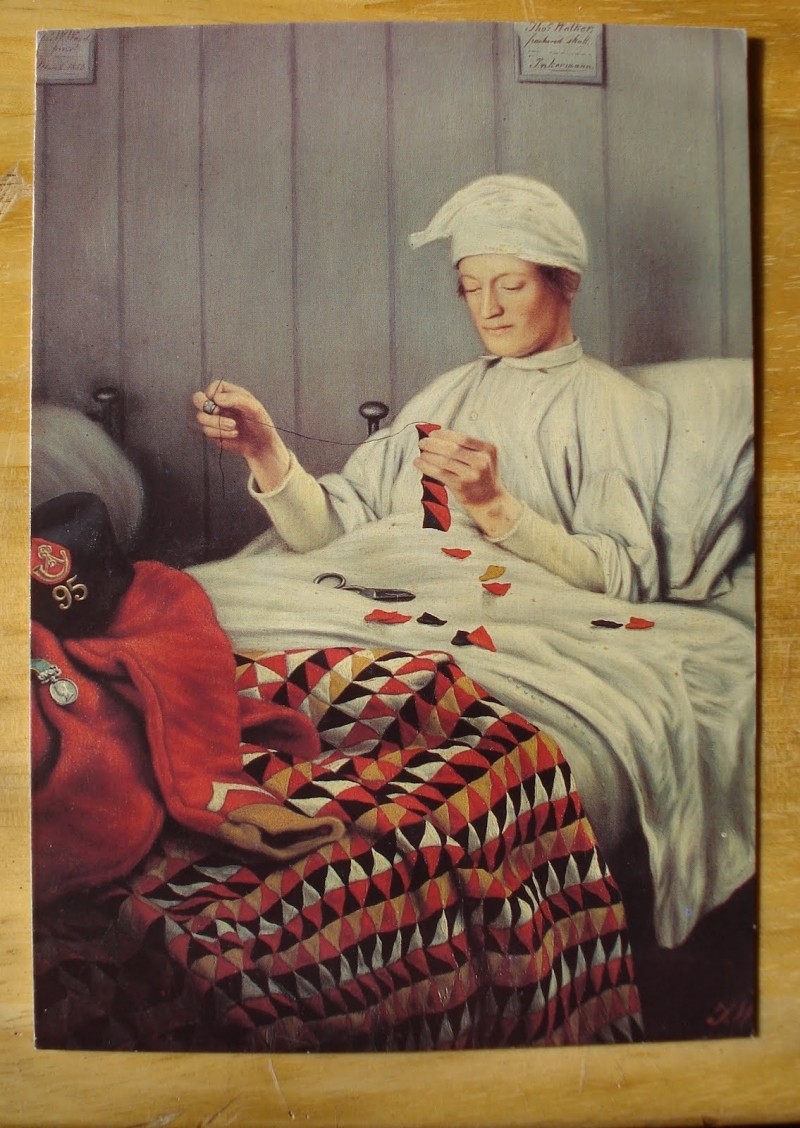 Private Walker, by Thomas William Wood, 1856.Monday, March 3, 1856: An artist is engaged in the Military Hospital, Fort Pitt, Chatham, completing an oil painting of Thomas Walker, 95th Regiment, who has been an inmate at the hospital for fourteen months, during which period the entire top of his skull has been removed by skilfull operation at different periods by Mr. William Perry, surgical operator. The painting, which is intended for an exhibition, represents Thomas Walker in bed, busily engaged sewing together pieces of different coloured cloth, for the purpose of making the quilt which the Queen, upon seeing, was pleased to order to be sent to the palace. A part of the pattern is represented in the picture lying outside the bed. It was at the battle of Inkerman this youth received his wound, by a shell bursting directly over his head, which it fractured in the most extraordinary manner, causing insensibility for several days, until a piece of bone which pressed on his brain was removed.
Gillian and Willem Vogelsang, 25th April 2017