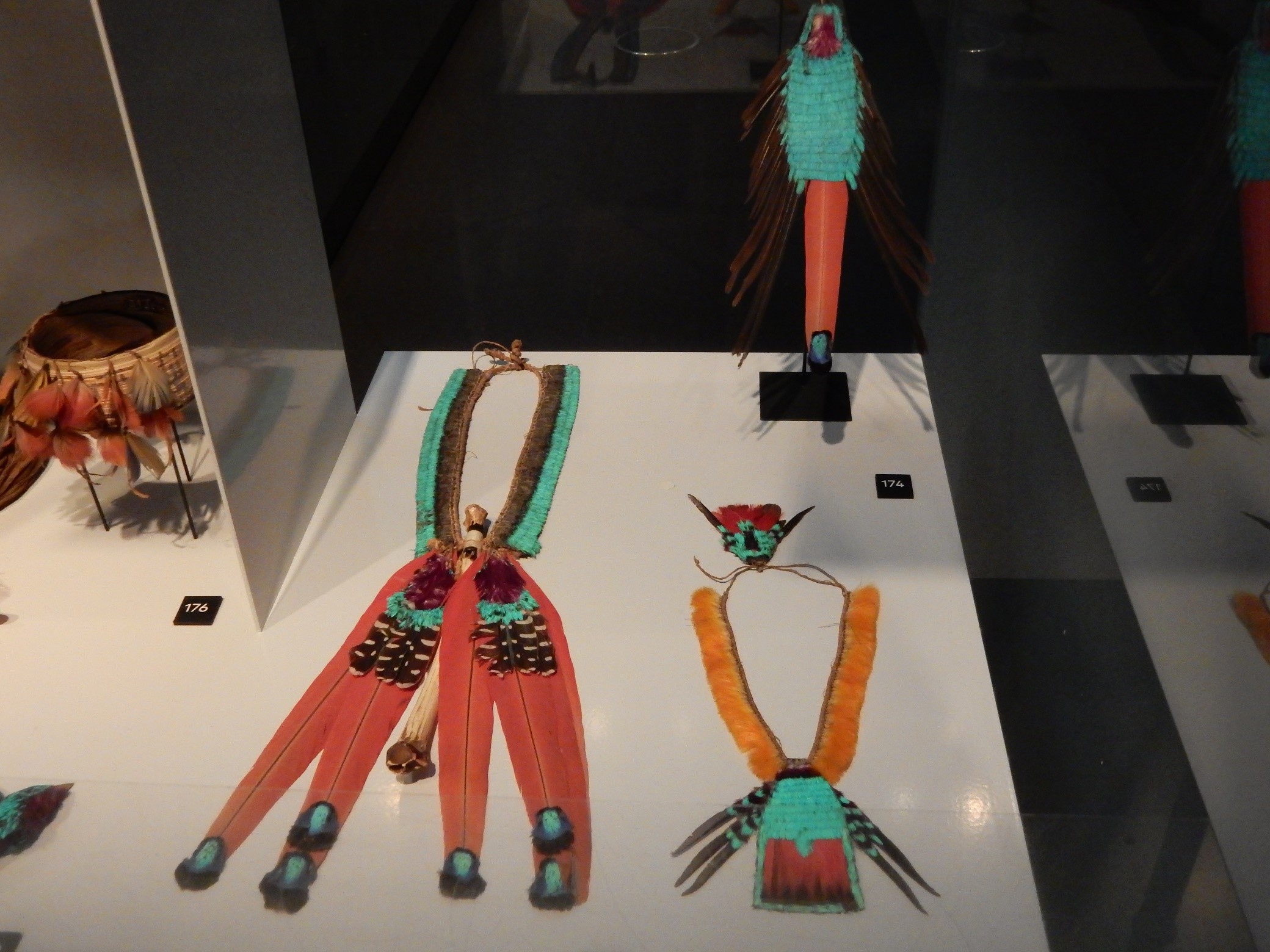
 Showcase with feather jewellery from Brazil, in the exhibition "Jewellery: Made by, worn by", in the Volkenkunde Museum, Leiden. Photograph: Shelley Anderson.This is the name of the latest exhibition at the Volkenkunde Museum (Ethnographic Museum) in Leiden. Some 1000 pieces of jewellery are currently on display, out of the Museum‘s collection of thirty thousand pieces. Interestingly, in addition to the pieces themselves, the exhibit focuses on makers of jewellery. There are dozens of videotaped interviews with makers of both modern and traditional jewelry, from Japan, the Netherlands, Yemen, Ghana, India, the USA and elsewhere.
The exhibit is broadly divided into four sections, based on materials. The first section was an eye opener for me. An astonishingly wide variety of materials from nature have been, and still are, used to make jewellery. The necklaces, bracelets, brooches and head gear on display are made from stone, flowers, seeds, shells, bone, feathers, teeth, antler, hair, skin, wood and plant fibres. Many of the objects in this section are from indigenous cultures, like the large opalescent mother-of-pearl pendant, engraved and then rubbed with red ochre, from an Aboriginal nation in Australia, or the jade hei-tiki Maori pendants.
These objects have much to say about human creativity—and the desire for status and identity. Interestingly, they also speak to globalization: one of the first objects on display are agate hair ornaments/necklaces, used by Tuareg women. These were made, beginning in the mid-19th century, in Germany—from agate found in Brazil.
The juxtaposition of pieces by modern designers alongside these older objects was jarring at first, but also thought provoking. This mix of modern with tradition continued throughout the exhibit and into the next section, which featured silver. One of Europe’s indigenous peoples, the Sami, have a long tradition of silver jewellery, which is inspiring modern designers. There are collections of Tuarag crosses, and silver from Jewish smiths in Yemen and Morocco and from different Native American designers.
My favourite part of the exhibit were the reconstructed jewellery workshops from India, Indonesia and Ghana, with accompanying videos of crafts people. Last but definitely not least was a room devoted to beaded jewellery, and another to a stunning gold display. An excellent colour catalogue of the exhibition with all the information texts is available for 2 euros.
“Jewellery: Made by, worn by” is on now until 3 June 2018.
Shelley Anderson, Sunday 8th April 2018