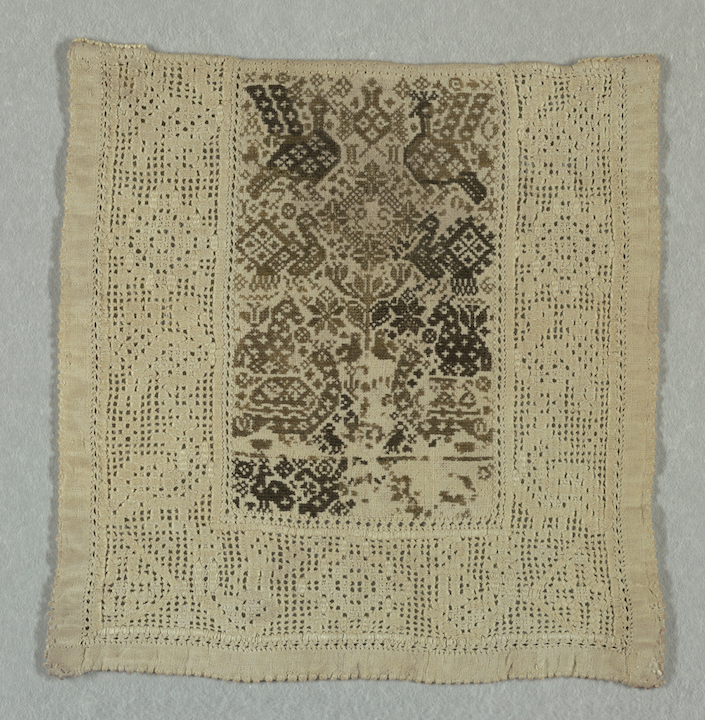
 An embroidered panel with a cross stitch centre and a drawn thread work border (1794, Amager, Denmark; bequest of Mrs. Henry E. Coe, courtesy of the Cooper-Hewett Museum, New York 1941-69-116).On Saturday, 25th January 2020, Gillian Vogelsang wrote:
While working on the forthcoming quilt exhibition at the TRC and on the Encyclopedia of Embroidery series at home, I was struck by the modern need for precision and symmetry and how computers and their need for 'accuracy' have changed our lives. And in this case, also embroidery.
A feature of early twenty-first century embroidery, for example, is the use of computer programmes in order to create and re-create certain designs, and the distribution of such patterns online via social media groups such as Pinterest. Many of these designs are worked out on graph paper (or rather the computer equivalent) and then copied and mirrored, so quickly producing a symmetrical design.
However, when working with sixteenth century and later designs it is clear that what may look symmetrical was not necessarily identical on both sides of a central line. For example, eighteenth century cross stitch samplers from Amager in Denmark are full of small variations in the place and the way different parts of the overall design are worked out. Furthermore, it is clear that the embroiderer did not always ‘correctly’ count how many ground threads, and indeed which of these threads they were working the stitch over. From a distance these samplers look visually regular, but they are not ‘computer’ regular. But are these samplers therefore inferior?
Trying to achieve exact symmetry in a design is nothing new. The importance of symmetry was strengthened with the publication of lace and embroidery pattern books from the sixteenth century onwards. By the nineteenth century the public desire for high(er) standards of work (both with respect to design and stitching) and, more significantly, for conformity to 'norms', wherever, was increased by the introduction of compulsory education for girls and the publication of numerous sewing guides for teachers concerning what was and was not acceptable.
Since the late nineteenth century machine embroidery, especially forms that are programme driven, as well as hand embroidery designs have strengthened this need (or shall I call it an obsession?) for symmetry, regularity and precision. This is not to say all embroidery is mechanical in appearance. There are many people working in the field of embroidery who have chosen to work in a much freer style (see the blog on the autonomous hemstich developed by the Danish embroiderer, Rikke Ruff), but I am curious how embroidery historians in the future will view the early twenty-first century insistence by some vocal people on the observance of TC-embroidery and the role of some of the embroidery, lace, and quilt groups (the latter sometimes disrespectfully known as the 'quilt police' etc.) in their persuit of what they regard as perfection, and their opposition to what they consider poor quality, non-TC ('technically correct') work.