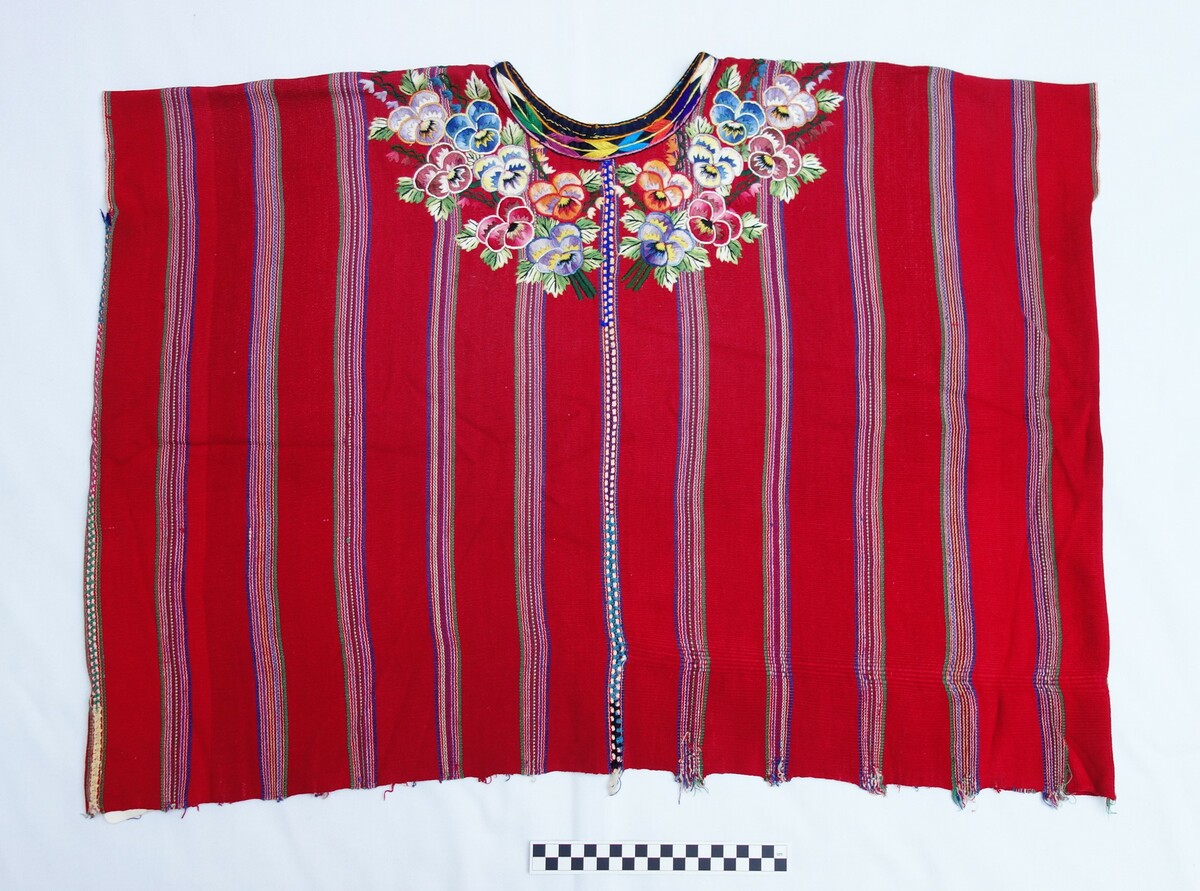
 A Maya huipil from Patzicia, Guatemala, late 20th century (TRC 2019.1840).On the 17th February 2020, Dorinda Terhoeve wrote:
To tell the story of the huipil is to tell a story of resilience. This Mayan garment looks simple in its appearance, being a sleeveless rectangular tunic made of only two or three panels.
However, the embroidered colours, local variations, history and its makers are highly intriguing and fascinating. The huipil has changed little since the ancient civilization of the Maya’s. Even the Spanish conquest had little influence on how the garment was, and still is made and worn today by women in parts of Mexico and Guatemala.
Using mostly a backstrap loom, women produce their own huipil with patterns and embellishments that are typical of their village. The huipil has a long history, and although it changed little over the years and centuries, there was a definite development. Influences from foreign fabrics, materials and technologies have been incorporated and the Mayan clothes are, in return, used for western markest and tourism.
The actual wearing of the traditional clothing (traje) is now in decline, because people are moving away from their villages and into the big cities. Despite this decline, the huipil has certainly not disappeared and the tradition continues.
The TRC is preparing a small exhibition about the huipil for the spring of 2021. The exhibition will dive into the story of the garment, showing materials and techniques of weaving and embroidery, history of dress and local variations and, last but not least, it will show the story of the women behind the textiles.
The TRC recently acquired a particular example of an huipil (TRC 2019.1840). It dates to the late 20th century and originates from Patzicía, Chimaltenango, in Guatemala. It shows the key features of the huipil: a rectangular design, bold colours and bright embroidery. Even the typical handmade ‘randa’, seam, can be seen.