• F1
  • F3
  • F4
  • F2

In May 2018, the TRC welcomed Dr. Magdalena Wozniak, a Marie Curie Fellow from the Polish Academy of Sciences. She is an archaeologist working on the textiles found at (Christian) Nubian sites in the north of Sudan. She had attended the TRC five-day Intensive Textile Course in 2015, and it was wonderful to see her again.

But her visit had a special purpose: she wanted to study the Sudanese textiles, and the raw fibres and spinning weaving equipment, all of them collected by the grande dame of British archaeology, Grace Crowfoot (1879-1957) and now housed at the TRC. For a blog about Magdalena’s visit in May 2018, click here.

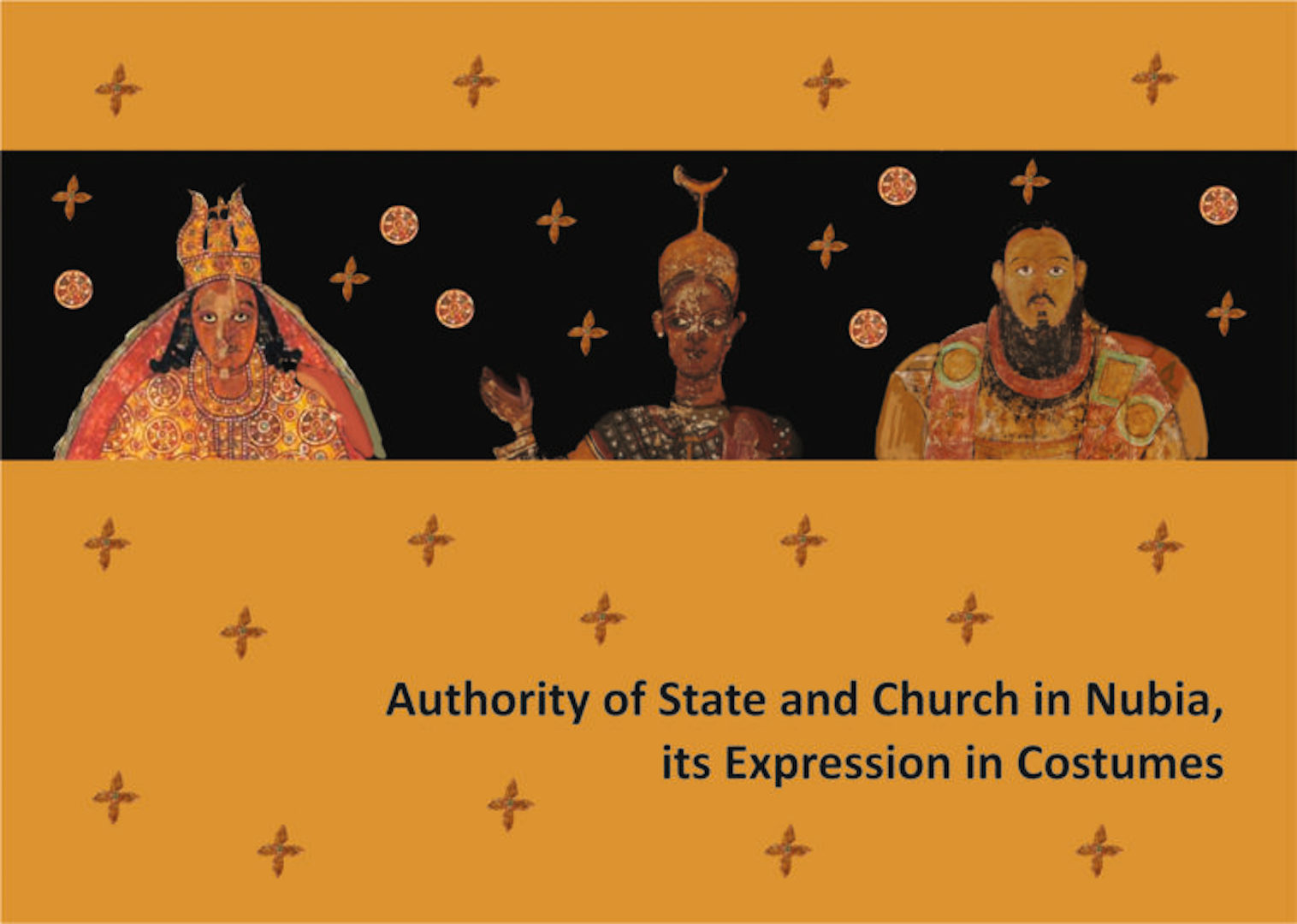
She again came to the TRC in April of this year, together with a group of colleagues, and accompanied by Dr. Karel Innemée, formerly working at Leiden University and now employed as assistant professor by the University of Warsaw. He is also a board member of the TRC. They are all working on the project: ‘Costumes of Authority: Images of Royalty and Clergy in Christian Nubia.’ A detailed report of their visit and the project they are working on can be downloaded here.

Fresco with the reconstructed clothing. Research project, University of Warsaw: ‘Costumes of Authority: Images of Royalty and Clergy in Christian Nubia.’Fresco with the reconstructed clothing. Research project, University of Warsaw: ‘Costumes of Authority: Images of Royalty and Clergy in Christian Nubia.’

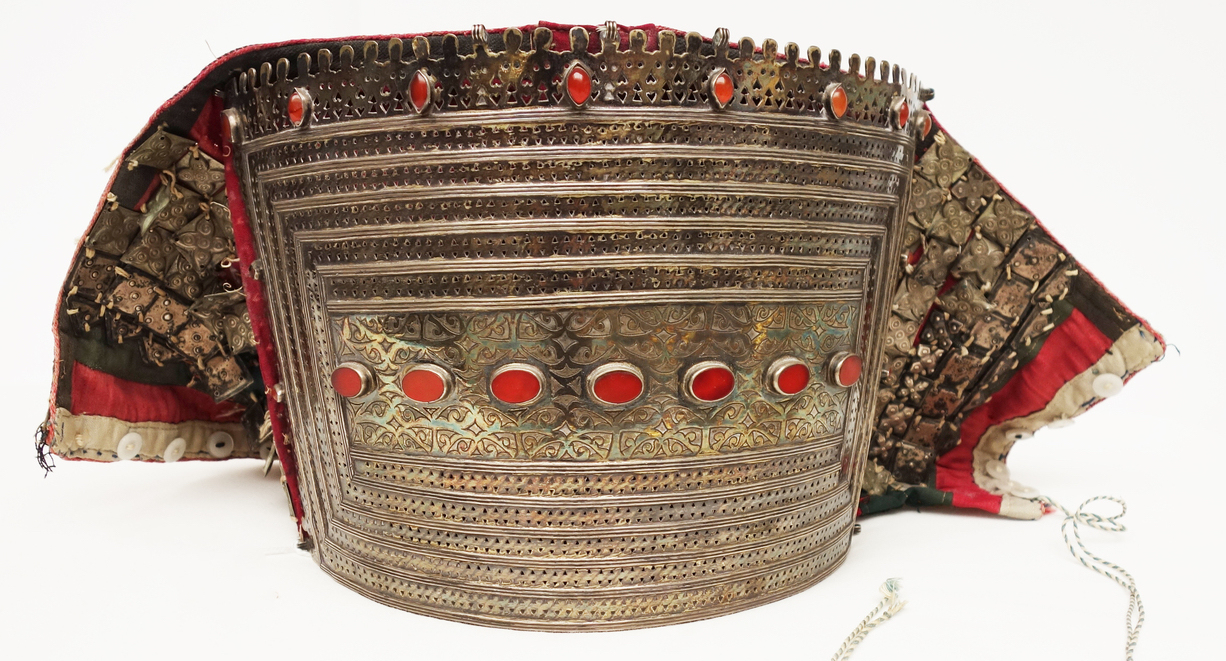
The British magazine Jewellery History Today (autumn 2024) has just published an article by Gillian Vogelsang-Eastwood and Emilie Lambert about a collection of Afghan jewellery donated to the TRC by May and Rolando Schinasi from Nice, France.

Teke Turkmen headpiece for a woman, early 20th century (TRC 2024.0321). Donated by May and Rolando Schinasi.Teke Turkmen headpiece for a woman, early 20th century (TRC 2024.0321). Donated by May and Rolando Schinasi.

Both have a fascinating history. Rolando, an Italian born in Egypt before the Second World War, initially went to Afghanistan in 1957 as an importer and exporter. May, French by birth, studied Persian and its Afghan dialect (Dari) while living with her uncle, Daniel Schlumberger, director of DAFA (Délégation Archéologique Française en Afghanistan). The couple met in Kabul in 1964, married in France in 1965, and lived in Afghanistan until 1977.

The full article, in PDF-format, can be downloaded here.

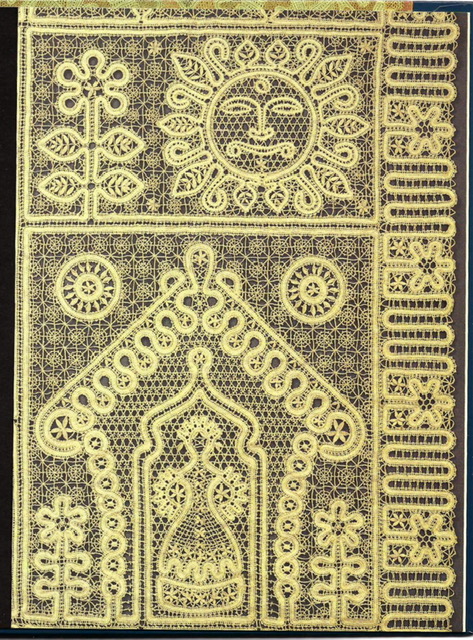
Example of Russian tape laceExample of Russian tape laceRussian tape lace is mainly known from the Vologda region, some 450 km north of Moscow. It is the most famous lace centre in Russia. The decorative aspect of Vologda lace is made from tape, made in cloth stitch with a gimp in it, and fillings in and around the taped motif. The fillings are made with only two pairs of bobbins. This asks for a great understanding of how the fillings are made. 

The instructor is Gon Homburg. She learned to make lace from her mother and from 1983 she has been officially registered as a bobbin lace teacher. She teaches enthusiasts and gives workshops to various artisan schools, including the TRC.

The course is given on three Wednesdays, on 2, 16 and 30 October 2024, from 10.00-13.00. The course of three workshops will be followed by another series of three workshops in which some simple Christmas lace decoration will be made in various techniques, including Russian tape lace.

Venue: TRC Leiden, Hogewoerd 164, 2351 HW Leiden. Teacher: Gon Homburg. Language: Dutch/English. Costs: 40 euros per Wednesday (to be paid per individual workshop on the day itself). Material/coffee/tea are provided. Max. number of participants: 8. Minimum: 5. Please register well in advance: This email address is being protected from spambots. You need JavaScript enabled to view it..


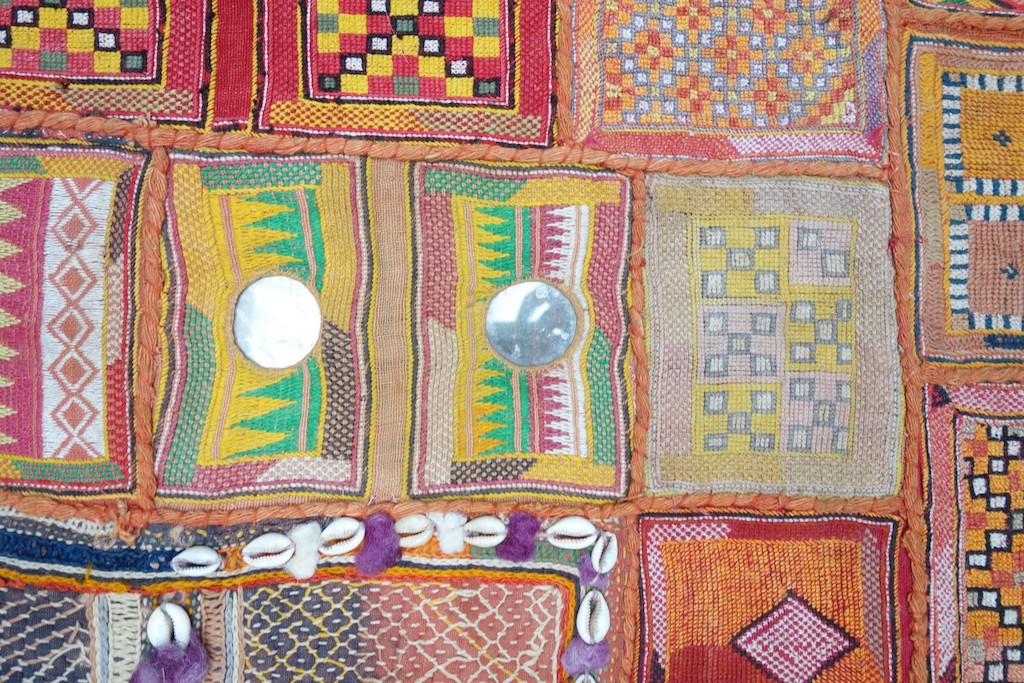
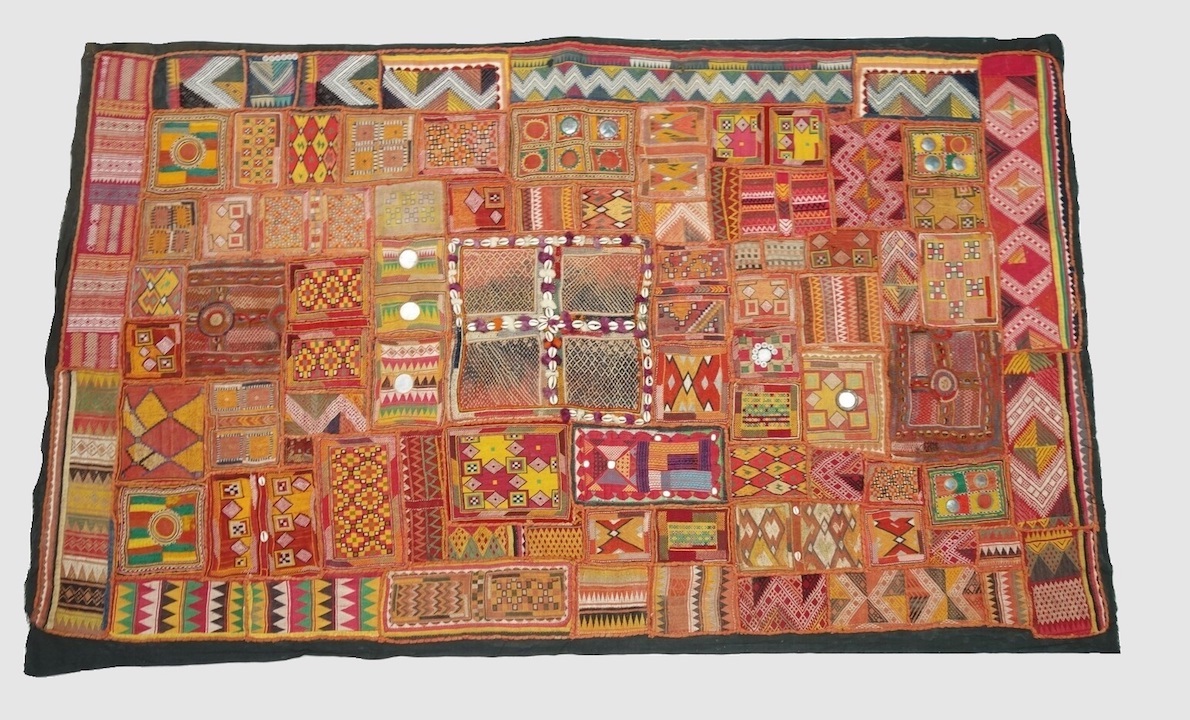
Detail of TRC 2024.2190.Detail of TRC 2024.2190.(5 August 2024) Among the textiles recently given to the TRC by Hélène van Spaendonck, Belgium, there is a large patchwork cloth (TRC 2024.2190) from India that is made up of numerous pieces of Banjara embroidery.

This type of Indian patchwork is often dyed by dealers, and others, in a dull brown, dark grey, black or a red colour, which makes it virtually impossible to see the original colours or patterns. Fortunately this cloth has not been subjected to this undignified treatment.

Patchwork of various squares and rectangles of (mainly) Banjara embroidery with a wide variety of repeating, geometric patterns in various colours. India, 20th century (TRC 2024.2190).Patchwork of various squares and rectangles of (mainly) Banjara embroidery with a wide variety of repeating, geometric patterns in various colours. India, 20th century (TRC 2024.2190).

Moroccan kaftan made from a Japanese obi (sash), 1950s (TRC 2001.0074).Moroccan kaftan made from a Japanese obi (sash), 1950s (TRC 2001.0074).Gillian Vogelsang, Director TRC, 13 July 2025.

The TRC collection of textiles, clothing and accessories from around the world was started in 1997 with 43 pieces from Afghanistan, Egypt and Syria. Since then it has grown to nearly 51,909 items (16 September 2025), most of which are online (click here for the online catalogue).

The items come from very diverse backgrounds with respect to time and place. Some of the items in the collection have been purchased, but the vast majority has been collected during fieldwork or very kindly donated by various institutions and private donors. The TRC  is a good example of Citizen Culture and Heritage at work!

The collection has no boundaries with respect to geography or time. It ranges from Afghan embroidery, German Lederhosen, Indonesian batiks, historical textiles from Leiden, to delicate silks from Renaissance Italy and spinning and weaving equipment from the Andes.

by Martine Benot-Teunissen, costume historian, 14 June 2024

I am proud to announce the publication of a book about recent archaeological textile finds in the Netherlands: Textiel uit Hollandse bodem. Archeologische vondsten uit de 17de en 18de eeuw ('Textiles from Dutch soil. Archaeological finds from the 17th and 18th century'). The book can be ordered here. Last week I was very happy to present a copy of the book to Dr Gillian Vogelsang-Eastwood, Director of the TRC.

The initial plans for this book were developed following the rediscovery of a large number of textiles that were excavated in the 1980s at the Waterlooplein (Vlooienburg), in Amsterdam. Some of these textiles were not yet properly identified and registered, and as a result remained unknown to the general public. It soon became clear that there were more textile treasures housed elsewhere in other depots!

Together with archaeologist Marijn Stolk we embarked upon a project to unlock and investigate archaeological textiles from the seventeenth and eighteenth century which are housed in various depots. This project has now resulted in a beautifully illustrated publication.

by Shelley Anderson, long-time volunteer and supporter of the TRC, with a special interest in textile crafts, including  American quilts. She was born in the USA, and now lives in the Netherlands. 1 May 2024.

Hamilton, Missouri, is a typical small town in the American Midwest. This means a small population (in Hamilton’s case, around1,600 people), and a much smaller pool of local jobs.

At least that was the case until 15 years ago, when a passionate quilter named Jenny Doan opened the Missouri Star Quilt Company on the town’s small main street. Today, the company runs quilting shops in 35 of the town’s buildings. Some of the shops are pop-ups, selling , for example, only Halloween- or Christmas-themed fabrics during these holidays. The business now makes about US$ 20 million a year. An estimated 8,000 people visit Hamilton every month to shop for quilt-related materials, especially fabrics; to take quilting classes; and to tour the large murals of quilts painted on the town’s buildings.

Quilt with an appliqué design of large, stylised flowers and leaves in various materials. USA, 1850s-1860s (TRC 2019.2402).Quilt with an appliqué design of large, stylised flowers and leaves in various materials. USA, 1850s-1860s (TRC 2019.2402).

As many of you will know the TRC Collection is growing, and so are the demands on our resources, and available space, as more and more people discover textiles and want to learn about them! We are actively talking with Leiden Council and others about extra space for the TRC, funding possibilities, etc, all of which takes time.

So we have been looking into external storage space here in the Leiden region where the occasionally needed items, such as display stands and mannequins, boxes filled with books for the next sale, looms and spinning wheels, can be stored, leaving more space at the TRC for working on the Collection, giving classes, working in the library, etc.

Hence our unglamorous request! We will need €2,000 per year for a large storage space close to the TRC and we are looking for help with raising this amount, initially for a one year period, but with the chance it will be for two years.

If you are willing to help, please let us know at This email address is being protected from spambots. You need JavaScript enabled to view it., or make a donation over to the TRC at bank account number (IBAN) NL39 INGB 000 298 2359, in the name of the Stichting Textile Research Centre. BIC code is: INGBNL2A. Please add: For storage.

You can also, very simply, if you have an iDEAL app, use the iDEAL button (press the button to the right) and fill in the amount of support you want to donate and the note it is for storage.

Since the TRC is officially recognised as a non-profit making cultural institution (ANBI), donations by Dutch tax paying citizens/companies are tax deductible for 125% for individuals, and 150% for commercial companies. For more information, click here.


Search in the TRC website

Contact

Boerhaavelaan 6
2334 EN Leiden.
Tel. +31 (0)6 28830428  
office@trcleiden.org 

The TRC is open every day from 10.00 to 15.00

facebook 2015 logo detail 

instagram vernieuwt uiterlijk en logo


Bank account number

NL39 INGB 0002 9823 59, in the name of the Stichting Textile Research Centre.

Donations

The TRC is dependent on project support and individual donations. All of our work is being carried out by volunteers. To support the TRC activities, we therefore welcome your financial assistance: donations can be transferred to bank account number (IBAN) NL39 INGB 000 298 2359, in the name of the Stichting Textile Research Centre. BIC code is: INGBNL2A.

 You can also, very simply, if you have an iDEAL app, use the iDEAL button and fill in the amount of support you want to donate: 


Since the TRC is officially recognised as a non-profit making cultural institution (ANBI), donations are tax deductible for 125% for individuals, and 150% for commercial companies. For more information, click here