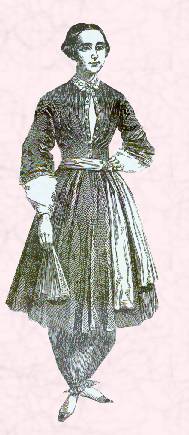
 Amelia Bloomer (1818-1894), American dress reformer and suffragist, in the costume named after her.The weather is becoming cold and grey here in the Netherlands. But there’s a 1920s white summer dress (TRC 2007.0710) in the TRC collection here in Leiden that reminds me of warmer days, and tennis and tea parties in the garden. This dress looks simple and light-weight, but there is a long history of controversy and social change behind it.
Women won the right to vote in the Netherlands in 1919, and in 1920 in the US. Alongside decades of struggle for the vote was a fight for dress reform in women’s clothing. In 1850s America, the suffragist Amelia Bloomer scandalized society by throwing away her whale bone corsets, petticoats, tight long sleeved bodices and long heavy skirts. Instead she wore a more comfortable short dress over loose trousers (sometimes called Turkish trousers). This costume may have been based on the loose dress and leggings of some Native American women. Though Amelia did not invent the costume it was immediately dubbed the ‘Bloomer’, as she wore it publicly and popularized it through her newspaper, including publishing a pattern of how to sew the dress.
Women who wore the costume were called ‘Bloomers’. They were ridiculed and accused of mannishness and subversion. Yet they also found friends among health reformers and those in the medical profession who criticized tight corsets and restrictive clothing as dangerous to women’s health. In the Netherlands, too, there was a Vereeninging voor Verbetering van Vrouwen (-en kinder) Kleding (Union for the Reform of Women’s and Children’s Clothing), which published a monthly magazine from 1899 to 1909.
The magazine continued as “Onze Kleding (‘Our Clothing’) from 1911 to its last issue in December 1920. The Dutch suffragist and journalist Esther Welmoet Wijnaendts Francken-Dyserinck (1876-1957) and her mother were members of the Union, which fought for clothing that women could “walk, sit and work in; that we can put on and off without the help of strangers; that we can carry our handkerchief and keys with us”.
In 1895 the Dutch school girl Mia Boissevain, in an article for her school newspaper, complained that women’s fashion was childish and needed to adapt to modern times. Mia loved botany and exploring nature, but her long dress stopped her from jumping and climbing trees. Also, unlike boys whose trousers included pockets, she had to carry her “ink holder, pens, pencil and knife, wallet, match box, needle box and gloves” in her hands. “There is an urgent need for pockets –and big pockets at that,” she wrote. It’s a complaint that women over a century later can still understand.
Shelley Anderson, 30th November 2020.