Among the items in the TRC Collection there are a range of handbags and purses, as well as a couple of what are called miser’s purses and yesterday we were given seven more. But what exactly is a miser’s purse?
Basically it is made up of a long, flexible tube with two rings. Apart from miser's purse, this accessory has various names including ring purse, string purse, long purse, and finger purse. In the Netherlands it was known as a kousenbeurs ('socks' purse'), and in France as a bourse aumônière. It was fashionable in many Western countries for both men and women from the latter half of the 18th to the early 20th century. They were sometimes hung over a belt, on other occasions stored in pockets or within other bags.
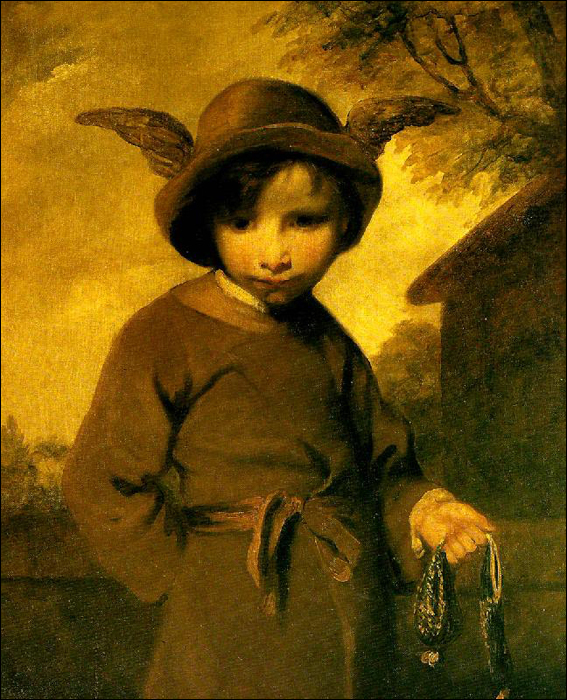 Joshua Reynolds: 'Mercury as cut purse', AD 1774. A boy, representing Mercury, is holding a miser's purse in his left hand. Courtesy Faringdon Collection Trust.
Early evidence for the production and use of this type of purse comes in the form of a painting by the English artist Sir Joshua Reynolds (1723-1792). It depicts a young boy holding such a purse. The painting dates to 1774 and is now in the Faringdon Collection Trust. It is part of a series of paintings depicting different classical gods in the guise of young boys. The young boy represents Mercury! Reynolds painted them wearing contemporary garments and Mercury is actually shown as a cut-purse thief!
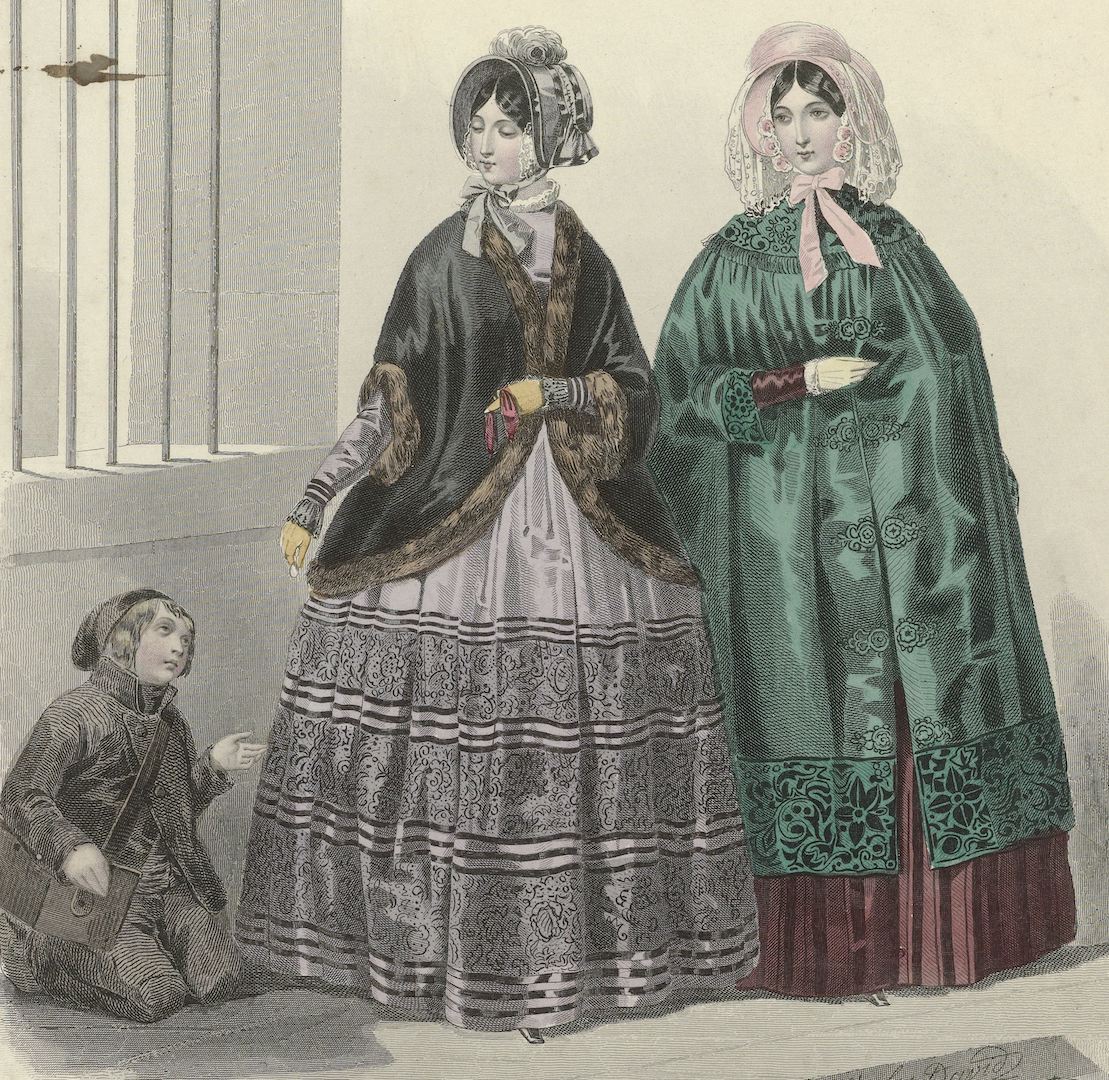 Detail of an illustration in Le Moniteur de la Mode, No. 95, 1845. The woman to the left is holding a 'bourse aumonière' in her left hand, and giving a coin (aumône) to a beggar.
Structure
The miser’s purse is basically a long narrow tube of flexible material that is often wider at the ends (sometimes known as toes) than in the middle. It normally has a long slit opening down the middle section. In addition, there are two rings, sometimes called sliders, which are often made of metal, but bone, ivory and glass forms can also be found. These rings are used to open or shut the two purse ends. When one of the rings is pushed to one end, one or more coins are inserted through the slit into the revealed purse section and then slid back to secure the coins in place.
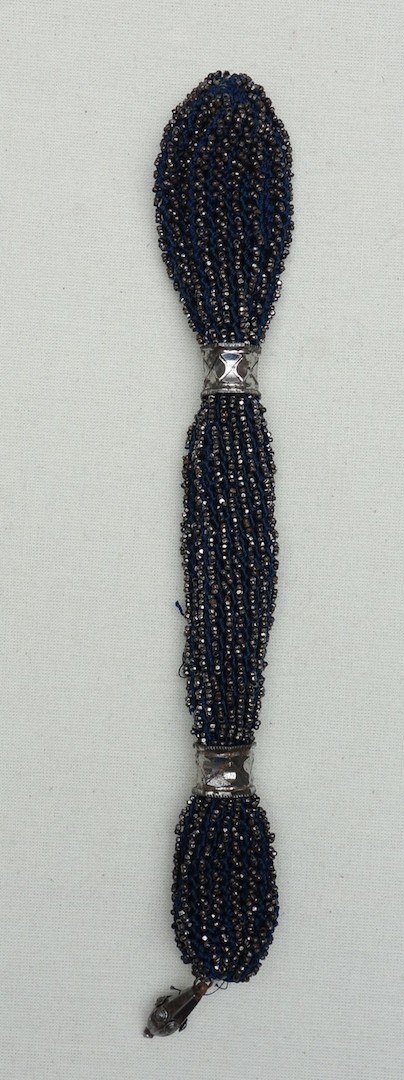 Miser's purse from Europe, hand crocheted and beaded, late 19th century (TRC 2021.2668).
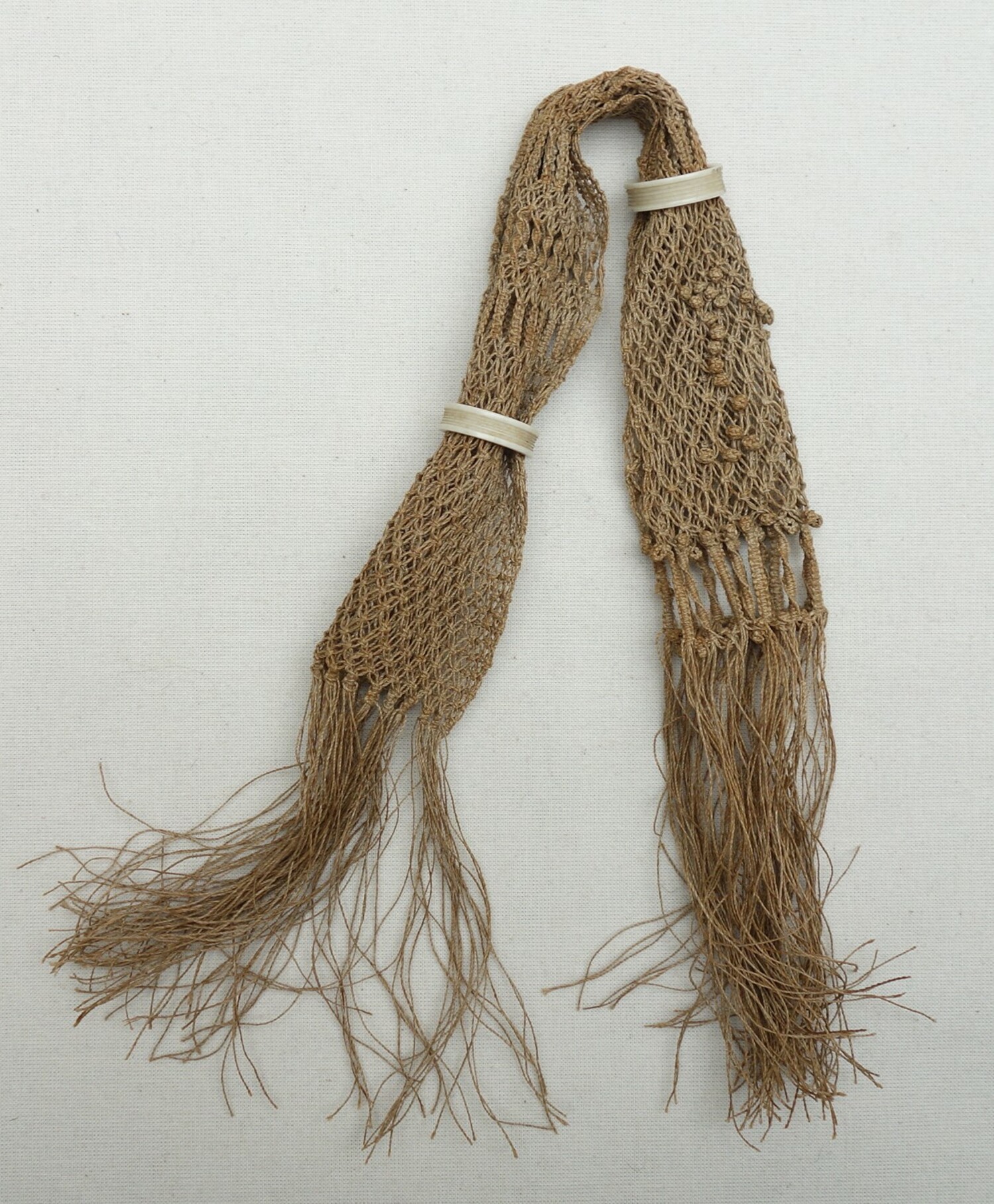 Miser's purse from Europe with two ivory rings, late 19th century (TRC 2021.2665).Over the centuries it would appear that thousands of these purses were made by both professional and domestic makers. It could be made out of silk (especially a hard, twisted thread called a ‘purse’ or ‘netting’ silk), linen, cotton, leather, mesh, hair threads as well as wool or velvet cloth, all in a wide variety of colours. Many examples were made by knitting, crocheting or knotting, or even by shuttle netting or macramé.
The purses were often decorated with beads, some of which were steel cut forms, others made of glass (often seed forms), or gilt versions. It would appear that the use of steel beads, for example, dates from the 1850s onwards.
The purses were decorated with a wide range of patterns, from geometric shapes to floral forms including paisley (buteh) motifs. Sometimes the ends of the purses were decorated with tassels in either glass or metal beads, which are often much larger than those decorating the main purse. In some cases the tassels are identical, on other occasions they are deliberately different. It is sometimes said this was to make it easy to feel the two different purse sections with their various coins.
Another painting
A beaded and tasselled miser’s purse can be seen in a painting by James Collinson (1825-1881) and is called "At the Bazaar". The painting dates to 1857 and is now in the Sheffield Museums (acc. no. VIS.11). The painting depicts a fashionably dressed woman at a bazaar who is holding a red, beaded miser’s purse with beaded tassels in her left hand. It is not clear if she has just purchased the purse or had bought so many items her purse was empty!
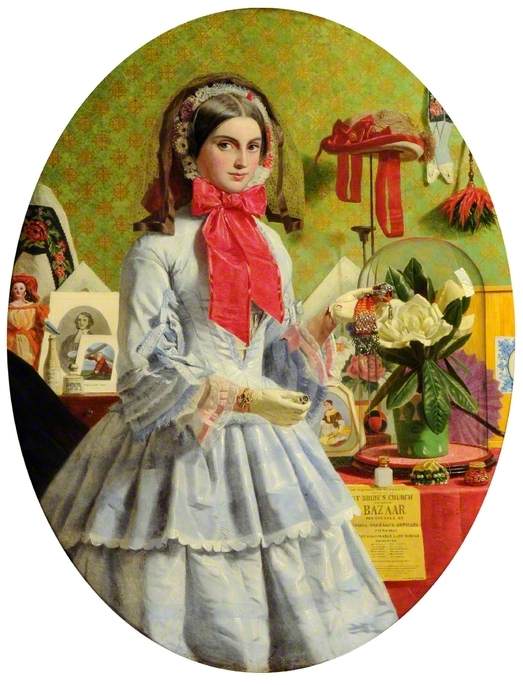 "At the bazaar", by James Collinson (1857). The woman is holding a miser's purse in her left hand. Courtesy Museums Sheffield (acc. no. No. VIS.11
The TRC is planning to mount a small exhibition about miser's purses; if you have any information and/or examples, and if you want to share them with us, please let us know.
Gillian Vogelsang, 14 September 2021