The last few weeks we published various blogs about the garments worn by Taliban men and about the dress that they 'suggest' Afghan women to wear. As for the latter, we noted that the niqab and abaya, now promoted by the Taliban as 'Islamically correct', is Arabic in origin and distincty different from the traditional, all-enveloping burqa that was enforced by the Taliban leaders upon Afghan women in the 1990s.
We indicated that the niqab and abaya set was introduced in Peshawar and other parts in the Pashtun-dominated Afghan-Pakistan borderlands in the 1980s when many Arabs flocked to the area to help the Afghan Mujahedin against the then communist regime in Kabul and their Soviet backers. One of them was Osama bin Laden.
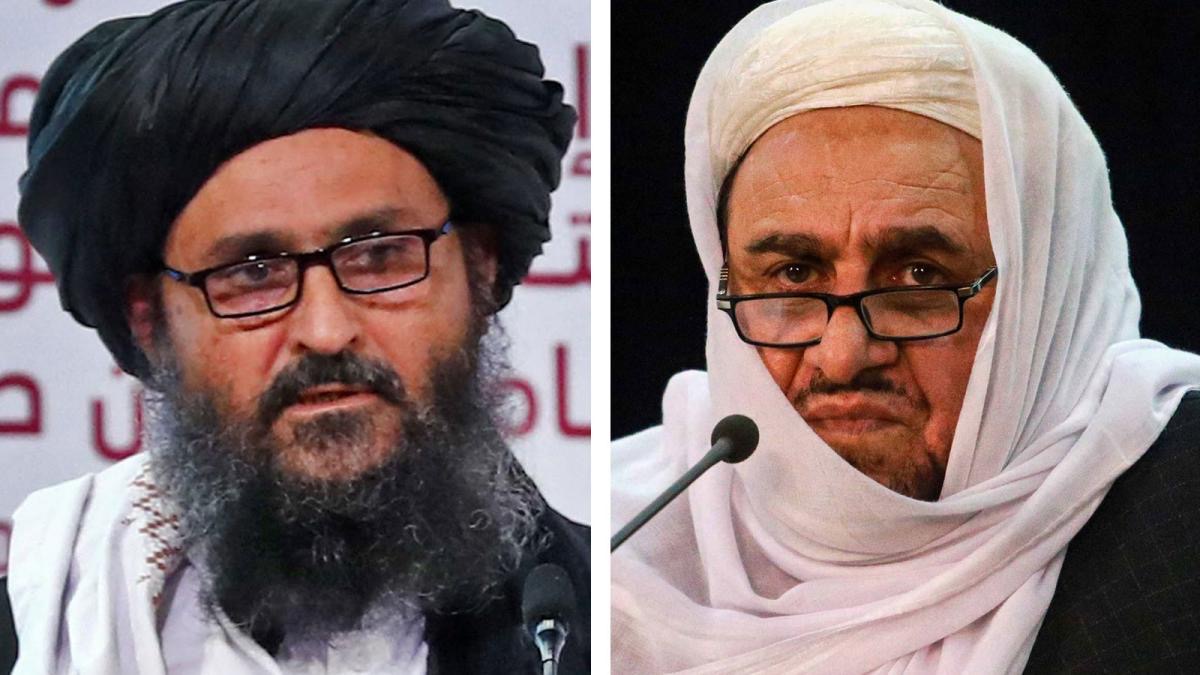 Mullah Abdul Ghani Baradar (left), and Khalil ur-Rahman Haqqani (right). Photograph: The Times.
Two photographs seem to shed some more light on the sartorial struggles in Taliban Afghanistan. The photographs, published together in The Times, show Mullah Abdul Ghani Baradar to the left, and Khalil ur-Rahman Haqqani to the right. Recent reports refer to mounting tension between the two, culminating in a shouting match at the presidential palace in Kabul and the departure of Mullah Baradar to kandahar.
Mullah Baradar was recently appointed as acting Depuy Prime Minister. He is a Durrani Pashtun from near Kandahar, The Durranis constitute historically the most important Pashtun sub-ethnicity; he also belongs to the Popolzai tribe from among the Durranis, the same tribe as ex-President Hamid Karzai. The Popolzai Durranis produced the first king of Afghanistan in the mid-18th century, and another Durrani tribe, the Barakzais, provided the kings and emirs from the early 19th century until 1973. In other words, the Durranis are important, have a proud history, and they know it.
Khalil ur-Rahman Haqqani was appointed as acting Minister for Refugees. He is not a Durrani. He belongs to the tribe of the Zadran. They lived, as many of them still do, in the mountainous and wild lands along the modern border between Afghanistan and Pakistan. They came to the fore in the 1980s when they and many others fought the communist regime in Kabul and their Soviet supporters, and in doing so they were supported by Arab activiists, including Osama bin Laden. The links between the Zadran and the Arabs grew strong. Many Zadranis married Arab women.
One of the most famous Zadran leaders was Jamaluddin Haqqani. He was fluent in Arabic and married a woman from the Emirates. One of their sons is Sirajuddin Haqqani, the present acting Minister for the Interior in Taliban Afghanistan. Another brother was Nasiruddin Haqqani, who died in 2013 and who played an important role as mediator between the Taliban and the al-Qaeda network. The man apparently brawling with Mullah Baradar, Khalil ur-Rahman Haqqani, is a brother of Jamaluddin (who died some years ago), and therefore an uncle of Sirajuddin.
So what do the two photographs tell us? Both men seem to have the same optician. But far more important: Mullah Baradar is wearing a traditional Afghan turban. But what is Khalil ur-Rahman wearing? It is certainly not what a gentleman Pashtun would wear. It is not what the proud Durrani Popolzai, Mullah Baradar, is wearing. Khalil ur-Rahman has donned a shawl wound loosely around his head and shoulders. It is very reminiscent of the so-called Taylasan, mentioned and depicted among others by Richard Burton in his Personal Narrative of a Pilgrimage to al-Madinah & Mecca (1855-56). It was worn by elderly preachers in Arabia.
Of course we cannot be certain whether Khalil ur-Rahman consciously adopted an Arab-style headdress, and he certainly is also sometimes photographed wearing a Pashtun turban. But would he haphazardly don some 'foreign' headdress without realising its relevance? His Arab family will certainly recognise its antecedents, more Arabic than Pashtun. And can we explain the preference by at least some of the Taliban leaders for the Arabic abaya and niqab in the same light? And what is the position in this sartorial struggle of the acting prime minister, Mullah Hassan Akhund, another Popolzai Pashtun just like Mullah Baradar (and Hamid Karzai)? Of course the recent tension between Baradar and Haqqani was not about their headdress, but it could reflect a much deeper antagonism, between an elite Durrani and a man from the hills with Arab connections.
In short, far from envisaging a monolithic Taliban organisation now controlling Afghanistan, we can detect some emerging fissures, which may grow wider in the time to come.
Willem Vogelsang, 17 September 2021
See also:
- About abayas, niqabs and the Afghan Taliban going global (7 September)
- Another sartorial make-over for Hamid Karzai? (4 September)
- Not all Afghan waistcoats are Taliban dull (4 September)