In 2020 the TRC received six samplers from Mrs. Trees Verberne-Van Hamersveld, The Hague (for more information, click here). One of them was an interesting darning sampler, TRC 2020.3687, dated to 1765, making it more than 250 years old. The large ‘nine patch’ in the centre and the many cross stitch motifs between the darning blocks make it rather unusual for a Dutch darning sampler. So what is it, and who made it?
 Sampler dated 1765, Leiden?, worked in a Roman Catholic context (TRC 2020.3687).
There is, however, a sampler that looks like the TRC one. I found it in Joke Visser's publication Oefenstof (2013, p. 103). This particular sampler is dated to 1768, and is therefore only three years younger than the TRC sampler. According to Joke Visser it was made in Brabant, in the south of the Netherlands, but it is not clear how she came to that suggestion. It has the same large 'nine patch' in the centre, the same number of darning blocks, the same sort of cross stitch motifs, and some similar sets of initials.
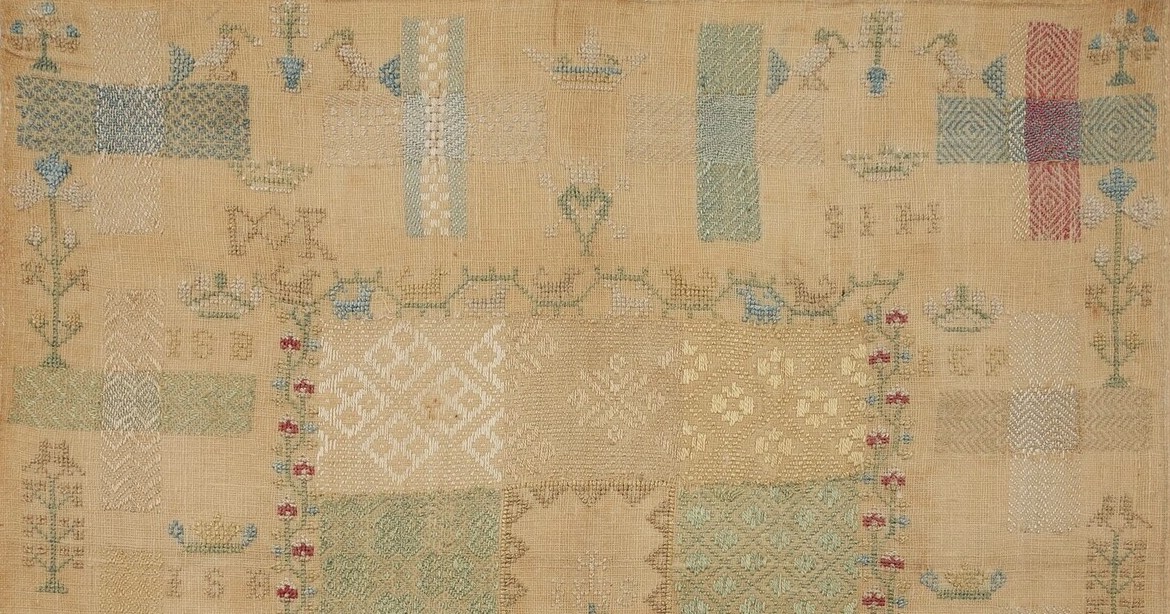 Top part of sampler TRC 2020.3687
More significantly, both samplers have a Maria-monogram in the top left corner, and the initials SIH in the top right. The 1768 sampler has an IHS in between, at the place where the TRC 1765 sampler has a pierced heart. The Maria-monogram indicates a Roman Catholic context, and so does the pierced heart of two samplers. IHS is of course the Christogram. I don't know what the SIH stands for.
There are more similarities. The series of initials MIH and CVS in Oefenstof take the place of SMIH and SCVS in the TRC sampler. Both samplers also have the initials KSB below the cdntral panel. What would these series of initials mean? Unless the two samplers belong to members of the same family, which is unlikely, the initials probably have a more general meaning. Can anyone help? The initials may refer to a Christian, and especially a Roman Catholic concept or organisation. The 'S' may stand for 'Soeur(s)", and refer to a Catholic convent or order, perhaps particulalry focused on the education of young girls. This would link up with the Mariagram and pierced heart of both samplers.
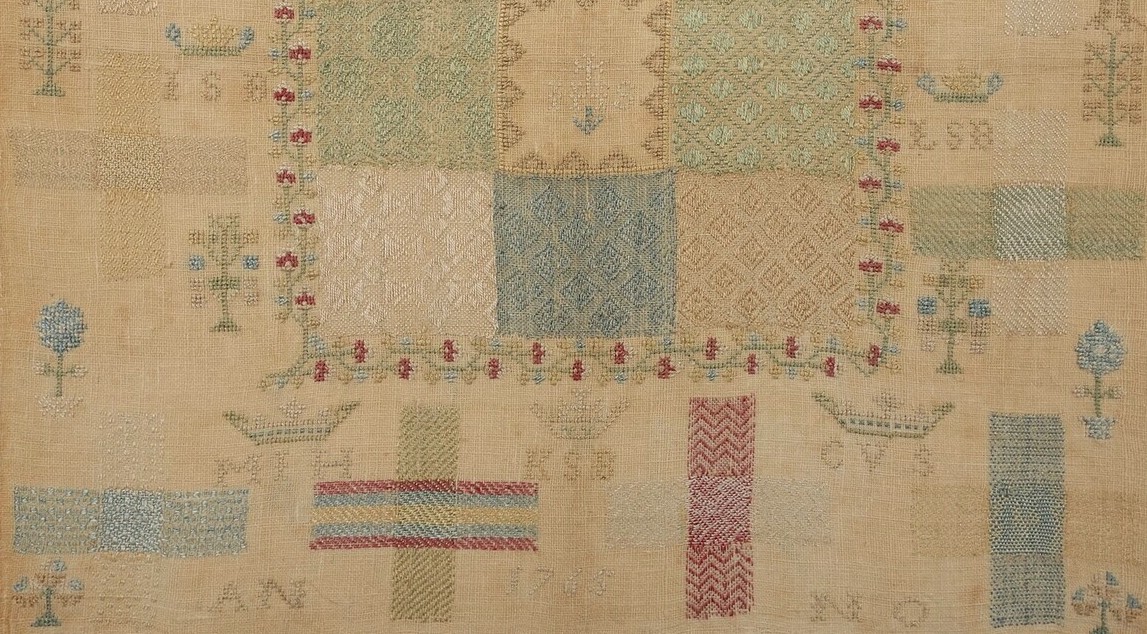 Lower part of sampler TRC 2020.3687
The other initials in the TRC sampler are, to the left of the central square, ISB and IEP; and to the right, IEP and LSB. Please beware that the 'I' can stand for the 'i' and the 'J'.
ISB IEP
ISB LSB
The series of initials would traditionally stand for the girl or young woman embroidering the sampler, her parents, grandparents, and perhaps other siblings. Father and the embroiderer, and siblings, are likely to have shared the same surname. In the case of the TRC sampler the initials SB would stand for the surname. P or EP would indicate the mother's maiden name. The ISB and IEP at the top would in that case be the father and mother. The ISB and LSB at the bottom two siblings, one of them the embroiderer.
The best candidate I could find so far is Lucia Maria Snarenberg born in 1753 in Leiden to Jacobus Snarenberg and Jacomina (Jacobina) Elisabeth Poock, who were married on 23 April 1747 in the Roman Catholic Mon Père kerk ('De Zon'), along the Haarlemmerstraat in Leiden. The name Snarenberg is written in different ways: Snarrenberg, Snaarenberg, Snarenburgh, Snakenburg, etc. They appear to have been staunch Roman Catholics, and the name occurs frequently among kists of Catholic priests.
But who would be the second ISB or JSB? The only siblings of Lucia Snarenberg I could find whose name started with an I or J were Johanna Cornelia Snarenberg and Jacoba Catharina Snarenberg. The first was born c. 1759. She was about six years old in 1765. The latter was baptised on 27 November 1765, in the same year, if all these identifications are correct, that Lucia completed her sampler in late 1765 and may have embroidered the initials of her baby sister into the sampler she was about to complete.
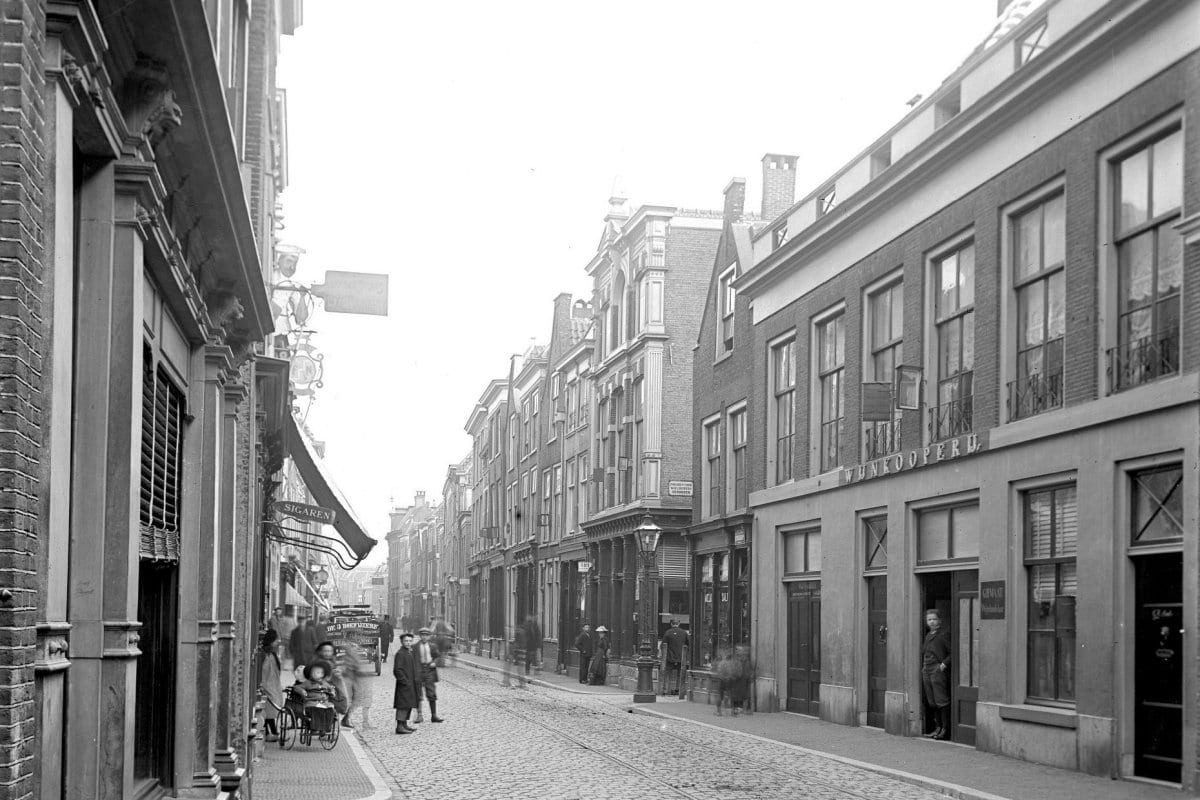 The Hogewoerd in Leiden around 1900. This is also the street where the TRC is established. Lucia Maria Snarenberg lived here when she married on 2 September 1780 to Johannes Giebe, in the Roman Catholic Le Père ('De Zon') church along the Haarlemmerstraat. Photograph Stichting Diogenes, Leiden.
So, if I am correct, what else can be found out about Lucia Snarenberg? She was born in Leiden and baptised on 2 March 1753 in the Roman Catholic church 'Mon Père' along the Haarlemmerstraat, in the centre of the city. Her family was probably relatively well-off. Her grandfather is mentioned in the taxation register of Leiden for 1742. She was twelve years old in 1765 when the sampler was completed. On 2 September 1780 she married Johannes Giebe. By that time, according to the records, she lived along the Hogewoerd. Her parents lived along the Heregracht. Lucia and her husband, as far as I could ascertain, had at least five children, one of whom died in infancy. They were all baptised in Leiden, in the catholic Le Père ('De Zon') church in the Haarlemmerstraat. Her father Jacobus Snarenberg died in 1801/1802.
A recurring feature in the story of Lucia Snarenberg and her family is the Roman Catholic church where Lucia was married and her children were baptised. By the mid-17th century, Roman Catholics were allowed to have their own churches in Holland, but these should not be too obvious. The Le Père church was established by Abraham Bertius in the attic of a house along the Haarlemmerstraat that was known as ‘De Zon’, hence the other name of the church.
In the years that followed, the church was regularly expanded. The parish, dedicated to Our Lady of Assumption, was run from the Parisian monastery of the Discalced Carmelites, who sent their priests to Leiden (the Discalced Carmelites were a missionary order, and Protstant Holland was regarded as a country that needed missionary work). Most of the French priests did not speak Dutch, which at first was not a real problem because most of the parishioners were immigrants from near Liege/Luik in Belgium. The church became known as the Le Père church, or, for the Leiden people, as the Franse Pier. in both cases after the way in which the priests were addressed, In 1838/1839 a new church was built, which in the 1930s was turned into a swimming pool. The building was pulled down in 1979.
If the identitication of the embroiderer of this TRC sampler is correct, it provides a rare glimpse of Roman Catholic life in Protestant Leiden in the 18th century.
Nelleke Ganzevoort and Willem Vogelsang, 19 januari 2022