The TRC depot in Leiden houses many treasures. The treasures I am most in awe of are the archaeological textiles. Sometimes they do not look like much, being scraps rather than a complete garment, but they can have an incredible history and often point to milestones in human technology. And stories of lost cities and cultures.
 Silk cloth fragment from Xinjiang, probably Niya, dug up by Aurel Stein. The sample may date to the 2nd century AD (TRC 2000.0009).
I am thinking especially of a cluster of small silk fragments excavated in the early 20th century by the famous archaeologist and geographer Sir Marc Aurel Stein (1862-1943), and around 1945 given by Sir Mortimer Wheeler, the then director of the Indian Archaeological Service, to Robert Charleston, who was an officer in the British army in India, but in later life the curator of glass in the Victoria & Albert Museum in London. Charleston gave them to Gillian Vogelsang, now director of the TRC, in 1985.
The fragments (TRC 2000.0009, 2000.0010, 2000.0011 and 2000.0012) are all warp-faced compound weaves, with designs that include zig-zags, paired dots and what may be dragons; TRC 2000.0009 also includes some traces of woven Chinese characters. The fragments are all dated to the second century CE, and are believed to have been excavated from the lost city of Loulan.
Loulan was an oasis settlement along the southern desert route of the Silk Road. It was part of the Kroraina Kingdom, which flourished from circa 200 CE to 400 CE. In 1897, when Stein asked the British Government of India for funding for his first expedition, the area was called Chinese Turkestan. Today it’s known as Xinjiang ("New Frontier'), the westernmost part of China.
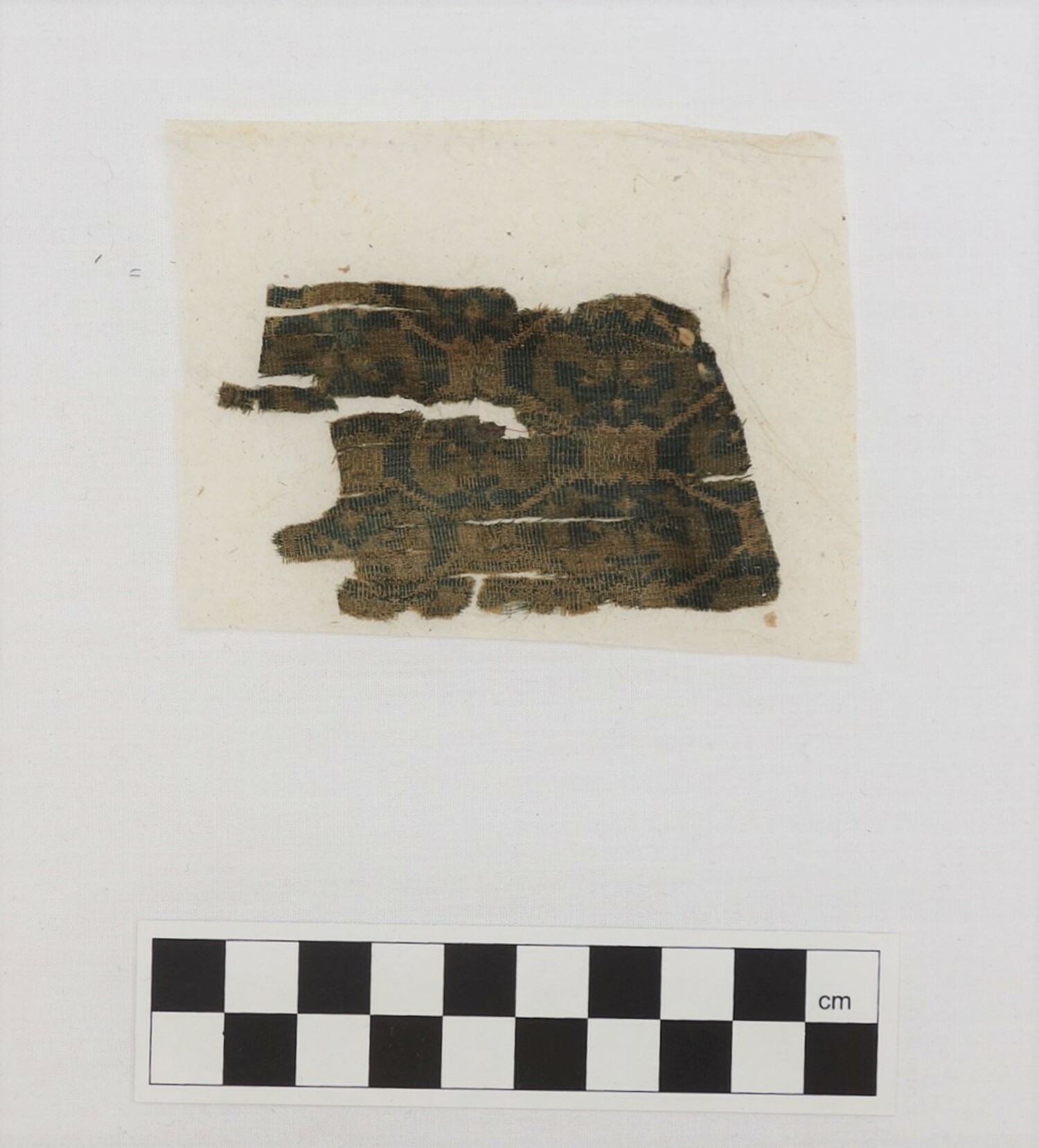 Silk cloth fragment from Xinjiang, probably Niya, dug up by Aurel Stein. The sample may date to the 2nd century AD (TRC 2000.0012).Stein, who had completed a doctorate in Sanskrit in 1883, wanted to discover ancient manuscripts to further his language research. In nearby Niya, in 1901, he did in fact discover almost two hundred wooden tablets (and some documents on leather) in the Kharoshthi script, which was used to write Sanskrit and other languages in the third and fourth centuries CE. He also unearthed textiles, some of them connected to the ruins of a Buddhist stupa. Stein would return to Niya on each of his four expeditions, the last in 1931.
And lost cultures? On another expedition, near today’s Dunhuang, Stein found five letters in an abandoned mail pouch in a ruined watchtower. He couldn’t read the language. Today we know it is Sogdian. The Sogdians built a powerful empire located in what is now Tajikistan and Uzbekistan. Their power was based, not on military might, but on trade. Known for their love of dancing, feasting and music, Sogdian merchants dominated trade along the east-west routes of the Silk Road from around 400 CE to 800 CE.
 Kaftan in Sogdian style, found in Central Asia, dated to 8th-9th centuries CE. From the Musée Guimet exhibition.A recent exhibition in the Musée National des Arts Asiatiques-Guimet (Paris) on the archaeology of Tajikistan features some silk textiles, including cloth covers for Buddhist texts, gold metal threads and embroidery (dated to the 4th to 3rd centuries BCE), and a magnificent caftan. The Central Asian cut of the caftan, dated to the 8th and 9th centuries CE, is made from two different fabrics. One features a motif of birds, the other deer and rams. Both are from Chinese silk.
I have absolutely no proof, but in my imagination, I see the lovely blue TRC fragments from Loulan being worn by a Sogdian woman, perhaps a merchant in her own right. She’s enjoying a good meal with dancing and music, oblivious as to how her dress will end up almost 1,500 years later, nestled among acid-free tissues in the TRC depot in Leiden.
For more on the archaeological finds of Loulan and the Sogdians, see The Silk Road: A New History by Valerie Hansen (Oxford University Press, 2012).
Shelley Anderson, 19 January 2022