For the last year the TRC Leiden has been cooperating with the indomitable Yasmine El Dorghamy, who is the editor of RAWI: Egypt’s Heritage Review series, based in Cairo, Egypt. More specifically, we have been working together on vol. 11 of the series, with the title: Egypt’s Costume History (2021). The project was supported by the Drosos Foundation and a grant from the Dutch Embassy in Cairo.
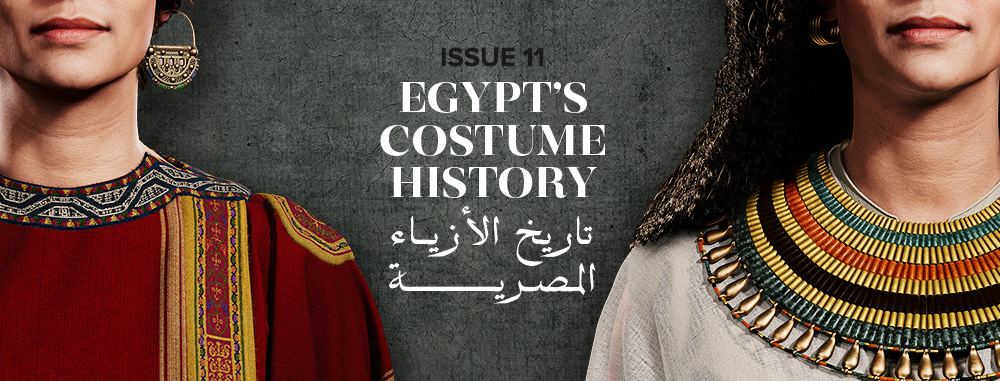
Many people have helped with this edition of RAWI, which takes the form of an edited volume of articles, photographs of garments, textiles and relevant items, as well as some amazing computer generated images. Those participating include Yasmine El Dorghamy, who also edited the volume, Shireen Ellinger, Azzy Fahmy, Engy Hanna, Sumru Krody, Maria Massakowska-Gaubert, Shahira Mehrez, Lucie Ryzova, Mohamed Abdel Salam, Marian Sardi, Jochen Sokoly, André Veldmeijer, and myself. Illustrations were prepared by Muhammad Mustafa and Haitham Zaki.
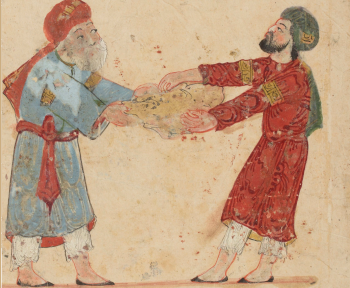 Cover page for the article 'Turbans and textiles. Mamluk Egyptian clothing', by Gillian Vogelsang-Eastwood. RAWI 11, 2021, pp. 54-59.This issue of RAWI came out a month ago and is beautifully illustrated with texts in both Arabic and English. There are articles about ancient Egyptian textiles, clothing and footwear; dress in Roman and Ptolemaic Egypt, as well as Coptic, Fatimid, Mamluk, Ottoman and modern dress forms. There is also the article by Shahira Mehrez about her outstanding collection of Egyptian regional dress. Copies of the magazine can be ordered via https://diwanegypt.com/?s=Rawi.
In addition to this publication, there was going to be a two-day seminar to be held at the American University in Cairo, which would explore the fascinating and diverse story of Egyptian dress in greater depth. I was asked to give one, possibly two lectures at the seminar on a subject that has long fascinated me, especially as a result of working as a textile archaeologist at ‘Amarna (Pharaonic Egyptian) and Quseir al Qadim (Roman and Mamluk period textiles and dress).
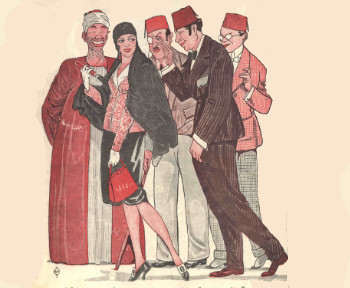 Cover page for the article 'Hemlines and aspirations. Western influence on Egyptian dress', by Lucie Ryzova. RAWI 11, 2021, pp. 88-95.
I was supposed to be in Cairo from the 2nd – 9th January and was looking forward to a little warmth and a glimpse of the sun, as well as taking the chance to see friends and to go down to the Khan al Khalili and to see what was happening in the historic Street of the Tentmakers.
Alas, thanks to Corona and a change in the Dutch governmental rules and recommendations concerning the crisis, it was not possible to go to Cairo. Another of the speakers could not go either, so some of the events had to be held via Zoom, on 10 January. There was an audience of 35 in a large room, with everyone wearing masks, a modern example of a global change in dress codes.
Participants included archaeologists, anthropologists, and just as interesting, film costumiers and fashion designers. The lectures were given by myself (ancient Egyptian dress), Anne Kwaspen, about Coptic period dress, by Dr. Mohamed Abdel Salam from the Islamic Museum on Mamluk dress.
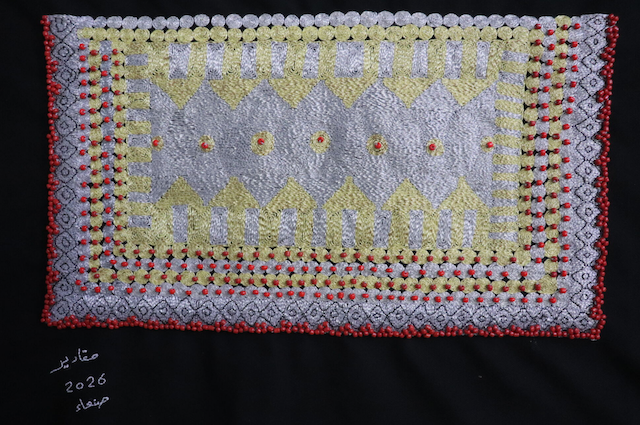 Cover page for the article 'Keeping up with the Alexandrians. Multiculturalism and clothing fashion in Ptolemaic and Roman Egypt, by Maria Mossakowska-Gaubert. RAWI 11, 2021, pp. 28-35.More specifically, my talk was about ancient Egyptian clothing, what it was made from, about the basic types and, in general, about dress and identity, in the past and in the present. A wide range of subjects were discussed in the one hour talk and subsequent questions session, about dress and senses, movement and social status of dress in ancient Egypt! One interesting question concerned what we can learn today from the ancient Egyptians about sustainable dress – i.e. move away from wasteful, highly tailored garments to more loosely fitting clothing based on squares and rectangles! This is an historic method of making garments that can be traced back for thousands of years in many parts of the world.
To make it a little different, Yasmine divided the audience into five groups and each group was given a different set of film clips to watch and give a critique of the garments portrayed. Some of the films were Egyptian, another Polish, and one from Hollywood (The Ten Commandments, 1956). It was a fascinating exercise in realism versus inspiration. And yes, the Ten Commandments ‘won’ the prize for the least realistic costumes, very 1950s Hollywood!
Gillian Vogelsang-Eastwood, Director TRC, 12 January 2022