We are sometimes asked how a particular object found its way to the TRC Collection in Leiden? Who are the donors? How do people hear about the TRC? Sometimes it is very simple and there is direct contact, or a parcel arrives in the post. On other occasions it can be a little more convoluted and involves the help of various people in different parts of the world.
Let me give you an example. A few weeks ago, 28 December, we published a blog by Shelley Anderson about the French designer, Elsa Schiaparelli (1890-1973) and her fashion house.
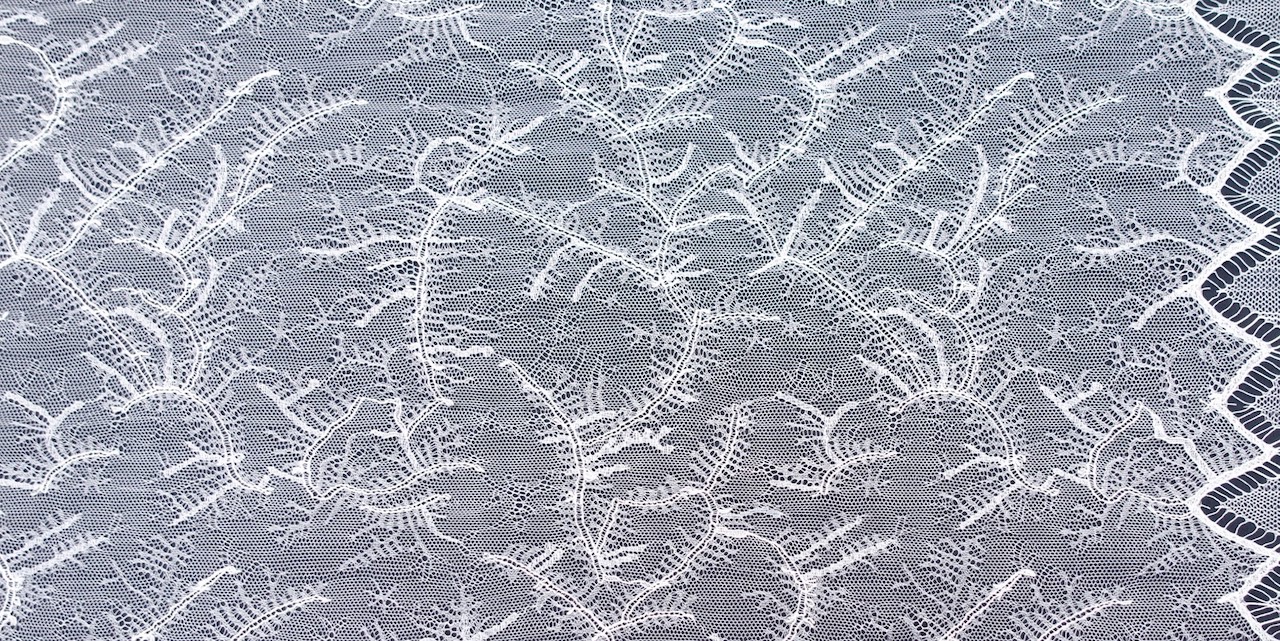 Sample of the 'Tears & Lace' design, Darquer & Méry, Calais, France (TRC 2022.0003a).
That blog led to another TRC blog, this time by Gon Homburg and published on 31 December, about a type of machine lace (Chantilly lace) called ‘Tears & Lace’, which was produced by the Calais company of Darquer & Méry for the fashion house of Schiaparelli. This lace was on display in an exhibition called The Art of Lace (2020j in Tilburg, here in the Netherlands. The author of the blog described the inspiration behind the particular design, which happened to be a microscope photograph of a human tear, which was made into a digital sketch by the lace designer, Vincent Fasquel.
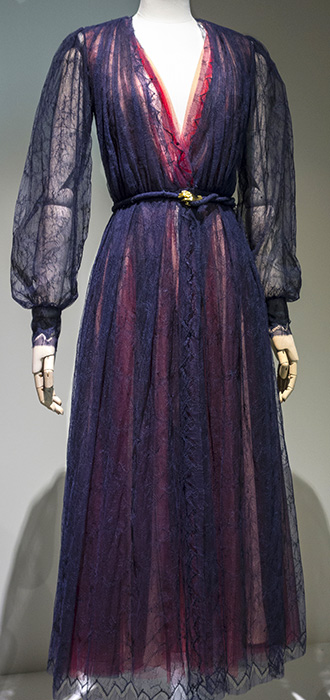 Tears & lace dress, Elsa Schiaparelli. Haute Dentelle exhibition, Calais, 2018.A reader of the blog, Sylvia Marot from France, quickly got in contact with the TRC to say she was the curator of a previous exhibition in France where the 'Tears & Lace' had been on display, and she kindly put us in direct contact with the photographer Rose-Lynn Fisher, who lives in the US and who took the macro-photographs of her own tears. We asked about the possibility of a sample of 'Tears & Lace' for the TRC reference collection of machine lace. And she kindly contacted Erich Soldat, the representative of the Darquer & Méry firm in the USA, who in his turn contacted Francois Heumel, a senior manager in Calais.
And yesterday morning two samples of ‘Tears & Lace’ arrived in the post! This is an amazing example of what can happen when people who understand textiles work with each other, understand each other enthusiasm, and all within two weeks! We catalogued and photographed the two samples straight away (TRC 2022.0003a and TRC 2022.0003b).
But why was the TRC interested in having a sample of this particular lace in the first place? There are various reasons. As noted above we are building up various reference collections, including one on machine made lace, which will be used to identify different forms, such as Leavers and bobbinet forms, which are housed in the TRC Collection or which may find their way to the TRC in the future. The machine lace collection will also be used in exhibitions, publications and various courses and workshops to demonstrate the technological history of lace and answer questions concerning how to preserve and present its history for future generations.
On a more personal level, we are also very interested in the people behind the textiles, the all-too-often forgotten and hidden faces of the artisans, the people who designed, adapted and made the textiles . After all, one of my great-uncles was a designer of Nottingham lace, but all that the family knows about his work is encapsulated in a single, ebony ruler. I would have loved to know more about what he did.
Gillian Vogelsang-Eastwood, Director TRC, 13 January 2022