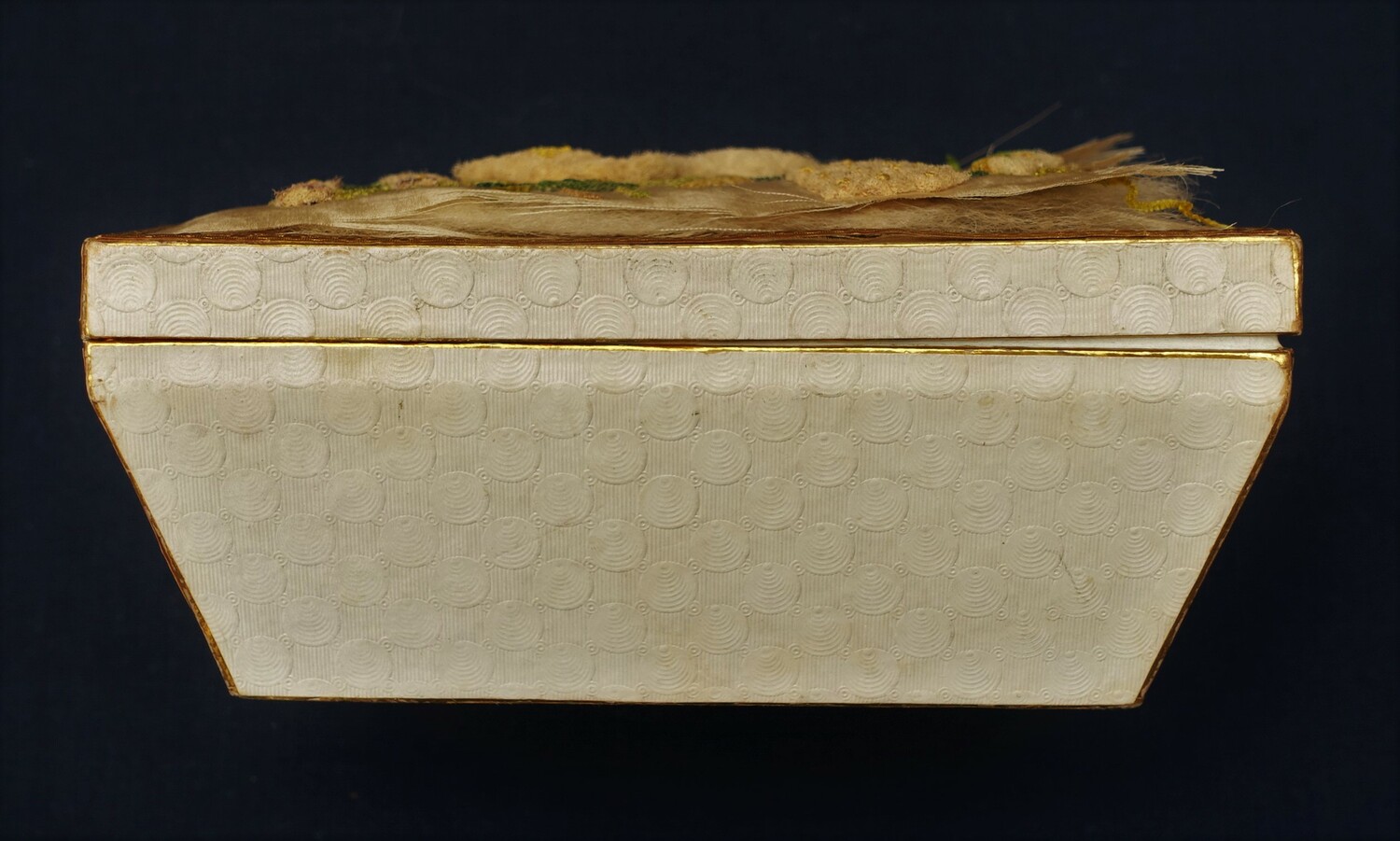
 Cardboard box that contained the early 19th century bridal treasure (TRC 2014.1060e).The TRC Collection houses many fascinating and historic objects with a real human interest, and some of these items become even more intriguing when they are linked to specific people.
Recently we had another look at a small cardboard box (TRC 2014.1060e), 16 x 11 x 7.5 cm in size, and made in the shape of a Classical sarcophagus (typical for the late 18th - early 19th century).
Its lid is covered with ivory-coloured satin cloth that is decorated with fine, chiffon flowers and seeds, and with embroidered leaves and stems in chenille thread and floss silk. The box and its contents were briefly described in a TRC blog of 11 November 2014, ‘Little treasure box’.
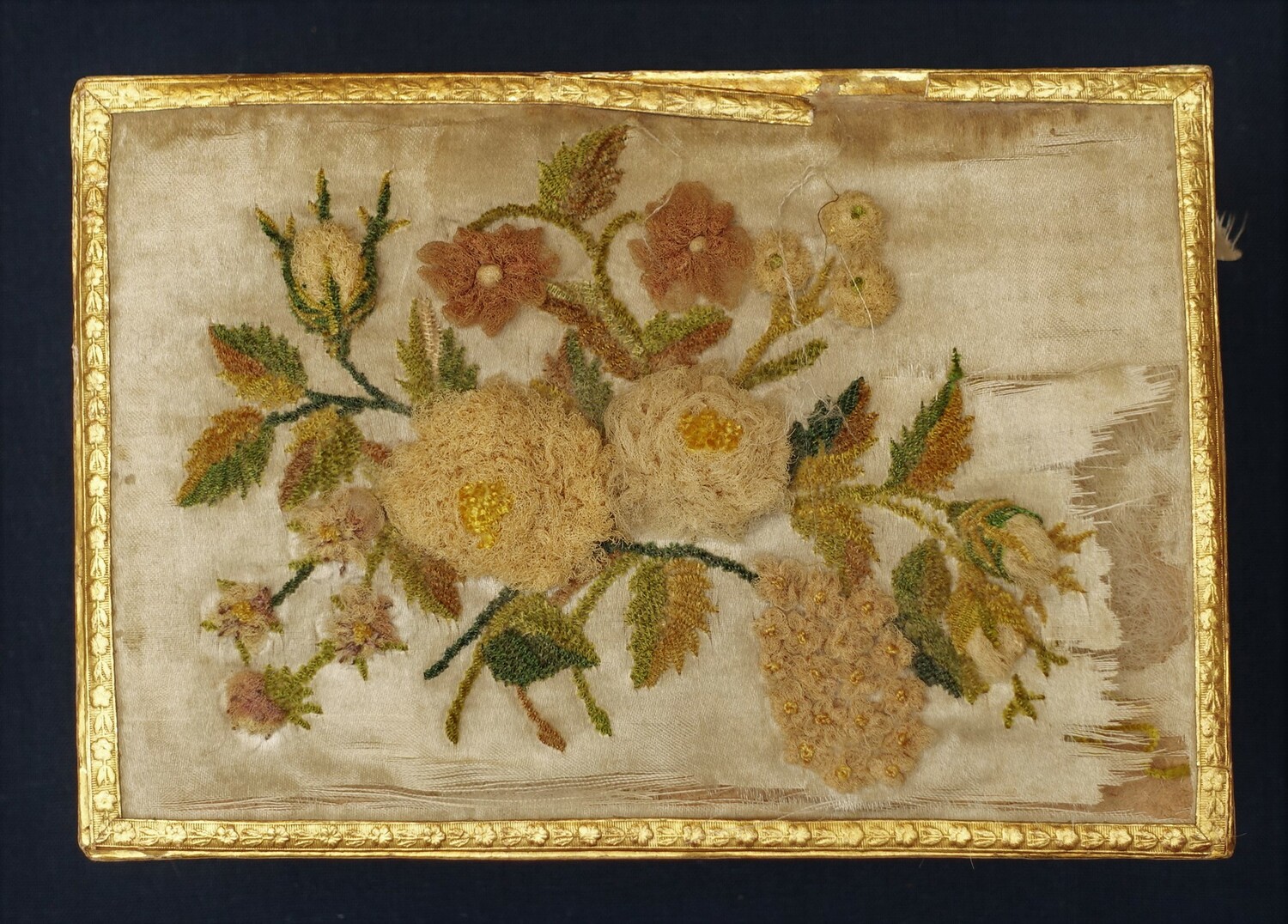 Lid of cardboard box that contained the bridal treasure, photographed from above (TRC 2014.1060e).
Inside the box, when donated to the TRC, were four oval shaped, Ivory-coloured satin pads, 13 x 9 cm in size, which were decorated in the same way as the box's lid. One of the pads (TRC 2014.1060c) has an embroidered text with the Dutch word Bruid (‘bride’), and another (TRC 2014.1060d) with the word Bruidegom (‘bridegroom’). The box also contained a small, woman’s white handkerchief with a lace edging (TRC 2014.1060g), a small handwritten label, and finally a handwritten postcard (TRC 2014.1060f).
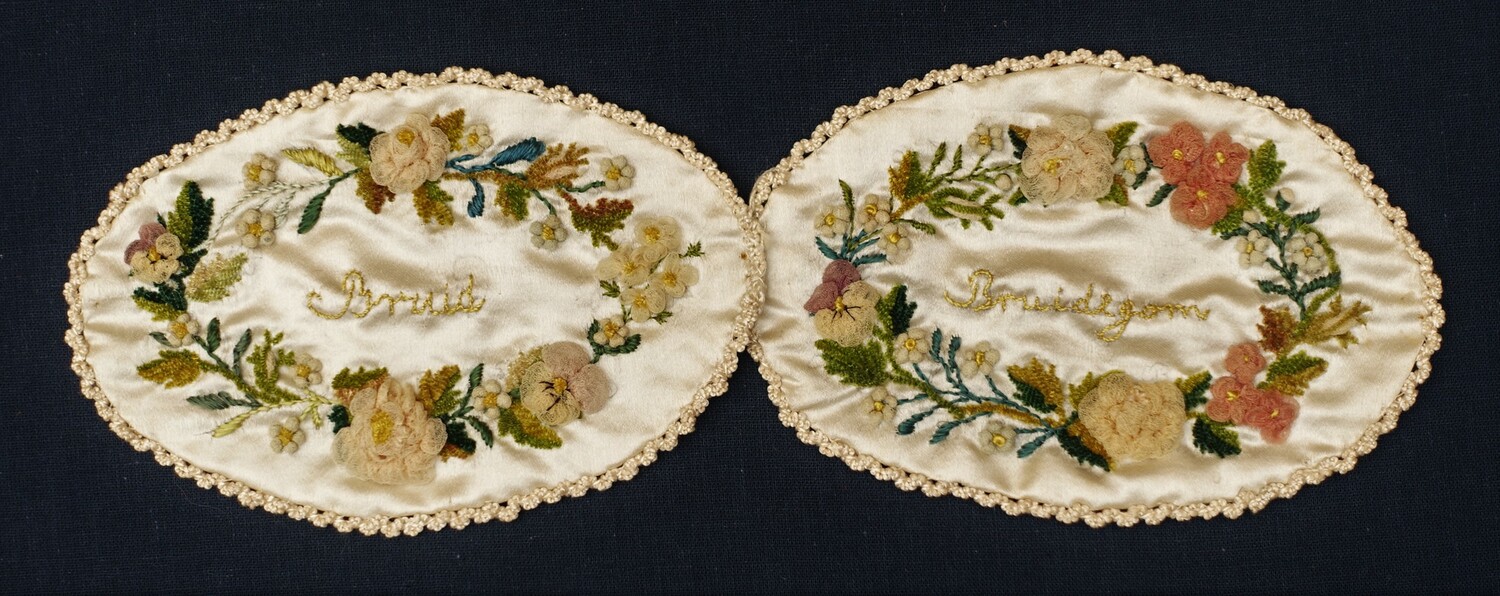 Two of the four early 19th century pads placed within a cardboard box, with the words 'bruid' and 'bruidegom' (bride and groom) (TRC 2014.1060c
The small label has on one side the Dutch text: “2 bijpassende kleedjes met bloemmotief (bruid)” (‘two matching cloths with floral motif [bride]). The other side: “mevr. S. van Deinse, Middelburg”.
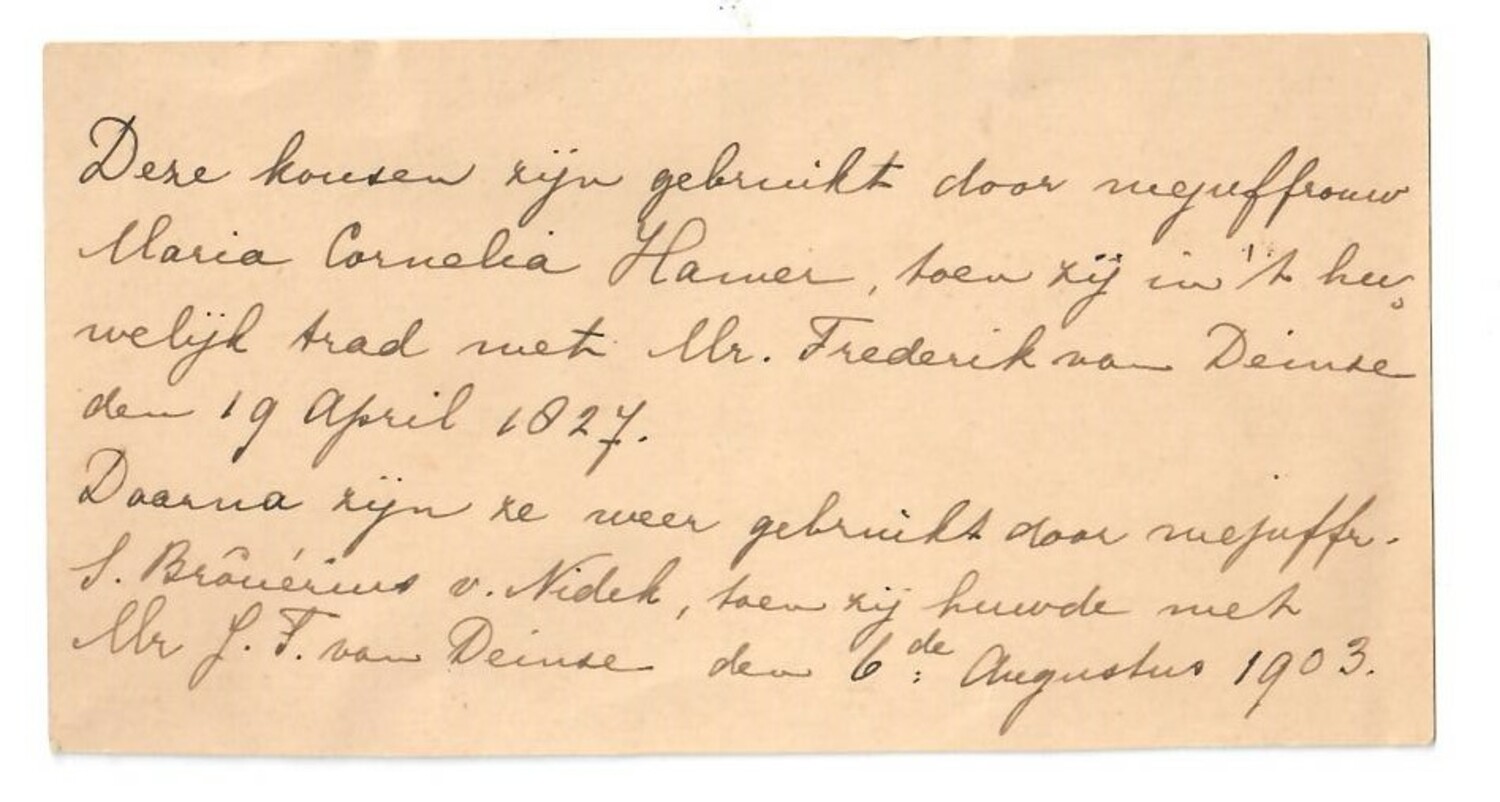 Postcard with hand written text, with reference to bridal treasure, written after 1903 (TRC 2014.1060f).
The text on the postcard runs as follows: “Deze kousen zijn gebruikt door mejuffrouw Maria Cornelia Hamer, toen zij in ‘t huwelijk trad met Mr. Frederik van Deinse, den 19 April 1827. Daarna zijn ze weer gebruikt door mejuffr. S. Brouerius v. Nidek, toen zij huwde met Mr J.F. van Deinse, den 6de. Augustus 1903.” (‘These stockings were used by Miss Maria Cornelia Hamer, when she married Mr Frederik van Deinse, on 19 April 1827. Afterwards they were used again by Miss S. Brouerius van Deinse, when she married Mr J.F. van Deinse, on 6 August 1903.’).
The four pads and the box, because of their identical decoration, clearly belong together. The small label refers to two of the pads, and also carries the name of Van Deinse, which would also link the postcard, which refers to the same family, to the group. The handwriting is also the same.
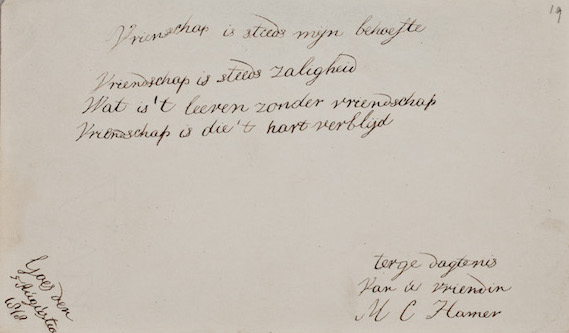 Hand written album text by Maria Cornelia de Witt Hamer (1804-1902), dedicated to her elder sister, Cornelia Johanna Eversdijk de Witt Hamer (1801-1879), dated 5 August 1818. National Library of the Netherlands. The stockings constitute a bit of a problem; they are absent. They probably did not survive. What the surviving four pads were used for remains unclear. The small label refers to two of them; another label may have gone missing. The pads may have been used to support and cushion the two wedding rings, which would explain the references to bride and groom. I don't know.
So who were the people mentioned in the text? We may safely conclude that they were Dutch or Flemish, belonged to an elite family, and the style and decoration of the box and pads date to the early nineteenth century or earlier. The texts on the label and postcard were written after 1903, but refer to a wedding in 1827.
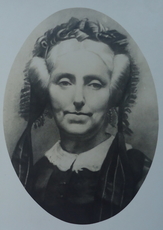 Wilhelmina de Witt Hamer, younger sister of Maria Cornelia de Witt Hamer (1808-1987).The people mentioned on the postcard could easily be found in the civil records. The 1827 bride was Maria Cornelia de Witt Hamer. We learn that she was born on 17 February 1804 in the city of Goes, in Zeeland, the most southwestern province of the Netherlands.
Maria was the daughter of Mr Jan Gerard de Witt Hamer (1767-1850), a lawyer from Vlissingen, and Susanna Maria van der Bilt (1782 -1851). She grew up in a large family with at least nine siblings. Her family clearly belonged to the elite of the small provincial town of Goes.
I could not find any photograph, painting or other visual reference to her, apart from a handwritten album inscription that she wrote on 5 August 1818 when she was about 14 years old, for her elder sister, Cornelia Johanna Eversdijk de Witt Hamer (1801-1879). The album text is now in the National Library in The Hague. There is also a photograph of another, younger sister, Wilhelmina (1808-1887).
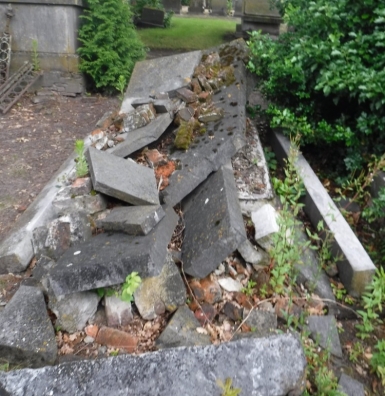 Recent photograph of the grave of Frederik van Deinse and his wife, Maria Cornelia de Witt Hamer, in Hulst, Zeeuws-Vlaanderen. Oudheidkundige Kring Hulst.According to the postcard and the civil records, Maria was 23 years old when on 19 April 1827 she married Frederik van Deinse. Her husband was a local magistrate in Goes, ten years her senior, who came from an elite family in Middelburg, Zeeland's capital, where he was born in 1794.
Frederik's father, Anthonius van Deinse (1764), was a vicar of the Dutch Reformed Church in Middelburg. He and his wife had many children, most of them occupying important positions in adult life. One of them, Joannes Jacobus (1791) became a magistrate in Goes in 1835, where his younger brother Frederik, Maria's husband, occupied a similar function. The same brother was also a conservative member of National Parliament in The Hague.
A younger brother of Frederik, Barnard Samuel, became a vicar of the Dutch Reformed Church in Naaldwijk, south of The Hague. Yet another brother, Jacobus Johannes (1792), became, like his father, a vicar in Middelburg,
Some time after 1845, Frederik and Maria and their children left Goes for Hulst, in nearby Zeeuws-Vlaanderen. He remained a magistrate, but he also became a member of the Provincial Council of Zeeland, a position he occupied until his death in 1873. Maria died at the ripe old age of 98, in Hulst, on 31 December 1902.
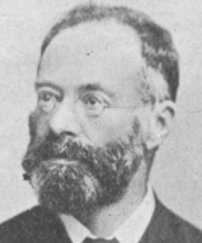 Jan Gerard van Deinse (1841-1908), the son of Maria Cornelia de Witt Hamer and Frederik van Deinse.Frederik and Maria had at least two children, namely Jan Gerard van Deinse, born in 1841, and Frederik Maria Cornelis van Deinse (1845-1880). They were both born in Goes. There are no records of children having been born between 1827 and 1841, but we may safely surmise that there were more children. They may have died young.
Jan Gerard van Deinse obtained his Doctorate degree in Leiden in 1863. He became a lawyer in Hulst, in the footsteps of his father. He was joined the Provincial Council after his father's death, and was, like his paternal uncle, a member of National Parliament between 1894 and 1901.
In 1870 he married his cousin, Jacoba Sara van Deinse, in Naaldwijk, where her father (and paternal uncle), Barnard Samuel van Deinse was a vicar. One of their sons was Johan Frans van Deinse, who was born in 1878. He is the second bridegroom mentioned in the postcard, and he married Susanna Wilhelmina Brouerius van Nidek, on 6 August 1903.
On this occasion, according to the postcard, the bride wore the stockings that the grandmother of her groom had worn at her wedding in 1827. Did she also use, in whatever form, the four pads and the decorated box? It would have been an emotional affair; Maria, aged 98, had died some seven months before the wedding.
Was Susanna also the person who wrote the postcard and the small label? Was she the Mrs S. van Deinse? This is likely. The place mentioned on the label is Middelburg. Susanna died in Middelburg on 1 July 1962. Her husband, Johan, had died seven years earlier, in 1955. After her death the box and its contents may well have been passed on to children and grand-children, and eventually to the TRC in Leiden.
Willem Vogelsang, 8 February 2022