by Emilie Lambert, archaeology intern at the TRC; 20 March 2024
The TRC is working hard at cataloguing the Afghan jewellery from the Schinasi donation. The current blog focuses on the vast array of finger rings. Many of the pieces are already accessible in the TRC online collection catalogue. As someone who does not wear jewellery herself, I was amazed at the number and variety of styles within this group of objects, although they all derive from a relatively small part of the world and date to a specific period of time.
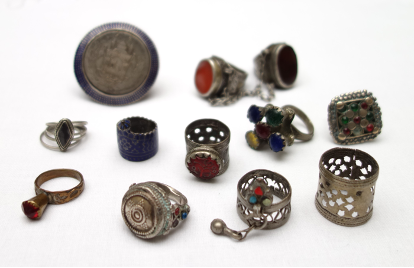 Group of rings from Afghanistan and beyond, 20th century.
As a student in archaeology, we are often taught that each period and each region has its own particular style. Going through the finger rings from Afghanistan at the TRC I realise that that is not the case.
 Kuchi-type silver finger ring, Afghanistan, 20th century (TRC 2024.0713).Moreover, when we take a closer look at some of the different styles and their variations, it is important to consider the items, not as stand-alone objects, but as accessories that form part of a much larger outfit. Ideally, the rings should not be sudied by themselves, but against the background of the garments and other ornaments a person is wearing.
I can only draw attention to some styles of finger rings: those with colourful glass inlays and ornate decoration are often classified as ‘Kuchi’ jewellery (compare TRC 2024.0713). Kuchi is a term applied to various nomadic ethnic groups (mostly Pashtuns) migrating throughout Afghanistan and the wider area.
There are a large number of pendants and earrings of the same 'Kuchi' style in the collection, and this gives us the fantastic opportunity of studying these pieces interacting with each other and together with the garments building the 'dress' of a person.
 Silver ring with a wide decorated band with two rows of floral cut-outs, with two oval pendants under a crown decorated with a red glass circle, granulation and circular plates. Afghanistan, 20th century (TRC 2024.0800).Another very distinctive style in the new collection comes from ateliers in Multan, a city in Pakistan which has always maintained close contacts with people from the Afghan mountains and highlands to the west (compare TRC 2024.0743). These deep blue, enamel signet rings contain in the centre a large, coloured piece of glass, a stone, or a coin. The finely decorated undersides suggest a certain prestige and status, when considering the high craftsmanship involved in ornamenting an ‘invisible’ part of the ring. The blue enamel style is also represented on other, smaller pieces.
The final category for this blog are the rings with cut-out bands and often with a crown (compare TRC 2024.0800). While they obviously follow the same style, hardly any are identical! They come with or without pendants, with or without the crown, and with or without coloured stone or glass beads.
 Silver ring with an earring-like opening and a circular front with a blue glass centre, red glass triangles and granulation. Afghanistan, 20th century (TRC 2024.0755).There are many more categories of the rings in the collection and perhaps each of them will see their own blog, as we continue to process the pieces. Here I list just a couple of unusual rings that have drawn my particular attention. There is a ring which is so large that it goes over two fingers. The inlay is unique, because it is not the usual stone or glass, but in fact consists of a layer of textile fabric under clear glass.There is also a swivel ring, in the shape of a little figure wearing a hat. And then there is a peacock design with colourful beads around a central stone.
There is one of the ‘rings’ from the Schinasi Afghan collection that I want to discuss in more detail (TRC 2024.0755). This ring did at first not particularly stand out from the rest.
 Clip at the back of TRC 2024.0755.When I first saw it, I thought it was a some sort of up-cycled earring. But on closer inspection, I noticed that the band has clips that open in the same manner as the earrings that I had seen before in the collection; the glass inlay of the head is also reminiscent of earrings. But on the other hand, the head's circular front and the granulation fit in better with finger rings.
So what is it? A ring, an earring, or something else? What are the defining features? The band on this particular piece certainly is not ring-shaped, yet it fits comfortably on the finger. As an earring it would point straight down and the head would be hidden. The same goes for its use as a brooch, as the hoop is too wide, forcing the beautiful front downwards. In all, the head and the clip do not seem to go together.
 Silver ring with a plain band and circular front, Afghanistan, 20th century (TRC 2024.0723).We face a further challenge in trying to identify the style of the head of this object. The closest items are two rings in the collection (compare TRC 2024.0723 and TRC 2024.0716 ), but only in that they also use circular designs. However, they are larger and bevelled.
The question is: at what stage of this piece’s life history was the decision made to add this band to the front? Was it a left-over piece in the atelier and the craftsperson decided to play with the options at hand? Was the decoration a sentimental piece re-worked? The connection runs along the back so it may cover up the original attachment.
It is still unclear how to classify this piece. Perhaps it should not be ‘classified’ at all. We are reminded that not everything fits into neat little boxes. Words and categories, like the objects, are man-made, and transitional pieces exist everywhere.