• F2
  • F4
  • F3
  • F1

Double Wedding Ring quilt from Canada, 1930s (TRC 2023.0626).Double Wedding Ring quilt from Canada, 1930s (TRC 2023.0626).Quilts and the TRC have been the focus of various discussions!

We recently welcomed, for example, various visitors who came to examine our collection of American quilts, two of them were Americans who came a few days ago.

At the same time we had a material culture group from Heidelberg University, Germany (a blog about this visit will be published shortly), who came to see Asian textiles and garments. Their tutor (who is a quilter) and some of the students, however, spotted the quilts and wanted to see and know more about them as well.

I have just come back (10th – 16th May 2023) from an intense, yet relaxing time spent in Estonia looking at embroidered textiles for information and inclusion in Vol 5 of the Bloomsbury World Encyclopedia of Embroidery.

In addition, Willem and I were able to see and hear about a far wider range of textiles, dress and their uses, both in Estonia and in neighbouring countries. We also came away very impressed with the country, its museums and indeed, its food and countryside.

Merle Ernits and Gillian Vogelsang at the Heimtali Museum, Estonia; in the background a garden fence painted with knitted socksMerle Ernits and Gillian Vogelsang at the Heimtali Museum, Estonia; in the background a garden fence painted with knitted socks

A little while ago Monique Amsel from Paris donated a collection of mainly Central European items to the TRC. But there was also a small tunic-like Turkmen garment (TRC 2023.0477), the front of which covered with amulets of various types, including lots of coins. According to Monique, the garment was acquired in Paris many years ago.

Turkmen open-sided tunic, 1980s (TRC 2023.0477).Turkmen open-sided tunic, 1980s (TRC 2023.0477).

We are visiting the small university city of Tartu in southeastern Estonia, as part of the preparation of Vol. 5 of the Bloomsbury World Encyclopedia of Embroidery (central and eastern Europe). What we did not expect to see was a workshop run by Estonian volunteers and Ukrainian refugees that designs and produces camouflage nets for the Ukrainian army. Since last year, they have produced more than three thousand square metres of netting.

Camouflage netting for Ukraine in the making: University of Tartu, Estonia. 11 May 2023. Photograph by Willem Vogelsang.Camouflage netting for Ukraine in the making: University of Tartu, Estonia. 11 May 2023. Photograph by Willem Vogelsang.

Francesc Masriera, 'Winter 1882'.  Museu Nacional d'Art de Catalunya. Public domain.Francesc Masriera, 'Winter 1882'. Museu Nacional d'Art de Catalunya. Public domain.Just by coincidence, we received on the same day two donations of muffs, one (TRC 2023.0627a) made of muskrat and originating from Canada and the other (TRC 2023.0630) is made of astrakhan and was acquired here in Leiden.

Muffs used to be very common, but it is unusual to see them nowadays. Perhaps they are due for a revival as a part of sustainability and decreasing energy resources?

A muff, also known as a hand warmer, consists of a cylinder that is open at both ends. It is often hung around the neck on a long cord or metal chain.

There may also be a purse attached to one side or set into the top of the muff (the muskrat example mentioned above had a strip of hooks and eyes inside the purse that date to the Second World War, TRC 2023.0627b).

Brown muff made from muskrat and lined with pale brown silk. Canada, mid-20th century (TRC 2023.0627a).Brown muff made from muskrat and lined with pale brown silk. Canada, mid-20th century (TRC 2023.0627a).The word muff derives from Old French mouffle for a thick glove or mitten, a term itself probably linked to an Old Germanic word, compare Dutch vel, for 'hide' or 'skin'. There appears to be no link with Dutch mof, a derogatory term for someone with the German nationality.

Muffs were usually worn in cold weather and as a result they were often made from furs such as astrakhan, ermine, beaver, fox, mink, muskrat, raccoon, sable, feathers (such as goose, peacock, swans), as well as from felt, velvet or another thick, warm material.

More fashionable forms, however, may be made of silks, satins and moiré cloth.

Muff made from black astrakhan and lined with black cloth. The Netherlands, mid-20th century (TRC 2023.0630).Muff made from black astrakhan and lined with black cloth. The Netherlands, mid-20th century (TRC 2023.0630).More expensive versions were decorated with lace (both bobbin and needle forms). Cheaper versions were sometimes made of rolls of cloth that were padded with sheep’s fleece. Sometimes mini-heaters in the form of metal cylinders containing heated charcoal were placed inside muffs to help keep the hands really warm. There are currently battery-operated examples available!

The wearing and use of muffs became popular in Europe in the 16th century and quickly developed into fashion statements. The earlier muffs tended to be small, but as time went on fashionable forms became larger and decorated with feathers, embroidery, expensive materials, etc.

Late 19th century photograph showing a young girl from Scotland with her hands tucked into a muff (TRC 2019.0002).Late 19th century photograph showing a young girl from Scotland with her hands tucked into a muff (TRC 2019.0002).It is clear from depictions in prints, paintings, as well as from small figurines, especially in the 18th century, that both men (including soldiers) and women wore a wide variety of muffs. But by the early 19th century it would appear that muffs had become primarily associated with women.

The use of muffs died out in the latter half of the 20th century, partly due to increased use and availability of gloves, as well as a general move against the wearing of furs.

The TRC is planning a mini-exhibition on the theme of muffs and we are looking for actual examples (especially those with a known history), prints, photographs, etc. Should you be willing to donate relevant items to the TRC, please contact us (Dit e-mailadres wordt beveiligd tegen spambots. JavaScript dient ingeschakeld te zijn om het te bekijken.).

Gillian Vogelsang-Eastwood, 8 May 2023 

 'A journey through ASEAN textiles', Malaysian Residence, Wassenaar, 3 May 2023.'A journey through ASEAN textiles', Malaysian Residence, Wassenaar, 3 May 2023.

It's been quite an international week at the TRC in Leiden, and more is expected next week!

Knitting sampler from Hungary, 1791 (TRC 2016.2261).Knitting sampler from Hungary, 1791 (TRC 2016.2261).We have been adopted by Robert Spiegelman from the US, who for a long time has been coming to Leiden every year for six weeks. Robert has been introducing family and friends to the TRC and they are now actively looking for help for the TRC in the US. It's good to know how the TRC can appeal to a wide range of people and backgrounds.

Then Jane Malcolm-Davies Jane (Copenhagen University, Denmark), a specialist in historic textile techniques, came on Monday (1st May 2023) to discuss the history of hand knitting and to look at items relating to the TRC’s 17th century silk stocking project that was led by Chrystel Brandenburg, Leiden City archaeologist. 

The TRC was also involved in the related, British Knitting Forum conference held in Leiden in November 2019. One of the suggestions made by Jane was that the TRC should become an international centre for knitting history!

We are already working on a knitting reference collection, but the idea of the TRC expanding its activities into an international centre for the study of this form of textiles was an interesting and intriguing concept for me to think about!

Small dark blue T-shirt for the 2023 Coronation, with a printed image of a King Charles spaniel and a Jack Russell terrier, both of which are wearing party hats, flags, etc. (TRC 2023.0679a).Small dark blue T-shirt for the 2023 Coronation, with a printed image of a King Charles spaniel and a Jack Russell terrier, both of which are wearing party hats, flags, etc. (TRC 2023.0679a).

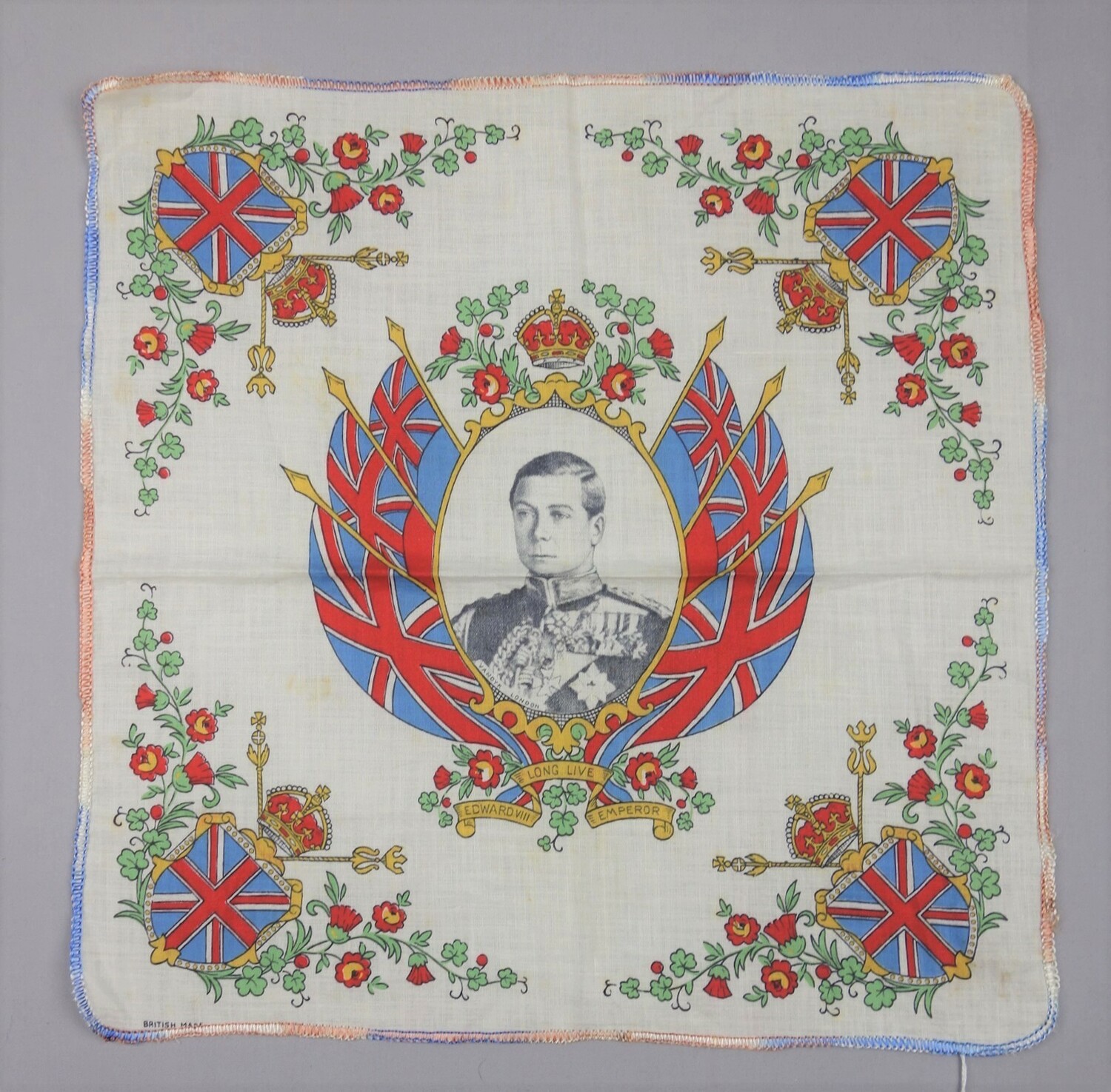
Handkerchief for the coronation of King Edward VIII, 1937. The coronation however never took place (TRC 2015.0405).Handkerchief for the coronation of King Edward VIII, 1937. The coronation however never took place (TRC 2015.0405).In the run up to the coronation of Charles III, tomorrow, on the 6th May 2023 in London, I thought I would have a quick look at the TRC Collection to see what we have that was relevant, and yes, we have several items! Oh, how I love the TRC having a broad based encyclopaedic textile collection rather than a ‘specialist’ one! There are several related items in particular I would like to highlight.

The first is a cotton handkerchief (TRC 2015.040) printed to commemorate the coronation of Edward VIII in 1937, after the death of his father George V (reign 1910-1936). Yet, the coronation never took place because Edward decided to abdicate from the British throne in December 1936 in order to marry Mrs Wallis Simpson, an American divorcee.

Hand resist dyed (batik), cotton cloth. Indonesia, 20th century (TRC 2023.0573).Hand resist dyed (batik), cotton cloth. Indonesia, 20th century (TRC 2023.0573).In December 2022 we announced the sad news of the death in Leiden of the well-known, Dutch textile curator and historian, Rens Heringa (1932-2022).

As noted, Rens grew up in Twente among textile producers, and from the early 1950s lived for many years in Indonesia. She has long been a grande dame in the field of Indonesian textiles and Indonesian batiks in particular.

Over the years Rens has helped the TRC with textiles, advice and suggestions with respect to its Indonesian textile collection, and although Rens is no longer around, her connections with the TRC continue.

To our surprise it turned out that Rens had included the TRC in her will. Last week we picked up 55 Asian textiles and garments, including Bangladesh, Indian, Indonesian, Thai and Philippine examples, as well as one West African piece (TRC 2023.0553 - TRC 2023.0606).

Zoek in TRC website

Contact

Boerhaavelaan 6
2334 EN Leiden.
Tel. +31 (0)6 28830428  
office@trcleiden.org

Het TRC is elke dag geopend tussen 10.00 en 15.00 uur.

facebook 2015 logo detail


instagram vernieuwt uiterlijk en logo


Bankrekening

NL39 INGB 0002 9823 59, t.a.v. Stichting Textile Research Centre.

Financiële giften

Het TRC is afhankelijk van project-financiering en privé-donaties. Al ons werk wordt verricht door vrijwilligers. Ter ondersteuning van de vele activiteiten van het TRC vragen wij U daarom om financiële steun:

Giften kunt U overmaken op bankrekeningnummer (IBAN) NL39 INGB 000 298 2359, t.n.v. Stichting Textile Research Centre. BIC code is: INGBNL2A

U kunt ook, heel simpel, indien u een iDEAL app heeft, de iDEAL-knop hieronder gebruiken en door een bepaald bedrag in te vullen: 


Omdat het TRC officieel is erkend als een Algemeen Nut Beogende Instelling (ANBI), en daarbij ook nog als een Culturele Instelling, zijn particuliere giften voor 125% aftrekbaar van de belasting, en voor bedrijven zelfs voor 150%. Voor meer informatie, klik hier