• F3
  • F1
  • F4
  • F2

A quilted shirt for a Pashai man, Afghanistan (TRC 2018.2581).A quilted shirt for a Pashai man, Afghanistan (TRC 2018.2581).Gillian Vogelsang writes about a recent trip to Cambridge:

Willem and I have just had a textile weekend in Cambridge, England. It was meant to be a mixture of holiday and work, but embroidery dominated the time. We were there to talk with Caroline Stone and John Gillow about the Encyclopedia of Embroidery series (Bloomsbury), Afghanistan and the Indian subcontinent embroidery in particular. It was intensive and hundreds of photographs were made, notes taken, embroideries examined and ‘new’ stitches identified. Not so surprising, perhaps, a number of textiles were acquired so that further technical analysis could took place at the TRC in Leiden.

Jet working atelier, Whitby, UK (photograph Shelley Anderson).Jet working atelier, Whitby, UK (photograph Shelley Anderson).TRC volunteer Shelley Anderson writes about her recent visit to Whitby, England:

Whitby is a small fishing village on England’s northeastern coast. It’s famous for its ruined abbey and for the fact that it is mentioned in Bram Stoker’s classic novel Dracula. I was there for neither ruins nor vampires. Whitby is also famous for its jet, a black gem stone that has been used for jewellery since the Bronze Age.

Jet is a fossilized wood, made from the Araucaria tree (a relative of today’s monkey puzzle tree) during the Jurassic period. Jet is found in several places around the world, including northern Spain and southwestern Turkey (in fact, the Romans called the gem stone gagates, from the Gages river in Turkey). Jet from Whitby is considered among the highest quality anywhere. It is also increasingly scarce. The jet mines have been closed and it’s illegal to hack at any seams found in the beach cliffs. Jet workers now comb the beach along a particular seven and a half mile stretch of the North Yorkshire coastline to look for the gem stone.

I was in Whitby looking for jet jewelry for my own small collection, and for some Victorian jet buttons for the TRC’s button reference collection. There are dozens of shops selling jet jewelry, especially on the narrow Church Street. If you are interested in the history of jet, it’s better to go to a shop where jet is still being made into jewelry, rather than a shop that simply sells jet jewelry. I had some very good conversations in several of the former, including the jet shops One O Five and the Black Market.

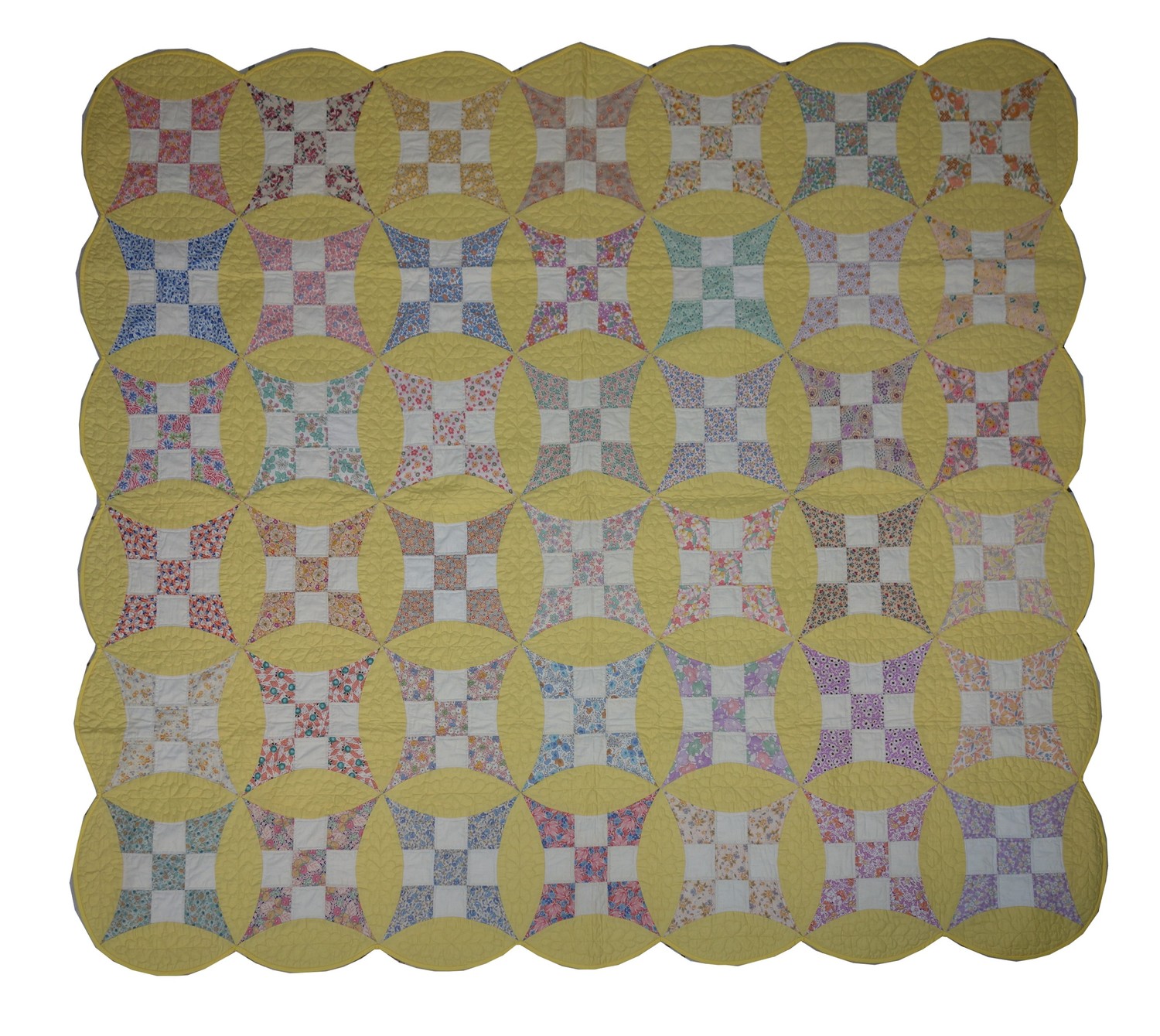
Quilt with 'cheater'  design, USA, 1960s (TRC 2018.2407).Quilt with 'cheater' design, USA, 1960s (TRC 2018.2407).The second box of US quilts, tops and related items, including some nineteenth century ‘spare’ blocks, has just arrived at the TRC. These are part of a donation of quilts by Sherry Cook, who has very kindly agreed to give some of her collection to the TRC (see previous blog about the first box, and Sherry’s blog about why she is making this donation).

The first box arrived a few weeks ago and already all the items have been put online at TRC Collection Online, nos. TRC 2018.2404 – TRC 2018.2432a. The items from the second box will come online by the beginning of August 2018.

The donation by Sherry Cook provides a fascinating look at American quilts from the late nineteenth century to about the 1980’s and includes examples made in silk, velvet, cotton, as well as synthetic materials. The designs range from Bow Tie, via Morning Glory, Pansy, Roman Square to Star Dahlia. A third box is due in a few weeks’ time! 

Gillian Vogelsang-Eastwood, Thursday 19th July 2018

Preparations for Vol. 8 of the Encyclopedia of Embroidery series, covering the Antarctic, are already well advanced. Martin Hense, the draughtsman for the full series, just completed the first illustration.Preparations for Vol. 8 of the Encyclopedia of Embroidery series, covering the Antarctic, are already well advanced. Martin Hense, the draughtsman for the full series, just completed the first illustration.During the last few months the Encyclopedia of World Embroidery series (Bloomsbury Publishing, London), has been gaining momentum. The first volume on embroidery from the Arab World came out in 2016 (see here) and to everyone’s pleasure won the prestigious international award, the Dartmouth Medal.

Since then we have been working hard on volume 2, which is about embroidery from Central Asia, the Iranian Plateau and the Indian subcontinent (see here). The manuscript for this volume has gone to Bloomsbury and the book should appear by the middle of 2020. For the Bloomsbury announcement, click here. Once again many people have been helping with advice, suggestions and with providing actual examples of embroidery. Preparations for Vol. 3 on (West) European embroidery are progressing well.

For the next few years, we are planning the following volumes: 3 – Scandinavia and Western Europe; 4 – East and Southeast Asia; 5 – Eastern Europe and Russia; 6- Sub-Saharan Africa; 7- The Americas. 


Thanks to the generosity of the Prins Bernhard Cultuurfonds and the Themafonds Digitalizering Erfgoedcollecties Zuid-Holland, the TRC Leiden has received a substantial grant to update the online catalogue of the TRC collection, improve and extend the digital database and to revamp the internet presence of the TRC in general. The work will start very shortly in re-styling the database, updating programmes, and getting even more photographs and information online!

Kangas at the exhibition “Our Kisses are Petals’, at Newcastle’s BALTIC Centre for Contemporary Art. Photograph: Shelley Anderson.Kangas at the exhibition “Our Kisses are Petals’, at Newcastle’s BALTIC Centre for Contemporary Art. Photograph: Shelley Anderson.Shelley Anderson, volunteer at the TRC, writes about a recent visit to England:

The words ‘textile’ and ‘art’ caught my eye, of course, on a recent visit to the city of Newcastle in northern England. The exhibition “Our Kisses are Petals’ was on at Newcastle’s BALTIC Centre for Contemporary Art.

The artist was Lubaina Himid (born 1954, in Zanzibar), who won last year’s prestigious Turner Prize for modern art. The exhibition consisted of over a dozen large, banner-like canvases, attached to a system of pulleys. Each canvas depicted a part of the body, for example, the eyes, tongue, or heart, and a line of poetry by a black British or American poet.

Himid herself is the first black woman to win the Turner Prize. She is also the oldest, at 63, winner in history. Visitors were encouraged to rearrange the order of the quotes on the canvases by pulling on the pulleys. The paintings were based on the East African textile known as kanga. Also worn in Oman, the kanga is a versatile garment used by women as a dress, a head wrap, and sometimes a baby carrier.

Late 19th century American 'crazy quilt', 159 x 135 cm, donated by Sherry Cook (TRC 2018.2407).Late 19th century American 'crazy quilt', 159 x 135 cm, donated by Sherry Cook (TRC 2018.2407).Sherry Cook writes from America: My husband, Darwin, and I downsized from a large home in the fall of 2014 and have had a lot of boxes in storage since that time. We are now building a barn that will have small living quarters and storage space so I can get myself and the boxes organized. We also have our 60th wedding anniversary in September, so the decision has been made to downsize even more, to get everything organized, and at a faster pace.

We have been donating textiles to the Center for American History (CAH) in Austin, Texas since 2008. You can google the “CAH” or “Sherry A Cook, Quilter” to see some of the items we have donated. But we have now decided to support and encourage the TRC Leiden. We are very impressed with TRC’s leadership team, volunteers and all their efforts to work with world textiles.

Zoek in TRC website

Contact

Boerhaavelaan 6
2334 EN Leiden.
Tel. +31 (0)6 28830428  
office@trcleiden.org

Het TRC is elke dag geopend tussen 10.00 en 15.00 uur.

facebook 2015 logo detail


instagram vernieuwt uiterlijk en logo


Bankrekening

NL39 INGB 0002 9823 59, t.a.v. Stichting Textile Research Centre.

Financiële giften

Het TRC is afhankelijk van project-financiering en privé-donaties. Al ons werk wordt verricht door vrijwilligers. Ter ondersteuning van de vele activiteiten van het TRC vragen wij U daarom om financiële steun:

Giften kunt U overmaken op bankrekeningnummer (IBAN) NL39 INGB 000 298 2359, t.n.v. Stichting Textile Research Centre. BIC code is: INGBNL2A

U kunt ook, heel simpel, indien u een iDEAL app heeft, de iDEAL-knop hieronder gebruiken en door een bepaald bedrag in te vullen: 


Omdat het TRC officieel is erkend als een Algemeen Nut Beogende Instelling (ANBI), en daarbij ook nog als een Culturele Instelling, zijn particuliere giften voor 125% aftrekbaar van de belasting, en voor bedrijven zelfs voor 150%. Voor meer informatie, klik hier