• F1
  • F4
  • F2
  • F3

Textiel Museum Tilburg. Exhibition '1920s Jazz Age - Fashion & Photographs'.Textiel Museum Tilburg. Exhibition '1920s Jazz Age - Fashion & Photographs'.Yesterday, Gillian and I travelled to Tilburg, in the south of the Netherlands. Gillian had been asked by the British journal Selvedge to write a brief review of a new exhibition mounted at the Textiel Museum. I happily plodded along. I had never been to this museum before, and was very curious. I love visiting museums and exhibitions, but to be honest, I find some of them more interesting for their exit than their entrance. What was the Textiel Museum going to be like?

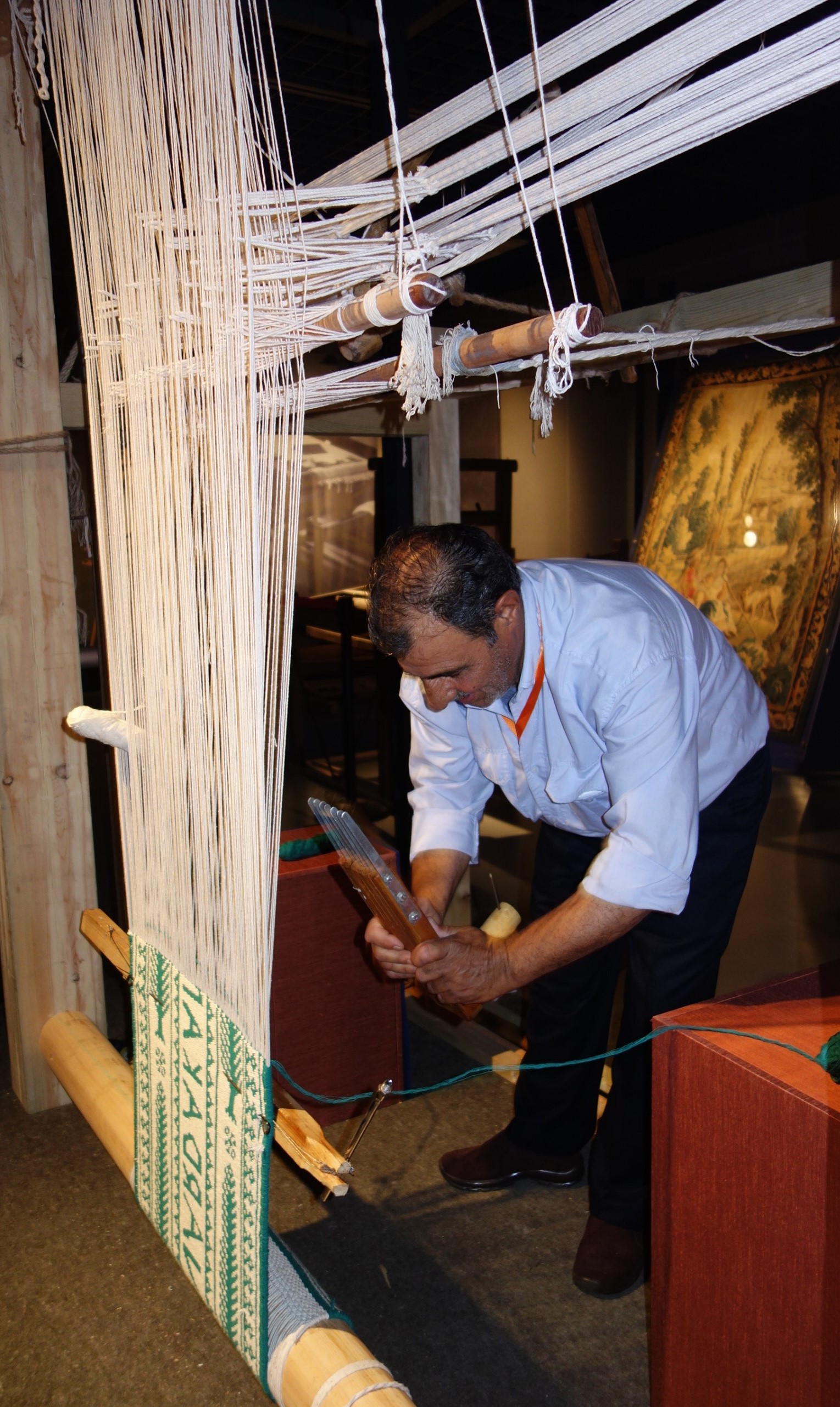
Tilburg is a former centre of the Dutch textile, and in particular wool industry. I had read before that the museum was housed in the premises of the former textile firm of Mommers. I was therefore wondering whether the Textiel Museum would be yet another place that was trying to keep alive, in a somewhat nostalgic manner, the former glories of an industry that had long disappeared. But I was very pleasantly surprised to find a very lively and active textile centre with some excellent exhibitions, with working machinery, and with craftsmen/women and artists actively doing their work. Perhaps the word ‘Museum’ for this place is a bit of a misnomer. It is far more than a series of rooms and corridors with objects being displayed. It is fascinating to see how wool was carded, reeled, and in the end worked into cloth on looms, many of which are shown in the museum and many of which are actually in active service. There was also a display of all the machinery used to make damask linen cloth; absolutely fascinating.

Textiel Museum Tilburg. Exhibition 'Colour & Abstraction - Generations in Dialogue'.Textiel Museum Tilburg. Exhibition 'Colour & Abstraction - Generations in Dialogue'.But it was not only the machinery that intrigued me. Also many of the objects on display as well were well worth seeing. One of the temporary exhibitions was about the so-called ‘flappers’, the young girls of the Charleston age in their relatively short dresses. It showed the mainly American fashion of the 1920s. I know, the clothes on display were for the well-to-do, but it does produce a happy smile.

Textiel Museum Tilburg. Exhibition 'Colour & Abstraction - Generations in Dialogue'.Textiel Museum Tilburg. Exhibition 'Colour & Abstraction - Generations in Dialogue'.But what we really came for was a new, temporary exhibition called ‘Colour and Abstraction. Generations in Dialogue,’ which can be seen until 3rd March 2019. We were shown around by one of the museum’s curators, Suzan Russeler, who guided us with great enthusiasm along the objects. Since the exhibition only opened yesterday afternoon, I think we were the first visitors. But it was certainly busy when we left.

The exhibition includes art works made during the last sixty years by a number of design artists, and using textile as their main medium. The exhibition includes works by Rafaël Rozendaal, who uses images from the internet and social media to create a mesmerizing array of geometric shapes and colours. There is also a beautiful wall hanging designed by Peter Struycken, with a mishmash of subtle colour combinations. There are also art works that are three-dimensional and thus make ample use of the flexible nature of the medium by providing spectacular changes with the use of light and movement.

Some of the objects on display were actually designed and made at the Textiel Museum itself, in its so-called TextielLab, which is a space that provides the facilities for artists to experiment with designs, colours, techniques, but also with types of yarns, dyes, etc. And what is great, is that visitors to the museum can have a good glimpse of what is being done in the Lab. It was bitterly cold, but the museum cafe served excellent coffee, and while drinking that, you can admire the textile decor. No regrets. Well worth a visit. The website of the Textiel Museum is https://www.textielmuseum.nl/en. The photographs were made by Gillian.

Willem Vogelsang, Sunday 18th March 2018

Two Manchester students at the TRC Intensive Textile Course, March 2018.Two Manchester students at the TRC Intensive Textile Course, March 2018.This last few weeks have had a Manchester flavour! And I am not talking about football teams. On the 6th-7th March, I was in Manchester, UK, to discuss the various ways the TRC Leiden and the Manchester School of Art (part of the Manchester Metropolitan University) could work together. The School is geared towards the training of textile designers who specialise in a variety of subjects, such as embroidery, knitting, printing and weaving. These subjects include both hand and machine forms. There is also a large fashion department training the students to design future fashions.

Outfit for an orphan girl, early 20th century, Foundling Museum, London.Outfit for an orphan girl, early 20th century, Foundling Museum, London.The Foundling Museum in London is a fascinating piece of social history. This compact museum records the history of orphans and of those who tried to help them. The story begins in 1741, when the Foundling Hospital (think ‘hospital’ in terms of ‘hospitality’, not medical treatment) was established in Blooomsbury, London, to care for abandoned and neglected children. The orphanage was in operation until 1924, and the building was demolished in 1926. The orphans were rehoused outside of London. The Museum is housed in another building, not far from the original premises, at Brunswick Square.

The displays include oral histories, paintings (William Hogarth was a supporter of the Hospital) and other art works. The latter includes a moving piece made in 2012 by Emma Middleton, and deals with responses from teachers to the orphans’ uniforms. Called “Labelled”, it features a row of pegs on which hang identical white cotton school shirts, each with a red stitched label. The labels record sentences the orphans were told in school: “I hate you”, “If you can’t bring a pencil with you, don’t come”, “You are stupid”. Nearby are two brown serge childrens’ uniforms: a dress and white apron and bonnet for girls; a black necktie, white shirt, red wool waistcoat, trousers and cap for boys. The example on display dates to the twentieth century.

Bolivian woman’s hat with sequins and beads from the Tarabucco region of Bolivia (TRC 2018.0600; v/d Bijl collection).Bolivian woman’s hat with sequins and beads from the Tarabucco region of Bolivia (TRC 2018.0600; v/d Bijl collection).During the 1990’s Yvonne van der Bijl was travelling through Bolivia and Peru as part of her work as a travel guide author. During her visits she started to make a small collection of Bolivian and Peruvian hats for women. She used these in her books and articles, as well also as part of a gallery exhibition about South American headwear held at the LAC Gallery, Amsterdam in 1998.

Woman’s hat with sequins and beads for an Aymara woman, Tarabuco region of Bolivia (TRC 2018.0602; v/d Bijl collection).Woman’s hat with sequins and beads for an Aymara woman, Tarabuco region of Bolivia (TRC 2018.0602; v/d Bijl collection).Yvonne van der Bijl is now downsizing and tidying up and as a result a few days ago twenty Bolivian and Peruvian hats for women arrived at the TRC ! Over the next few weeks the TRC will be sorting out, cataloguing and photographing the hats, but if you know of any books and articles in which there is detailed information about the different types of Bolivian and Peruvian hat styles for women can you please get in contact with us at: Dit e-mailadres wordt beveiligd tegen spambots. JavaScript dient ingeschakeld te zijn om het te bekijken. 

Peruvian woman’s hat with deep red fringe from the Checaspampa region (TRC 2018.0593; v/d Bijl collection).Peruvian woman’s hat with deep red fringe from the Checaspampa region (TRC 2018.0593; v/d Bijl collection).

Gillian Vogelsang-Eastwood, Sunday 11th March 2018

Peruvian woman’s embroidered hat from the Cabanacone region, Colca Canyon region (TRc 2018.0603; v/d Bijl collection).Peruvian woman’s embroidered hat from the Cabanacone region, Colca Canyon region (TRc 2018.0603; v/d Bijl collection).

Sampler with the text A W Arnhem 1912 (TRC 2018.0467).Sampler with the text A W Arnhem 1912 (TRC 2018.0467).A recent donation to the TRC came with a little mystery. It was a box of beautiful Dutch samples and samplers. They were said to be all made by the donor’s grandmother, a woman named Wilhelmina Johanna Wijers. She was born in 1900 in Arnhem and known within the family as Johanna or Anna. The earliest dated sampler (TRC 2018.0466), is based on the alphabet and is worked in cross stitch using a red cotton thread on a linen back ground. It was made in March 1909 when Johanna was nine years old. The mystery is the fact that her collection also contains a sampler dated 1912 (TRC 2018.0467), which is almost identical to the one made in 1909.

Johanna was an intelligent student, but she had to leave school when she was 13, to work for her father and others. She also had a younger sister. The grandchildren knew the younger sister as Tante Zus (‘Aunt sister’). Her real name has long been forgotten. Forgotten, that is, until the TRC staff began examining the earlier samplers.

All girls at the beginning of the 20th century were taught embroidery, for practical more than artistic reasons. They made samples and samplers. Some samplers featured the alphabet, with numbers stitched beneath the letters. The maker could use this sampler to show potential employers that she could read and also add, subtract and multiply—and, of course, that she could sew and mend clothing. Such samplers were a textile curriculum vitae. Johanna’s school samplers progressed from alphabets to decorative darning, mostly with a background of cloth with red stripes produced in Germany for Dutch and German embroidery teachers. 

The new collection of samples and samplers not only contains two identical, very simple samplers with letters and numbers, but also another set of virtually identical samplers, with ornate letters and numbers (TRC 2018.0469 and TRC 2018.0470). Why did Johanna as a child make two identical samplers of the alphabet and two with more complicated letters? This was a puzzle, until someone looked more closely at the samplers, initials and dates.

The set of two simple samplers has different initials that identify the embroideress. One of them reads J. Wijers Arnhem Maart 1909, the other A W Arnhem 1912. Considering the (limited) skill required for these simple samplers, the girls were probably around nine years old when they stitched their samplers. Johanna ('J' for Johanna), who was born in 1900, made her sampler in 1909. Someone else ('A') worked her sampler in 1912. Her surname started with 'W', probably short for Wijers. Could this have been the younger sister?

This younger sister could also have made the second of the set of far more ornate samplers. These samplers have no initials nor dates. But why would the same person make two almost identical samplers? 

The puzzle is a little closer to being solved —the identical samplers were made by two different girls. They were Johanna and, perhaps, her younger sister, whose (official) name probably started with an 'A'. 

Maybe the TRC should change its initials to the (textile) C.S.I.?

Shelley Anderson, Saturday 3rd March 2018

Workshop on the reconstruction of 17th century hand knitted silk stockings, TRC, February 2018.Workshop on the reconstruction of 17th century hand knitted silk stockings, TRC, February 2018.As part of the Texel Silk Stockings Project, and following an initial workshop on the island of Texel some weeks ago, the TRC Leiden recently hosted three further workshops, namely on Sunday 18th February (twice) and Friday 23rd February. Each of the three workshops was attended by some 25 volunteers. The Project has the aim of reconstructing the silk stockings that were discovered at a shipwreck that dates to the 1640’s. The ship was found off the coast of the Dutch island of Texel a few years ago.

The TRC is involved in writing a detailed publication about the stockings, how they were made, who made them and indeed who might have worn them. The Project is led by Leiden city archaeologist Chrystel Brandenburgh and helped by TRC volunteer, Lies van de Wege, and a large group of dedicated knitters who come from all over the world – literally. The vast majority of knitters come from the Netherlands and Belgium, but there are people involved in the Project from Hungary, Portugal, Germany, England, as well as America and Canada.

George Stark at the TRC, 14th February 2018George Stark at the TRC, 14th February 2018Georg Stark is one of a handful of traditional indigo printers and dyers left in Germany. He has also been researching the history of this craft for some 35 years. All of this experience made for a fascinating lecture recently at the TRC on the 14th of February.

Over 150 years ago indigo printing with wooden blocks was practiced all over Europe, from Spain to Russia. One of the first recorded workshops for printing cotton opened in 1672 in Amersfoort. An even earlier workshop to print and dye cotton, run by Armenians, was opened in Marseille, France. In 1681 the first workshop opened in southern Germany. By the 1730s there was a Dutch poem that boasted that “we on the Amstel can do the same quality of work as the cotton printers of Java.” The Dutch East India Company (VOC) had an important role in the transfer of this skill to Europe, as it regularly brought ready-made garments from India to Europe and beyond.

Annelien van Kempen was one of the participants to the TRC workshop on string piecing on 31st January, as given by Linzee McCray. She proudly sends us a series of photographs of her 'Spring Sack', sized 66 x 45 cm, which she finished after a week's hard work on the basis of what she learnt at the workshop.

Annelien van Kempen Atelier: Trix Terwindtstraat 2, Leiden Postadres: Buitenruststraat 32, NL - 2271 HB Voorburg T 06 15626367 E Dit e-mailadres wordt beveiligd tegen spambots. JavaScript dient ingeschakeld te zijn om het te bekijken. W http://www.annelienvankempen.nl  Luchthollers: https://www.pixum.nl/mijn-fotos/album/5833342 

Zoek in TRC website

Contact

Boerhaavelaan 6
2334 EN Leiden.
Tel. +31 (0)6 28830428  
office@trcleiden.org

Het TRC is elke dag geopend tussen 10.00 en 15.00 uur.

facebook 2015 logo detail


instagram vernieuwt uiterlijk en logo


Bankrekening

NL39 INGB 0002 9823 59, t.a.v. Stichting Textile Research Centre.

Financiële giften

Het TRC is afhankelijk van project-financiering en privé-donaties. Al ons werk wordt verricht door vrijwilligers. Ter ondersteuning van de vele activiteiten van het TRC vragen wij U daarom om financiële steun:

Giften kunt U overmaken op bankrekeningnummer (IBAN) NL39 INGB 000 298 2359, t.n.v. Stichting Textile Research Centre. BIC code is: INGBNL2A

U kunt ook, heel simpel, indien u een iDEAL app heeft, de iDEAL-knop hieronder gebruiken en door een bepaald bedrag in te vullen: 


Omdat het TRC officieel is erkend als een Algemeen Nut Beogende Instelling (ANBI), en daarbij ook nog als een Culturele Instelling, zijn particuliere giften voor 125% aftrekbaar van de belasting, en voor bedrijven zelfs voor 150%. Voor meer informatie, klik hier