• F4
  • F3
  • F2
  • F1

Amish apron, Jamesport, Missouri, USA, 2017 (TRC 2017.2999).Amish apron, Jamesport, Missouri, USA, 2017 (TRC 2017.2999).Jamesport, Missouri (USA), is a small farming town surrounded by hectares of maize fields. Its official population is approximately 500 people. There is one other thing you should know about Jamesport, which made it perfect for my mission of expanding the TRC’s collection of North American textiles.

Jamesport is home to the largest community of Amish people west of the Mississippi River. Some 165 Amish families live and farm around the town. You can see them driving horse-drawn buggies on the roads (the use of cars and electricity is considered too worldly). They worship according to their Anabaptist beliefs and still speak the German dialect their ancestors did when they first came to North America in the 1700s. They also wear a distinctive form of clothing that they call ‘plain’ or ‘simple’ dress.

I wanted to buy some examples of this clothing for the TRC. Amish clothing is unadorned, in muted colours. The women wear ankle-length dresses, with an apron and bonnet; the men long trousers with shoulder straps. The clothing appears old fashioned in the 21st century and immediately distinguishes the wearer as a community member.

Pair of trousers for an Amish man, from Jamesport, Missouri, USA, 2017 (TRC 2017.2986).Pair of trousers for an Amish man, from Jamesport, Missouri, USA, 2017 (TRC 2017.2986).It was easy to find Amish quilts for sale in Jamesport. This distinctive style is immediately recognizable: dark colours (except for the pattern known as Star of Bethlehem or Broken Star), no checks or prints, with a centre dominated by an abstract motif, frequently of bars or stripes or blocks, with wide, unadorned borders. Amish quilts are also very collectible and sell for USD 1000 to USD 2000.

Amish clothing, however, wasn’t so easy to find. Fortunately, two shops in Jamesport gave me the same advice: drive down the hill for three miles, cross the railroad tracks, and look for the first building on the left. The directions were spot on: inside this shop were rows and rows of used Amish clothing, plus pickles, preserves, and other home goods for sale.

All the clothes were of a synthetic mix (except for a few pairs of denim trousers), and were of factory woven material. The clothes were also all skilfully home made, except for the men’s long sleeved white shirts (TRC 2017.2981), which were factory-made. Male trousers (TRC 2017.2982, 2017.2986) had a buttoned fall-front flap, with pockets and shoulder straps in the same material. While trousers for adult males and younger boys had buttons, some clothes for infants (TRC 2017.2984 and 2017.2983) used metal snaps. Many Amish consider zippers too worldly and will not use them.

While the male clothes showed no personal embellishments, there were small differences in some of the adult women’s dresses (TRC 2017.2995a, 2996, 2998). Almost all were loose fitting and ankle length, in solid pastel colours (primarily blue, grey, and green), with no prints or checks. Some featured a yoke or bib in the same material and most had a pocket. Sometimes an apron was made of the same material as the dress. While all the sleeves reached below the elbow, some women had made close-fitting cuffs, others loose. On some dresses a thin strip of the dress material has been sewn around the cuffs, a discreet embellishment. I did find one unfinished woman’s white dress with thin stripes (TRC 2017.2997), which made me curious about its story. All the clothes can be seen in the TRC’s on-line catalogue at www.trc-leiden.nl.

18th September 2017, by Shelley Anderson

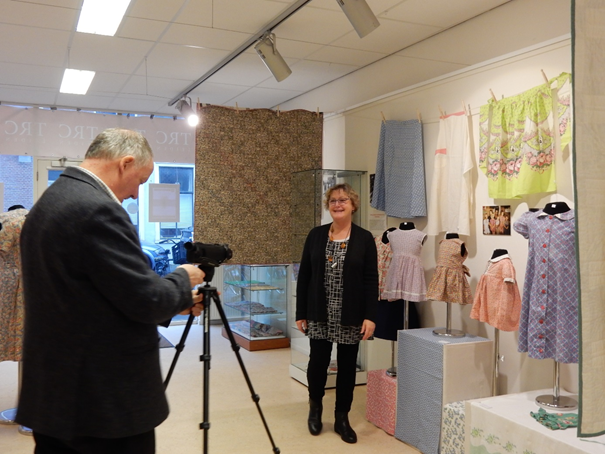
Opening of the TRC exhibition "Dressing the 'Stans', 12th September 2017, by Prof. Peter Frankopan.Opening of the TRC exhibition "Dressing the 'Stans', 12th September 2017, by Prof. Peter Frankopan.This last week has been extremely busy thanks to a wide range of activities taking place at the TRC Leiden. Monday was spent putting the last touches to our new exhibition called Dressing the ‘Stans’: Textiles, clothing and jewellery from Central Asia. This exhibition was created as part of the Asia Year celebrations in Leiden that culminated in the opening of the Leiden University’s new Asia Library by H.R.H. Queen Maxima of the Netherlands.

The TRC exhibition (which was not opened by the Queen), was in fact opened on Tuesday by Prof. Peter Frankopan, Oxford University and author of the now famous book The Silk Roads (2015). Prof. Frankopan gave a short, but very much to the point, talk about the important role of textiles, especially silk, in linking cultures and groups together over the centuries. The exhibition will be on display until mid-December, so you will have ample chance to see it. In addition, in a few weeks’ time a digital version of the exhibition will appear on the TRC digital exhibition list (which is getting longer and longer with a range of very different exhibitions!).

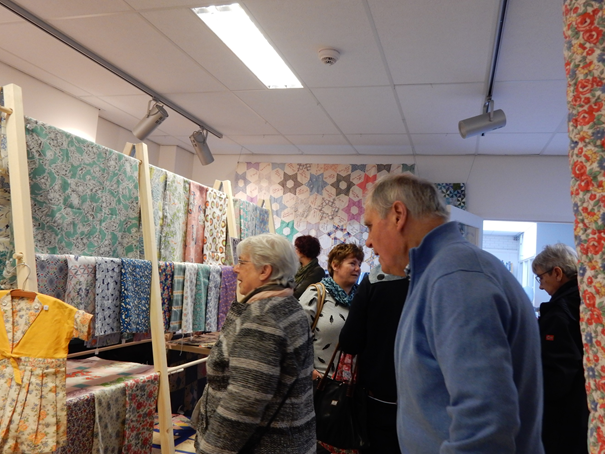
Dressing the 'Stans' exhibition, from 12th September until 22 December 2017.Dressing the 'Stans' exhibition, from 12th September until 22 December 2017.Anyway back to Tuesday, the opening was followed by a light buffet, which gave everyone the chance to talk with Prof. Frankopan and to see the exhibition. Various guests promised items from home for the TRC Collection. Speaking of which, we were offered some Dutch regional dress items from one family from Nieuwland (Nieuw- en Sint Joosland) in the south of the Netherlands. Thanks to the generosity of one of the ‘Friends of the TRC’ who was at the opening, these items will be coming to the TRC next week and will enhance our growing Dutch regional dress collection.

Wednesday was spent with visitors to the exhibition, sorting out administration and getting my lecture ready for the following day. Thursday was spent meeting people at the Pieterskerk Leiden, following the opening of the Asia Library by Her Majesty. I was also able to talk with more people about the TRC (including the new British Ambassador to The Netherlands). Networking and getting the message about the TRC known to a wide range of people is important! And yes, we were offered as a donation some more textiles by an elderly lady whose father and mother collected embroideries and other items from Asia.

In the afternoon I gave a lecture as part of the Opening celebrations. To my surprise, it was a full house and people were standing (well one person was, but as it was Peter Frankopan, I am not complaining!). It was fun to talk about the exhibition and what we are doing to such an interested group.

Friday was spent tidying up, photographing and cataloguing some items from Turkey related to the Syriac Orthodox Church, as well as Afghan garments and textiles kindly given by May and Rolando Schinasi from Nice in France (all these are now online, see our catalogue). We also sorted out and sent off a grant proposal to the Prins Bernhard Cultuur Fonds. This proposal is all part of a really exciting project that the TRC recently got involved in – if you are a knitting fanatic and interested in a challenge, please keep an eye on the TRC website! I can say no more at the moment, but it's BIG.

And now to find twice as much space and four times the amount of money to house, present and enjoy everything! But before all of that happens, a cup of tea and a biscuit are required.

Gillian Vogelsang, Saturday 16th September 2017

Participants to the ikat workshop having lessons on how to weave on a body-tension loom.Participants to the ikat workshop having lessons on how to weave on a body-tension loom.For the last fortnight (12th – 24th August 2017), the TRC has been host to two weavers, Mapung Salomina and Emiliana, and Mrs. Musrikah Siti. Mrs. Siti is a museum curator and representative of the Koperasi Jasa Menenun Mandiri, a weaving co-operation with well over 1200 members, of which c. 300 weave on a daily basis. All are from from Sintang, Kalimantan (Borneo) in Indonesia. Their visit was facilitated by Esmeralda and Theo Zee, both of whom with strong connections with Indonesia.

A series of ten workshops and lectures were presented to over seventy participants. These meetings helped people to understand the process of ikat production, from the preparation of the cotton threads (using a spindle wheel), to the binding of the warps for ikat making, the dyeing of the threads and the weaving of the end product. In addition, there were extra workshops on various basic basketry and beading techniques.

The first day of the series of workshops of original textile crafts from Kalimantan, Indonesia, 12th August 2017.The first day of the series of workshops of original textile crafts from Kalimantan, Indonesia, 12th August 2017.Today, Saturday 12th August, three of our guests from Kalimantan, Indonesia, showed their ikat production crafts to a group of fourteen interested enthusiasts. All the participants were invited to try out various phases in the ikat making process, in particular the binding and dyeing. The workshop was to last from 13.00 to 16.00 hours, but by 17.00 people were still dyeing.... Fortunately, tomorrow is another day and another workshop, on the weaving of ikats.

Our guests will stay at the TRC until the 24th, and provide a series of workshops and lectures. For more information, click here.

Willem Vogelsang, 12th August 2017

One of the Cahokia Mounds, Illinois, USA.One of the Cahokia Mounds, Illinois, USA.The Cahokia Mounds State Historic site, in Illinois (USA), is an UNESCO World Heritage site. It is most famous for its almost 100 human-made earthen mounds and for its Woodhenge, a circle of evenly spaced red cedars aligned with the solstices and equinoxes. Cahokia’s centre is Monks Mound, the largest prehistoric earthen construction in the Americas, whose base covers almost fifteen acres (over five and a half hectares) and which stands one hundred feet (thirty meters) high.

Archaeologists don’t know who built Cahokia or why, but during its peak from 1050 to 1200 CE it supported a population of between ten and twenty thousand native Americans. It was a highly structured society, which cultivated maize and squash on an industrial scale. They must have also manufactured textiles on an industrial scale. Numerous ceramic spindle whorls (often made from pieces of broken pottery) have been excavated in Cahokia and from its surroundings.

Modern example of gota and zardozi work from the City Palace, Jaipur (TRC 2017.2741). Acquired for the TRC collection on 1st August 2017.Modern example of gota and zardozi work from the City Palace, Jaipur (TRC 2017.2741). Acquired for the TRC collection on 1st August 2017.Today, Gillian and I visited Jaipur, the capital of Rajasthan, India. Since neither of us had ever been here, we were very curious this morning when our taxi driver and his brother, who have been with us for the last few days and have proven to be very patient and amused by our company and weird interests, drew up at the hotel and took us to the city centre. Our first port of call was the City Palace, where, we had been been told, there was a small display of garments worn by the past Maharajas of the city.

We were extremely surprised to discover that the palace grounds house a beautiful little textile museum with the most interesting garments, well displayed and with excellent text boards. They include some beautiful chogas, angharkhas and jamas, as well as a late-nineteenth century Chinese gown bought by the then Maharaja. The most prized item in the displayed collection is a pashmina (both warp and weft) floor covering dating to the sixteenth or seventeenth centuries.

Anyone paying a visit to Jaipur and being interested in textiles and garments used and worn by the Maharajas of Jaipur for the past few hundreds of years should certainly pay a visit. And not only the museum itself was a pleasant surprise, so was the museum shop with high quality merchandising, including textiles and garments made and embroidered in the palace workshop.

The afternoon we spent touring Jaipur and Jaipur bazaar, looking for textiles and textile materials. We ended up in a shop called Satguru’s, managed by Mr Aneesh Sharma, who not only showed us some of his interesting textiles, but also obviously loved talking about them and explaining techniques and giving us the local names. We bought several interesting Rajasthani embroideries, demonstrating various local techniques, including so-called Rajasthani phulkari (normally associated with the Panjab). We completed our tour in the bazaar itself, looking for materials for gota embroidery (characterised by pieces of metal thread ribbon cut or folded to shape). When with the help of many bystanders and some tea one of the bazaaris finally turned up with what we wanted, we decided that it was time to call it a day. A cappuccino in the City Palace was a well-earned reward. Tomorrow we will be heading back to Delhi.

Willem Vogelsang, 1st August 2017

If you ever find yourself near Tartu (Estonia), one place you should visit as a textile enthusiast, is the Estonian National Museum. Besides the wonderful exhibitions about Estonian culture and history, there is since the 22nd of June 2017 the exhibition “Regarded as a norm, perennially worn”. This exhibition consists of 150 sets of traditional folk costumes from all across Estonia. The costumes are from all the rural municipalities of the country and reflect the seasonal and geographical diversity of traditional dress.

Another exhibition that is of particular interest is the permanent exhibition “Echo of the Urals”. This exhibition gives insight into the culture of the Finno-Ugric peoples, who are indigenous to large parts of, among others, Scandinavia and Eurasia. The exhibition is a beautiful mix of costume, culture, daily life, rituals and traditional art of Finno-Ugric peoples. This mix gives a wonderful insight into the cultural landscape through the combination of these cultural elements combined with modern media, such as displays and music. One gets a taste of what it would feel like to be part of the various cultural worlds of Finno-Ugric societies.

When I visited the exhibition it felt like stepping into another world. Through the use of sound you feel like you are truly standing near an isolated cabin in the woods or in the middle of the village square during a festival surrounded by music.

For more information about the museum, see http://www.erm.ee/en and its exhibitions http://www.erm.ee/en/news/regarded-norm-perennially-worn and http://www.erm.ee/en/content/echo-urals

Deandra de Looff, 1st August 2017.

Modern piece of goldwork (zardozi) from Agra, India. Acquired for the TRC collection on 30th July 2017.Modern piece of goldwork (zardozi) from Agra, India. Acquired for the TRC collection on 30th July 2017.Today was spent in sight seeing and embroidery, a well-recommended combination in Agra, India. Agra used to be the capital of the Mughal kings (early 16th to mid-19th centuries) and not surprisingly Mughal period monuments abound. Willem and I went to the Taj Mahal at 07.00 and it was already getting busy. It lived up to expectations! It is an amazing complex and the Mughal inlay work is really beautiful. I now have a much better appreciation of Mughal textiles and designs in general. Then onto the Red Fort (where Willem was ecstatic seeing the so-called Gates of Somnath, which the British took from Mahmud of Ghazni's tomb in Afghanistan in 1842), followed by the exquisite mausoleum of Itimad ud-Daulah ("Baby Taj") and the tomb of the greatest of the Mughal emperors, Akbar, at nearby Sikandra. The latter is a bit disappointing, architecturally, especially after seeing his father's (Humayun's) tomb in Delhi.

After a break we then went looking for Agra embroidery. We had been told by some people that it did not exist and by others that it did. Well, it does and there are three styles associated with Agra, all of which come under the heading of zar-dozi ('precious work' or literally 'gold work') because of the use of metal threads. A characteristic feature of work from Agra is the use of precious and semi-precious gems that are sewn onto the silk and metal thread embroideries. These are in keeping with the Mughal embroidered hangings and carpets that are referred to in early written accounts. We saw one piece that literally glowed due to the silk, metal thread and gems. It only cost 50000 euros... it was very interesting talking with the embroiderers (male in public, with the bulk of the work being carried out at home by women). It would appear that there is a thriving embroidery scene in Agra!

Gillian Vogelsang, 30th July 2017

Zoek in TRC website

Contact

Boerhaavelaan 6
2334 EN Leiden.
Tel. +31 (0)6 28830428  
office@trcleiden.org

Het TRC is elke dag geopend tussen 10.00 en 15.00 uur.

facebook 2015 logo detail


instagram vernieuwt uiterlijk en logo


Bankrekening

NL39 INGB 0002 9823 59, t.a.v. Stichting Textile Research Centre.

Financiële giften

Het TRC is afhankelijk van project-financiering en privé-donaties. Al ons werk wordt verricht door vrijwilligers. Ter ondersteuning van de vele activiteiten van het TRC vragen wij U daarom om financiële steun:

Giften kunt U overmaken op bankrekeningnummer (IBAN) NL39 INGB 000 298 2359, t.n.v. Stichting Textile Research Centre. BIC code is: INGBNL2A

U kunt ook, heel simpel, indien u een iDEAL app heeft, de iDEAL-knop hieronder gebruiken en door een bepaald bedrag in te vullen: 


Omdat het TRC officieel is erkend als een Algemeen Nut Beogende Instelling (ANBI), en daarbij ook nog als een Culturele Instelling, zijn particuliere giften voor 125% aftrekbaar van de belasting, en voor bedrijven zelfs voor 150%. Voor meer informatie, klik hier