Below follows an annotated selection of new acquisitions to the TRC Library, July 2014.
*****
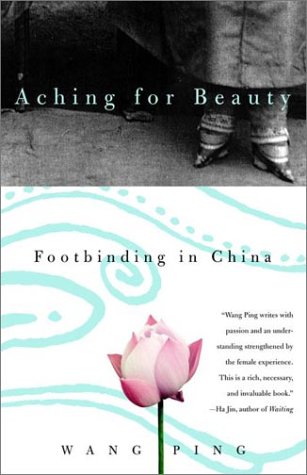 Aching for Beauty, by Wong PING. 2000, Minneapolis: University of Minnesota; ISBN 978-0-8166-3605-1, soft back, bibliography, b/w images, 288 pp. Price: USD 30.
Aching for Beauty gives a personal insight in the Chinese tradition of footbinding. It not only describes the process, which is fascinating in itself, but more importantly it illuminates the world in which this custom came to be. Wang Ping includes the social standards and the position of women in society during the 19th and 20th centuries in which footbinding was in fashion. She describes the relationship between mothers and daughters and the sometimes seemingly cruel choices that mothers had to make in order to give their daughters the best (marriage) chance for a good future, which would benefit the girl and her family.
The book shows a world of social status, love, pain, taboos and even erotic fetishism. Footbinding proves to be much more than just painfully tiny feet and beautifully embroidered shoes. Small feet were also represented in many forms of art and literature and this book provides a comprehensive account of the social standards and history of footbinding.
Recommendation: the book will be interesting for anyone who wants to learn more about the footbinding tradition and/or is interested in women's history.
M. de Nijs
****
A Cultural History of Fashion in the 20th and 21st Centuries: From Catwalk to Sidewalk, by Bonnie ENGLISH. 2013 (second edition). London: Bloomsbury. Softback; well-illustrated with both black/white and colour photographs, long bibliography. Price: £16.95.
 This book has been adopted as a textbook in fashion schools and it is easy to see why. It's a solid introduction to fashion history and to the significant social importance of fashion. The language is accessible and its coverage of relevant issues (e.g., changing gender roles, branding, sustainability, globalization, social media, etc.) comprehensive. The colour photographs help bring the subject matter alive. Major trends, such as art, politics and advertising media, that have influenced fashion in the last 150 years are identified and explored. For example, in Europe the Surrealist art movement, and its more recent step-child, Neo-Dadaism, inspired Elsa Schiaparelli and Viktor & Rolf, respectively.
Some of the most enjoyable sections look at both commercial and cultural influences on important fashion designers, such as Japanese designers Issey Miyake, Yohji Yamamoto and Rei Kawakubo, and their more conservative American counterparts, Lauren, Klein and Karan. The emergence of China and India's fashion design industries are also explored.
Recommendation: In short, whatever the style, from haute couture to punk, fashion reflects the values of its society. This book is a good balance of interesting anecdotes and modern fashion theory, which means the book will appeal to both the general reader and to fashion scholars.
SA
*****
 The Encyclopedia of Machine Embroidery, by Val HOLMES. First published 2003; soft back version 2008, London: Batsford, ISBN 9782906388188 (softback). 192 pp., colour illustrations, bibliography. Price: c. £16.
A well-illustrated and useful book about machine embroidery techniques, equipment and materials. The book, as one might expect from an encyclopaedia, is arranged in an A-Z format. It includes items relevant both to free motion and computerised machine embroidery. The subjects covered range from alphabets, applied forms, needles, stitches, threads of various types, tension and how to achieve different effects, traditional and modern designs, use of plastics and synthetic threads and materials, to the zipper foot. The bibliography/recommended reading is remarkably short, namely eight books, but the experience of the author comes through.
Recommendation: a useful book for anyone interested in machine embroidery, but also for textile libraries, as it explains both basic and more advanced terminology in a readable manner.
GVE
*****
Fashion and Orientalism: Dress, textiles and culture from the 17th to the 21st century, by Adam GECZY, 2013. London: Bloomsbury, ISBN: 978-1-84788-599-9, 255 pp, b/w illustrations, bibliography. Also available as an eBook. Price: Price: £19.95.
 Geczy points out early in the book that there is a great deal of cultural borrowing when it comes to clothing, dress and attire in the west, and that a lot of these come from the Orient. Chronologically laid out the book starts with the popularity of Eastern produced textiles among the elite in Europe from a pre-Orientalist period (16th century onwards), all the way down to Orientalist influences in postmodern and contemporary couture shows. He takes several specific topics, such as the wave of Egyptomania that followed the invasion of Egypt by Napoleon in the late 18th century and the Japonerie that was so popular in the late 19th century.
It is surprising however, that with such a subject, hardly any visual examples are given, none of the 44 pictures are in colour and most of them focus on the Far East rather than the Middle East. The writing is very complex and at times very metaphorical which requires a lot from the reader. The main focus of this book seems to give general information and observations. Hereby the focus is mostly on the historical and less so on the practical side of the actual textiles and garments. The Far East is the main topics so it eems, whereas the Middle East and North Africa also fall under the scope of Orientalism. All in all Gezcy left a lot of gaps to fill, and leaves the reader to visualize a lot for him or herself.
Recommendation: for historians who are interested in dress and textiles, but who want to focus more on general ideas and the dynamics of world trade than the actual garments and materials.
RM
*****
Islamic Fashion and Anti-Fashion: New Perspectives from Europe and North America, edited by Emma TARLO and Annelies MOORS, 2013. London: Bloomsbury, ISBN: 978-0-85785335-6; colour and b/w illustrations, bibliography. Also available as an e-Book. Price: £19.95.
Is there such a thing as Islamic fashion? Or is that an oxymoron? This book tries to look at Islamic dress in both Europe and North America from a number of perspectives. Divided into five sections it contains papers from disciplines such as anthropology, history, religious studies, media studies and fashion studies. The first section explores specific locations and dynamics of encounter, such as burkini's in Swedish pools; Islamic dress in Poland and the South Asian aesthetics that mark the Islamic fashion in London. Section two digs into the history and narratives of Islamic fashion. Şule Yüksel Şenler, a style icon of Islamic Urban fashion in the late 60s, is presented alongside the development and changes in style of the Pardösü (overcoat) trends among Turkish-Dutch women. The third section looks at the market of Islamic fashion and has among it some interviews with Muslim women who work in retail. Islamic Fashion in the Media is the fourth section that is illustrated with the exoticised images of 'Muslim women' as well as modern fashion-hijabi's from all over the world, who rose to stardom through social media. The last section explores the anti-fashion side of Islamic dress and the dynamics of negotiation by some converts who, upon converting, want to change their outward appearance.
Recommendation: This book is a great new way of researching Islamic fashion in the West. Especially interesting for those with an anthropological background and with an interest in fashion and the dynamics of (different kinds of) Islam in the West.
RM
*****
The Swimsuit: Fashion from Poolside to Catwalk, by Christine SCHMIDT. 2012. London: Berg. ISBN 978-0-85785-123-9; softback, black/white illustrations, bibliography. Also available as an e-Book. Price: £19.95.
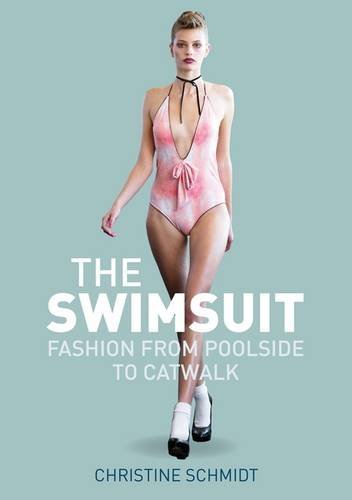 The history of the swimsuit begins in the late 1800s, with the rise of increasing leisure time for many in Europe, the USA and Australia, and an also increasing interest in fitness and sport. In terms of style, the swimsuit's origins lie in humble underwear. A male Victorian swimming suit was a cotton or woolen one-piece that covered torso, arms and thighs. Women wore a swimming dress, of the same material, with drawers down to the ankles. As cumbersome as this sounds, it would get worse for women. In the 1870s men's suits would be sleeveless. Women's swimsuits, however, started to include corsets, stockings and shoes, all of which might weigh up to 30 pounds.
How did fashion move from this to bikinis and thongs? That question forms the most interesting part of Schmidt's book. She argues that swimsuit development, unlike most fashion trends, did not trickle down from the rich and famous, but was a more democratic process. Circus performers and entertainers like Esther Williams, athletes like Australian swimmer Annette Kellerman, and ordinary women and men who resisted restrictive modesty laws in order to enjoy a day at the beach all contributed to the swimsuit we know today.
Recommendation: This book will appeal to academic and non-academic readers alike who are interested in swimsuits, in beach culture (especially in Australia) and in ideas about modesty and what parts of the body can or cannot be revealed to the public gaze.
SA
*****
Some Greek textile and embroidery books:
During a visit to Athens in July 2014, the TRC was able to purchase a number of books about Greek textiles and embroidery, notably at the Benaki Museum and the Greek Folk Art Museum (textile and costume building). Although some of these books are much older than are normally included in the Annotated Book section, it was felt that it would be useful to draw attention to these works. All of these books can be found in the TRC library, Leiden.
*****
Embroideries, by Amalia MEGAPANOU, 1983 (in Greek and English), Athens: Benaki Museum. pp. 24 numbers, with more illustrated pages with no page numbers; colour and b/w illustrations. Price: €.....
Basically this is a pattern book that draws its inspiration from a wide variety of textiles, woven, printed and embroidered, from different Mediterranean cultures, which are now in the Benaki Museum collection. The author uses a small number of vertical stitches (brick stitch, satin stitch and so forth), to create a series of designs that can be adapted. She also encourages the reader to look at textiles and adapt designs to their own needs. The book is of interest as it shows one way that older textiles from a variety of backgrounds can be used and then absorbed into another culture.
Recommendation: the book is intended to simulate beginners to embroider and to extend their repertoire through looking at older designs for inspiration. At the same time the form of the embroideries illustrated keep a 'Mediterranean' feel.
GMV
*****
Παραδοσιακες Βελονιες από τη Συλλογή του Θεατρου "ΔόραΣτρατου" by ΔΗΜΗΤΡΑ ΠΑΠΟΥΤΣΟΠΟΥΛΟΥ (in Greek; Traditional needlework from the collection of the "Dora Stratou" Greek Dance Theatre, by Dimitra Papoutsopoulou), 2008. ISBN 978-960-244-121-3; Athens: Piraeus Bank Group Cultural Foundation, 322 pp; bibliography, colour plates and b/w line drawings; illustrated glossary, no index. Price: €60.
A heavy book (literally) that is divided into two main sections. Firstly, there is an explanation of a wide range of hand embroidery techniques associated with Greek embroidery. As noted in the title, the Dora Stratou collection of costumes has been used as the basis for the book. The dance group was set up in 1953 by Dora Stratou and has a collection of over 2000 garments from all over Greece, many of which were and still are worn on stage by the dancers. In addition, they make replica garments for dancers (both individuals and groups).
A total of 128 forms (in Greek alphabetical order) are systematically explained in this section, including various counted thread, free style, metal thread and combined techniques. This information is presented with both 'normal' and close-up colour illustrations of the various techniques described, as well as line drawings and texts explaining the process.
The second section is much smaller and is basically a glossary of the main techniques with colour illustrations of each type.
Recommendation: The main 'problem' is that the text is written in Greek. Nevertheless, it is a must for a textile or embroidery library that focuses on traditional embroidery techniques and forms. This book will be used by the TRC to help create a multi-lingual embroidery glossary.
GMV
*****
Embroideries and Jewellery of Greek National Costumes, by Popi ZORA, 1981, in Greek and English; Athens: Museum of Greek Folk Art, Ministry of Culture and Sciences, 38 pp. of text, plus numerous colour plates of individual items; bibliography. Price: €8.
A general introduction to the main types of Greek regional dress, jewellery and embroideries. The main types of garments and jewellery associated with Greek dress are described and illustrated with a number of examples. While reading the text it would appear that the author is more comfortable describing clothing and jewellery than embroidery.
Recommendation: Although some of the information is now out of date, this book provides a good starting point for anyone interested in the subject of Greek regional dress and accessories.
GMV
*****
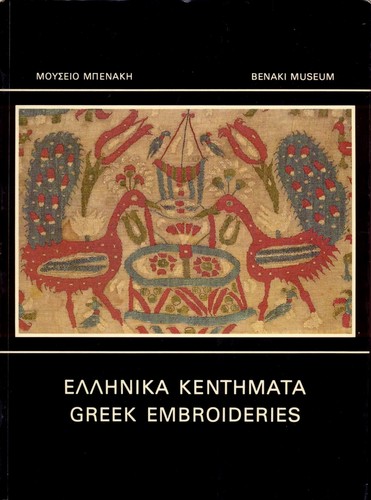 Greek Embroideries, by Helen POLYCHRONIADIA, 1980, in Greek and English; Athens: Benaki Museum, 118 pp., colour and b/w illustrations, bibliography, glossary and index. Price: €12.
A catalogue of the main types of embroidery and lace forms in the Benaki collection (since expanded in size). The introduction by Helen Polychroniadia provides a basic framework, as well as many extra details, of the main forms of Greek mainland and Island embroidery techniques and how they were used. The illustrations are mainly in black and white, which is a drawback, but they make sense of the complicated history and many forms of Greek embroidery.
Recommendation: A good introduction to a complicated subject, which makes this a useful book to have in any embroidery library.
GMV
*****
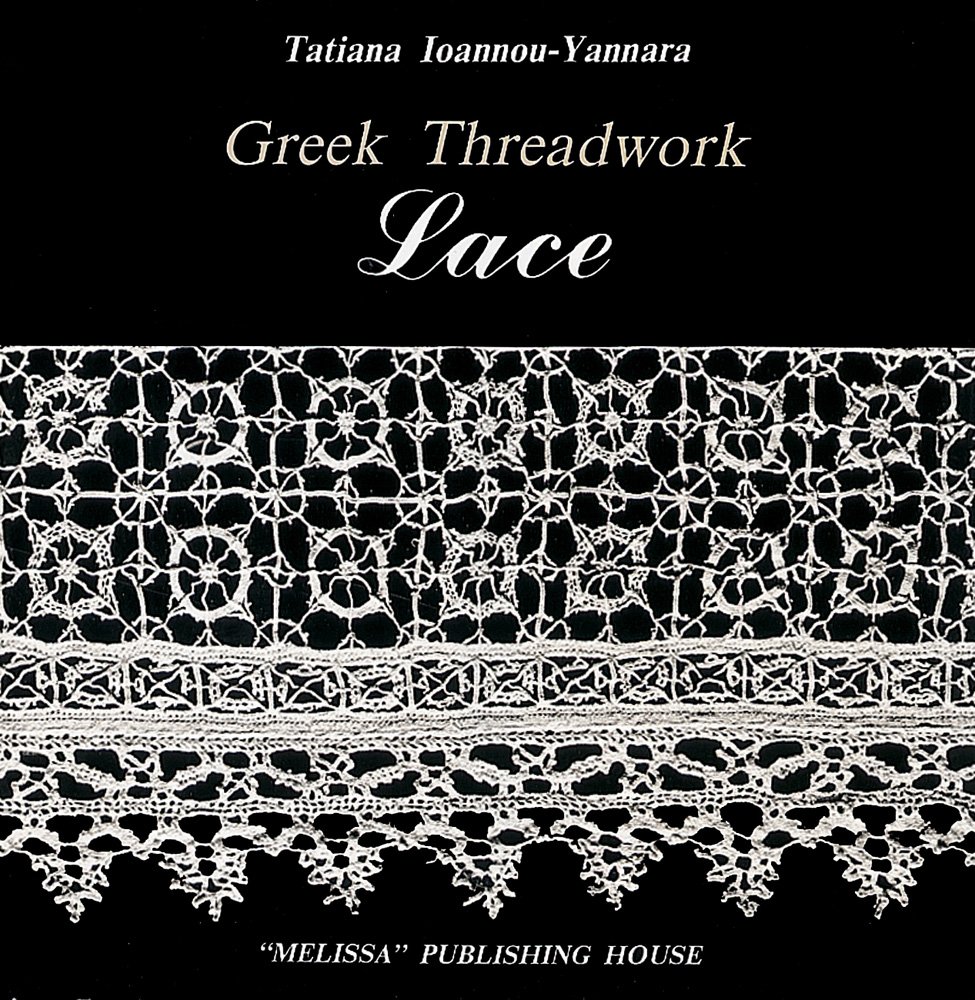
Greek Threadwork: Lace, by Tatiana IOANNOU-YANNARA, 1989. Athens: Melissa Publishing House, pp. 251, colour and b/w illustrations, glossary, bibliography. Price: c. €30.
A detailed account of the main types of needlelace associated with Greece, both mainland and islands forms. The author describes in detail the various types, how they were made and gives illustrations of historical examples. The examples given come from various collections, notably the Benaki Museum, the Greek Folk Art Museum, National Historical Museum, as well as private collections (monastic as well as domestic). Examples of Asian commercial pieces (notably from China and Japan) are also given.
 The author divides Greek lace (dantela) forms into the following basic types:
- Interlacing or tying of the threads by hand, without auxiliary tools
- Creation of knots with the assistance of a shuttle or sewing needle
- Bobbin lace
- Knitted lace
The book explores archaeological and historical evidence for these different forms.
Recommendation: a must for anyone interested in the history of lace in all its forms. This study is particularly strong on the various types of needle laces associated with this part of the Mediterranean world.
GMV