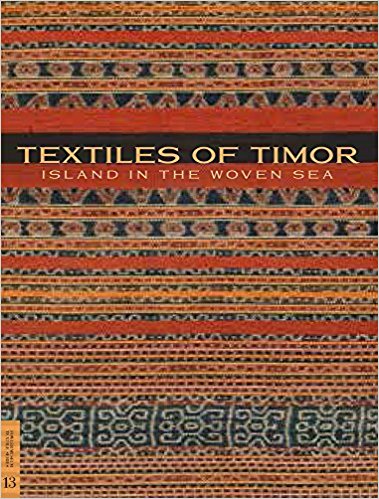
 HAMILTON, Roy W. and Joanna BARRKMAN (eds., 2014). Textiles of Timor: Island in the Woven Sea, Los Angeles: Fowler Museum Textile Series no. 13. ISBN 9780984755080, soft back, 252 pp., fully illustrated with colour photographs, bibliography. Price: US$ 50.
Timor, with a population of over three million people, is an island set between Australia and Indonesia. Half of the island is the independent country of Timor-Leste, while West Timor is a part of Indonesia. This collection of eleven essays gives a comprehensive ethnographical view of Timor and its rich weaving traditions. Textiles reflect Timor’s complex history. High status women’s tube skirts (originally made from locally produced cotton) may be decorated with silk yarn, first introduced by Chinese traders. In some areas traditional motifs have been replaced by Christian images, reflecting Dutch and Portuguese influences. Sometimes specialized weavers make imitation patola designs, based on textiles imported by Indian traders. The idea of democracy means that many traditional high status and distinct clan designs are being abandoned in favour of an emerging new 'Timorese' style, while cheap textiles from Indonesia and the West mean that some villages have lost their weaving tradition all together.
The information on motifs and the main decorative techniques (e.g., warp float, warp ikat and supplementary-weft wrapping) is detailed and informative, as is an essay on local plants used in sizing and dyeing, and the woods involved in making spindles. This collection of essays also look at the role textiles have in maintaining communities' sense of identity, and at the ritually-charged nature of many aspects of textile production, such as dyeing and weaving. The profuse colour photographs that appear on each page are excellent.
Recommendation: This book will interest curators, collectors and anyone who wants to learn more about Southeast Asian textiles in general, and Timorese textiles in particular.
Shelley Anderson