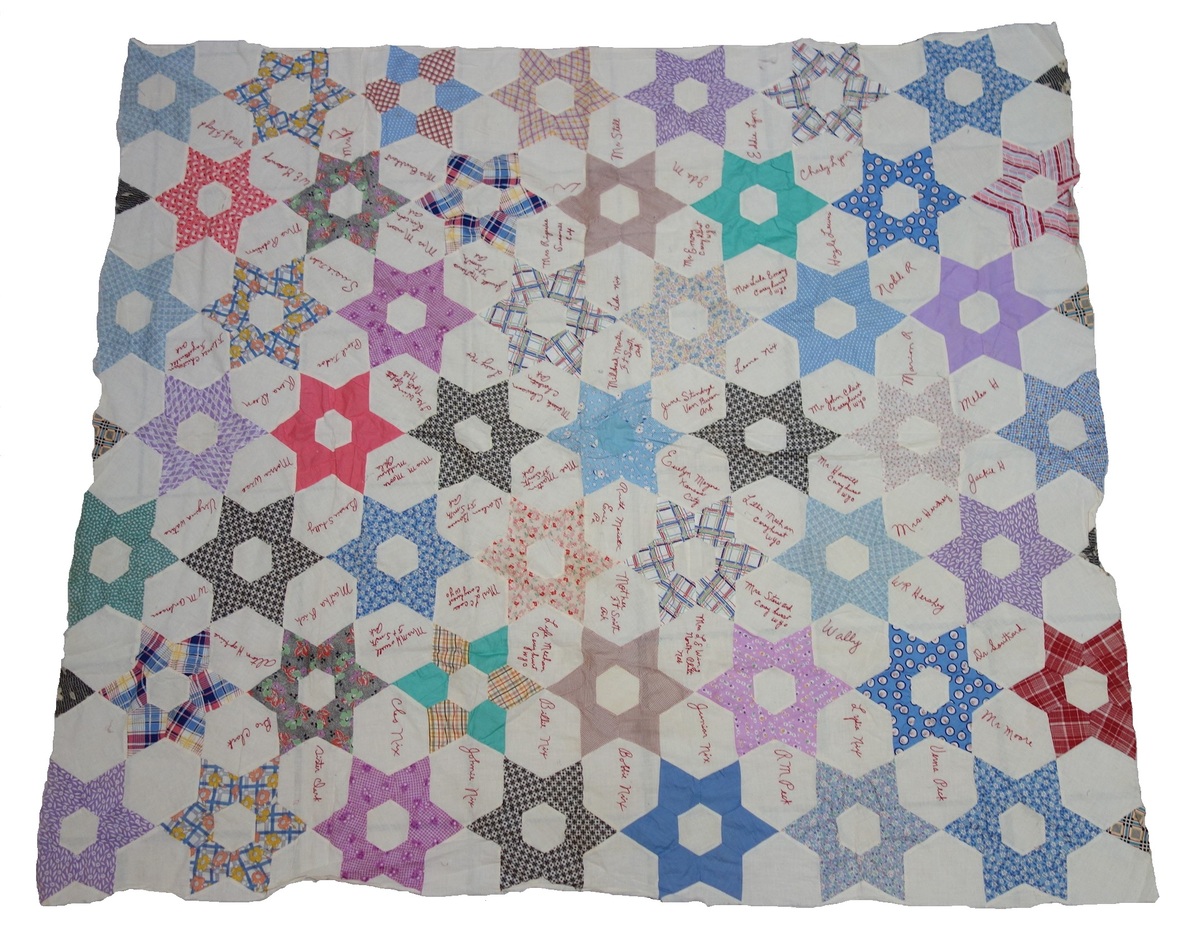
On Wednesday, 29 April 2020, Beverley Bennett and Susan Cave wrote about the sometimes curious names given to the types of quilt and quilt blocks in America:
Many of our TRC visitors and blog readers have asked us about quilt names. There are thousands of them, and sometimes we struggle to find the correct one for the era as fashion in quilt patterns are like children’s names when the “Emily and Charles” of one generation become “Kylie and Storm” in another. If the quilt comes with a name given by the maker, we stick to it, even if it doesn’t tally with the official block name in our reference books. That way, we keep the maker’s vision and preserve her name for it accordingly.
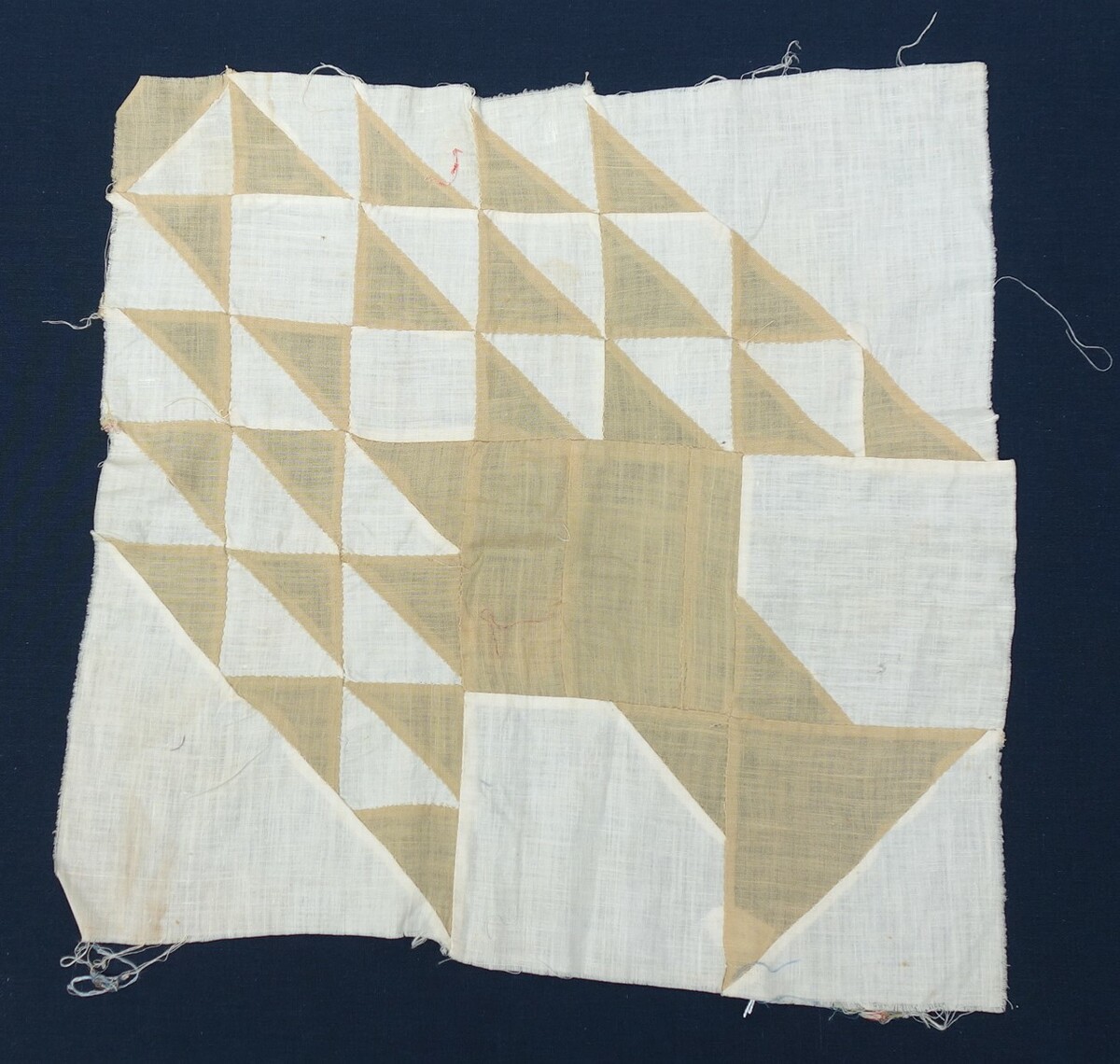 American quilt block, late 19th century, with 'Pine Tree' motif (TRC 2019.2047).
The names of some simple blocks are obvious and have remained unchanged, such as the Four Patch (2019.2532) and the Nine Patch (2019.2473). Other block names are purely descriptive and their origins can clearly be seen. Examples in the TRC Collection include Baskets (2018.3127 and 2019.2014), the Bow Tie (2019.2046), which was a very common pattern in the 1930’s, the Pine Tree (2019.2047) and the Pinwheel (2019.2526). Stars of all descriptions are a popular choice for names. Those in our collection include the Lone Star (2018.3118) and the Feathered Star (2019.1106), along with a spectacular Starburst (2018.3119).
However, there are some names that may have been clear at the time the block was named, but not so clear to us today, such as the Churn Dash (2018.2617q), which was the name of the implement used to churn butter and looks much like the block in cross section. Also, the TRC has several Sugar Cone blocks (2017.4351a, 2017.4351b), which date back to the days when sugar was sold in a cone-shaped solid block and had to be cut to be used.
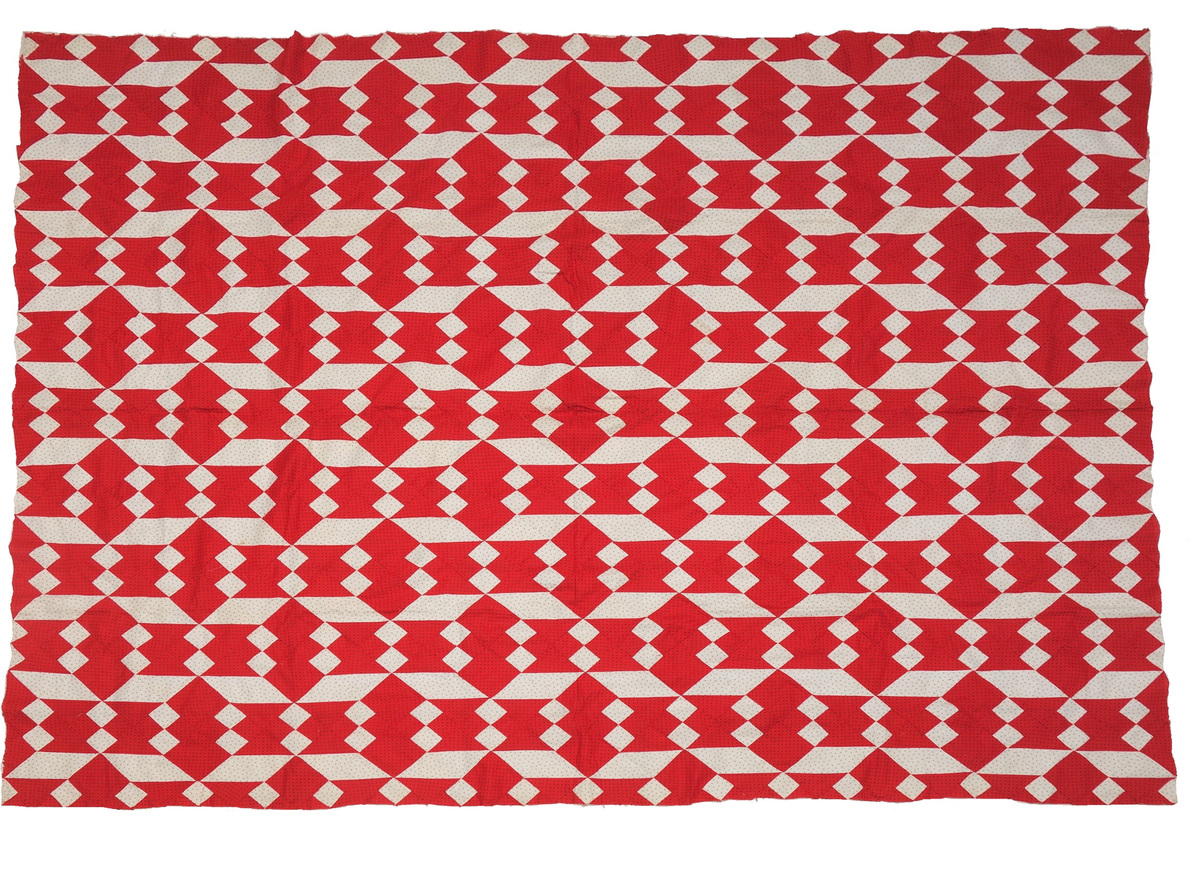 Quilt top, USA, 1930's, with 'Jacob’s Ladder' pattern ('Steps to the Altar' variation) (TRC 2018.2411).
The Bible was the most important book in early America, so it is not surprising that many quilts are named from the verses. Faith sustained families going through hardship and danger, as migration pushed them steadily across the country. Quilts made on journeys reflect this for example, with names such as Job’s Tears and Job’s Troubles. Others biblical patterns include Crown of Thorns, The Garden of Adam and Eve and Cross and Crown. The TRC has a quilt top called Jacob’s Ladder (Steps to the Altar variation) in red and white (2018.2411). The Old Testament book, Song of Solomon, was a favourite for young girls as it was slightly saucy, an example being The Rose of Sharon appliqué pattern. The TRC holds a Rose of Sharon cluster appliqué quilt (2018.2405). Designs also came from literature, Sir Walter Scott’s Lady of the Lake, and John Bunyan’s Delectable Mountains from Paradise Lost.
Pattern names changed with the move west. The Eastern Star in Pennsylvania gradually became Tippecanoe and Tyler, the Ohio Star, the Lone Star and finally the Texas Star, which follows the story of not only the pioneer family, but their contact with American Indians and adaptation to the new environment across the different Indian territories and states.
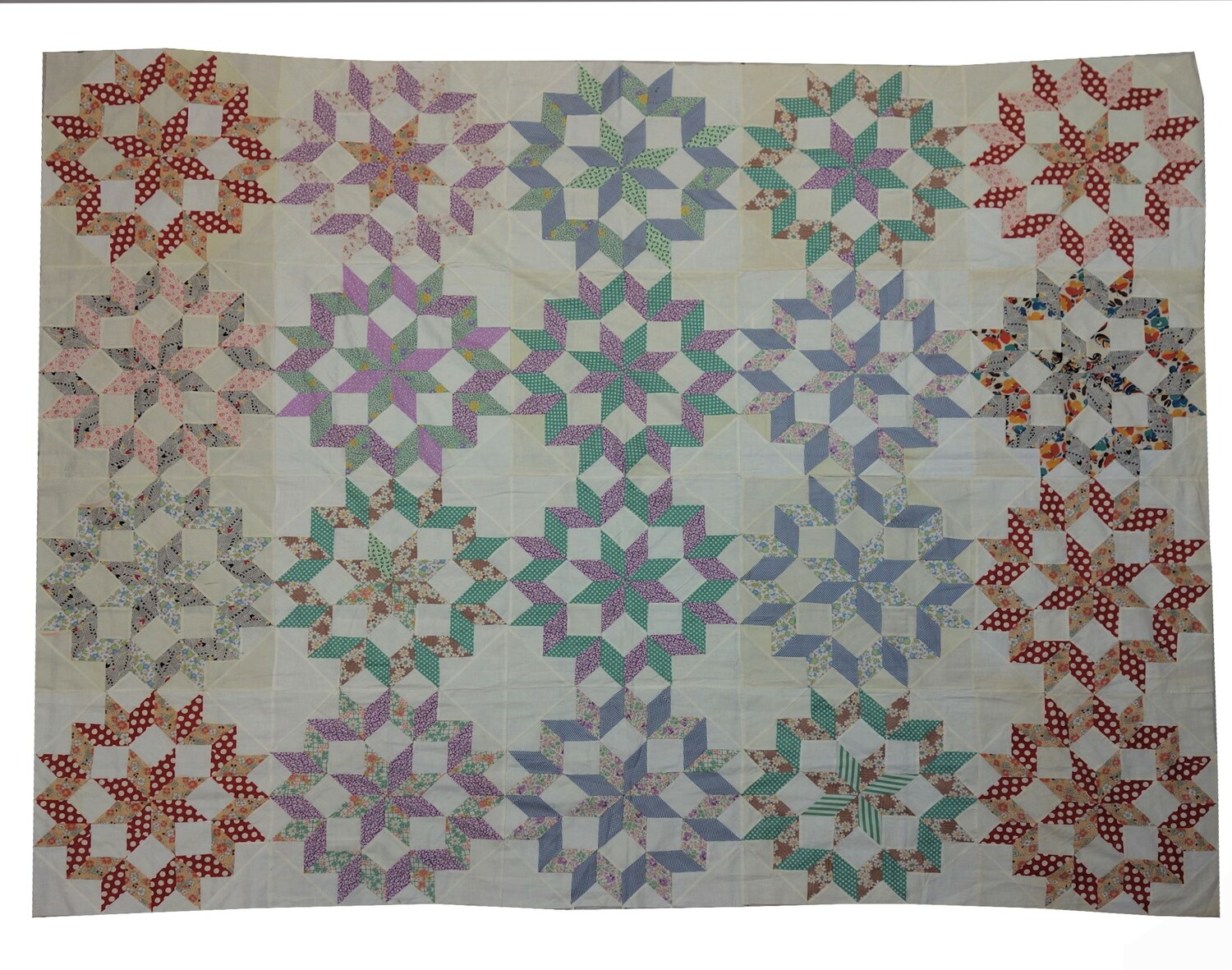 Quilt top, USA, 1930's, with 'Dutch Rose' pattern (TRC 2017.4291).
The Dutch have contributed to American quilt pattern names too. Like the English migrants of the 18th century, the Dutch had a tradition of patchwork but mainly in mosaics (hexagons, triangles) which became Grandmothers Flower Garden in the New World. We have two mosaic Snow Crystal blocks – 2018.2617g, 2018.2617h – which are a variation of Grandmothers Flower Garden and a Dutch Rose quilt top (2017.4291) also known as a Carpenters Star.
Since women made the quilts, it is surprising that many of the names are seriously masculine. Barn Raising, the Anvil, Indian Hatchet and the many varieties of Sawteeth are just a few. One of the most graphic (and most beautiful, an eight-pointed star with sawteeth) is Chips and Whetstone. The whetstone was carried by the man of the house to sharpen his axe, which he then used to make wood chips out of ash, oak and hickory logs. There are also designs reflecting America’s dependence on the mercantile trade, such as Mariner’s Compass and Ocean Waves. Hardly female pursuits! However, some block names are specifically named after women. There are a series of blocks named after President's wives, such as Martha Washington’s Star and Mrs. Cleveland’s Choice, which we have in the collection (2018.2625).
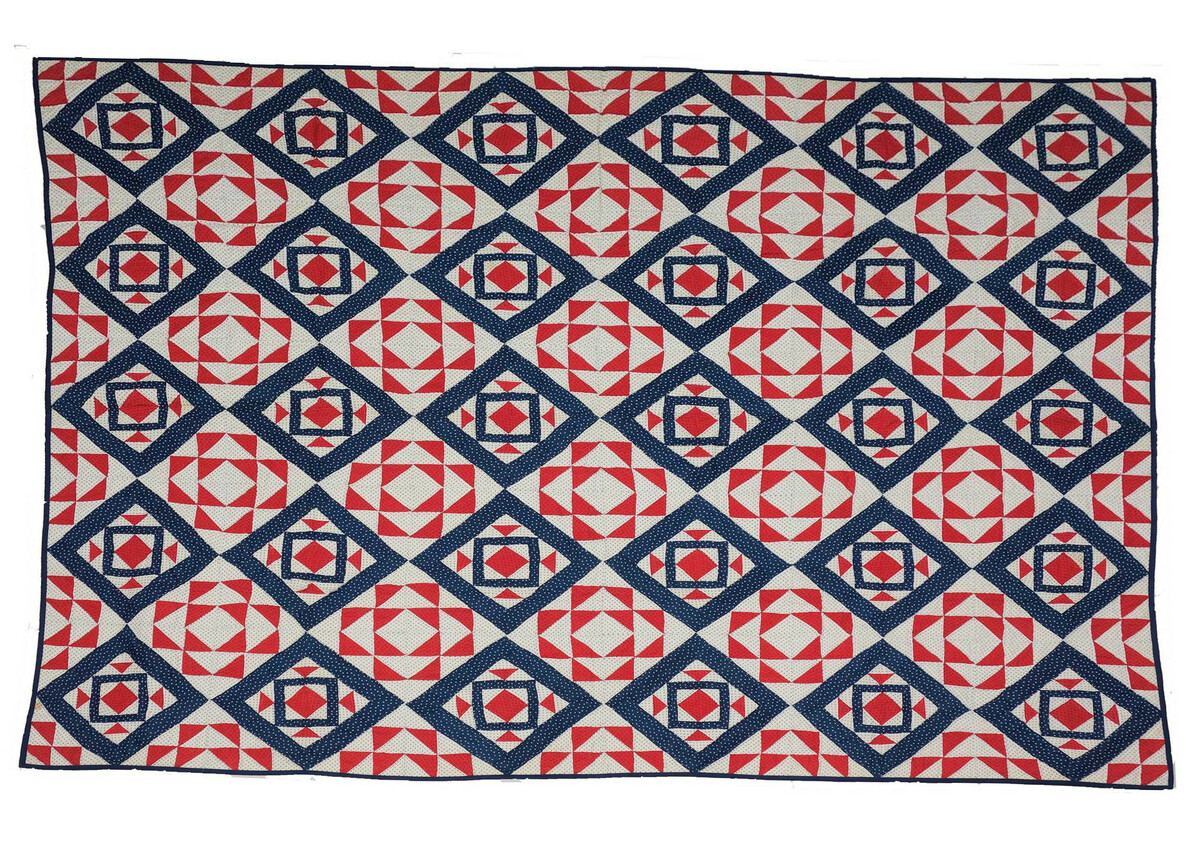 Quilt top, USA, late 19th century (TRC 2018.2625). The decoration is named 'Mrs Cleveland's Choice,'
Perhaps the most significant quilt names are those where women expressed their political opinions and sentiments long before they received the vote in 1920. In an environment dominated by men, a quilt block emerged in the 1840’s called 54-40-or Fight, which signifies the latitude of the northern American boundary. Clay’s Choice is also early as the popular statesman, Henry Clay, became famous for his anti-slavery statements around the same time. Radical Rose is a block with a black centre expressing sympathy for the abolitionist movement. The Whig Rose and the Harrison Rose are clear political messages.
Quilt block names are symbols of the daily lives of Americans, infused with meaning for us to decipher and to imagine the life and times of the maker. You may think our reference books, with many thousands of patterns, would tell us everything we need to know. Ah, no. We have one block at the TRC that we simply cannot name but we live in hope, so watch this space!


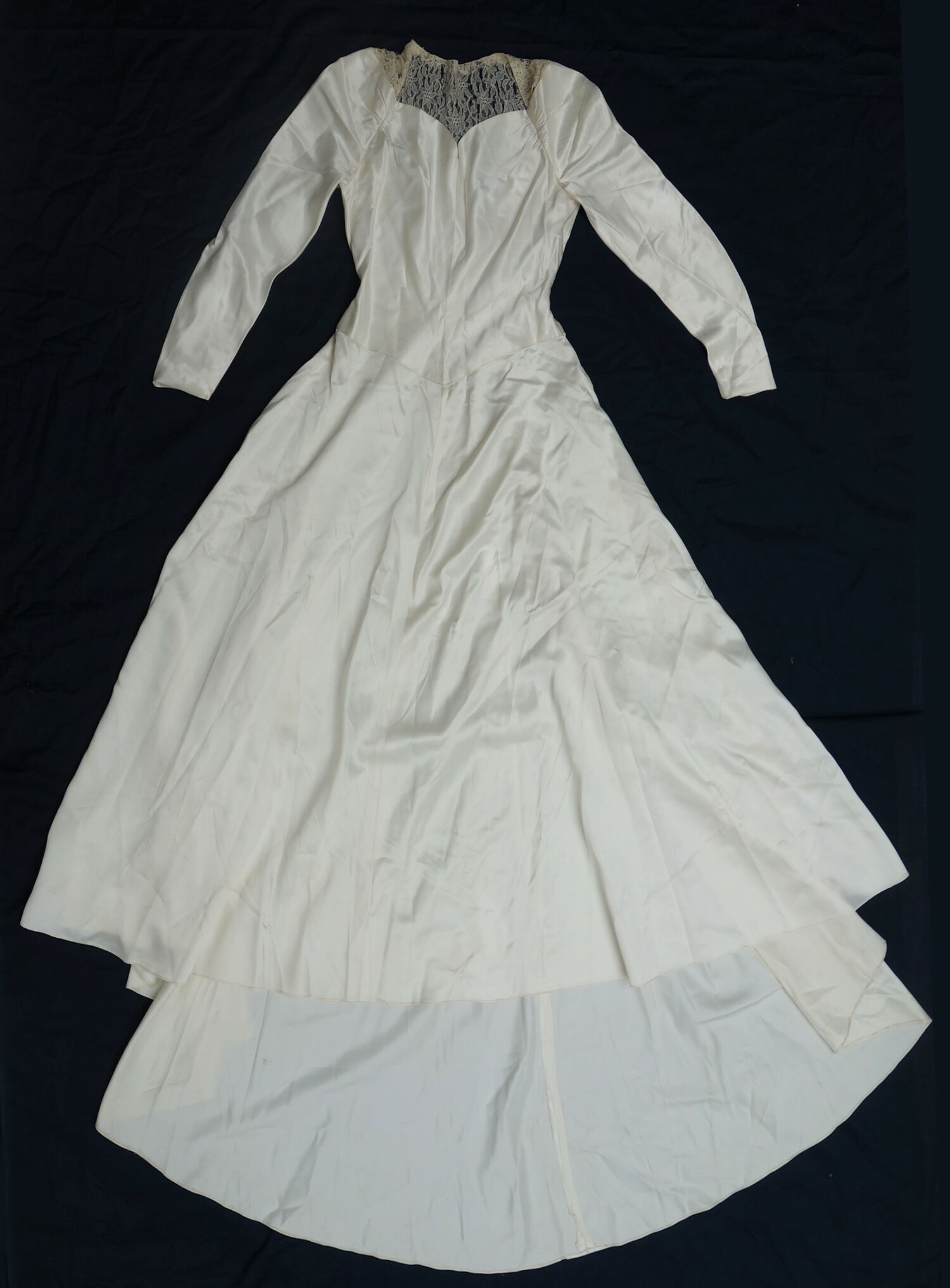 American wedding dress, 1942 (TRC 2020.2126).