Among the embroidery samplers kindly given to the TRC in Leiden by Betteke Boele-Vogelesang on the 8th April, were a few that were made in the Berlin wool work style (for more information on this gift click here). Since then, we have had several requests for more information about these pieces.
 School sampler by Minke Siemen (c. 1870, The Netherlands; TRC 2020.1630)
Berlin wool work, or briefly Berlin work, is a style of embroidery that is normally associated with the use of woollen yarn (tapestry yarn) on canvas or on an even weave cloth (generally in either linen or cotton). The same charts for this type of embroidery were used for beading and knitted forms. This type of work was traditionally carried out in many colours to produce intricate, almost three-dimensional effects.
Berlin wool work started in the late 1820’s in Berlin (Germany) and initially using Berlin wool (a local form of sheep). The designs were made on graph paper and had symbols that were hand painted to give the ‘correct’ colours. Later these were machine printed in colour. The early examples of patterns were all produced in Berlin, but this form quickly became popular and they were soon being produced in other parts of Germany, Austria, The Netherlands as well as in France, Britain and elsewhere. Berlin wool work became a rage from about the 1840’s -1870’s as it was relatively easy to carry out (only using a minimum of stitches, normally cross stitch, tent stitch and sometimes eyelet holes), and the new aniline dyes.
These new dyes were invented in the 1820’s, but it was not until the 1850’s that a range of bright colours became available. The downside to the use of aniline dyes, however, was that they were not stable and often, if an embroidered object was washed, the colours would run.
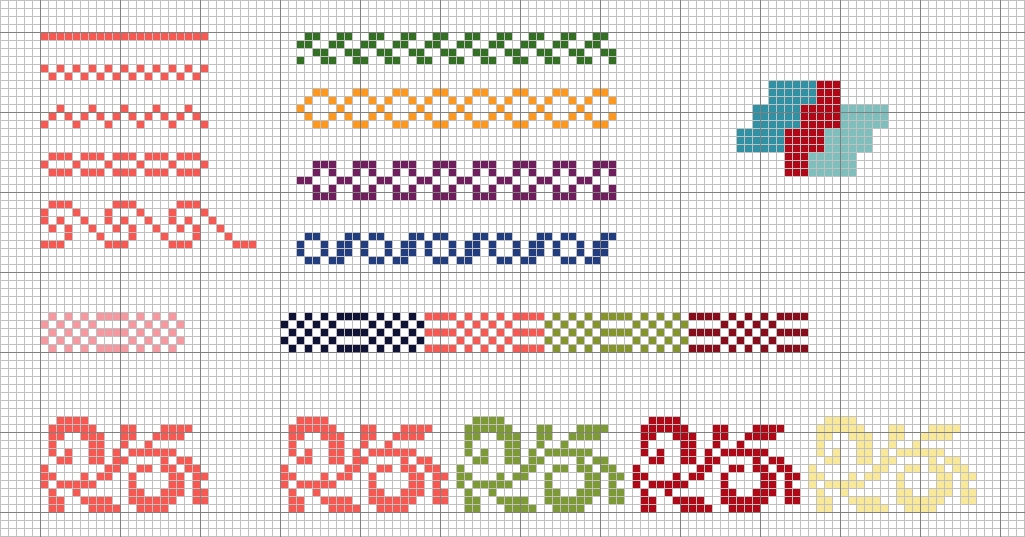 Border designs from various school samplers using Berlin wool work motifs.
The patterns associated with Berlin wool work included simple border designs to complicated floral designs, religious scenes, copies of well-known pictures, as well as a wide range of small animal and bird motifs that were placed as ‘sprigs’ (individually) on a ground. They were also often very sentimental!
Patterns were often published as single sheets (charts) for large designs, or as a range of small, related patterns, such as roses, often with four to eight designs to a sheet. Selling the patterns as individual sheets made it much easier and cheaper for people to buy a particular design – it was not necessary to purchase a whole book just for one or two patterns or motifs.
 Star design from a school sampler using Berlin wool work motifs (D.H. aged 11 years old, c. 1870; TRC 2020.1629).
By the mid-nineteenth century Berlin work had become extremely popular and patterns were being exported throughout northern Europe and North America. Berlin wool work was used for covering a wide range of objects, including samplers of various types, soft furnishings, such as chair seats and backs, cushions, curtains, footstools, fire-screens, ‘paintings’, as well items of clothing and accessories including bags, belts, book covers, caps, purses, slippers, tobacco pouches, just about anything that could be covered.
In the late 1880's the demand for Berlin wool work decreased due to changes in popular taste, and a desire for simpler and less ‘cluttered’ designs (the influence of the Arts and Crafts Movement, as well as Art Nouveau and later Art Décor forms).
But the attitude of domestic embroidery consisting of ‘only’ cross stitch designs has had a lasting and somewhat negative legacy, which was reinforced from the 1960’s onwards with the widespread introduction of cross stitch embroidery kits.
Berlin wool work school samplers
Generally speaking, school samplers are small items worked by girls in schools. Most of these girls would have been between 7 and 14 years old (when many left school). Berlin wool work style samplers were popular between the 1860’s and 1870’s and started to vanish in the 1880’s when the school samplers of so-called red work, based on published ‘recommended’ practical forms, became widespread.
The examples of Berlin wool work style school samplers given to the TRC Leiden by Betteke Boele-Vogelesang are:
- Jane Hardy, aged 10, Burton Leopard, 1872 (England, TRC 2020.1606)
- H.O. Oud, aged 12, 1879 (The Netherlands; TRC 2020.1627)
- J.B.V. Oud, aged 7, 1875 (The Netherlands; TRC 2020.1628)
- D.W., aged 11, c. 1870 (The Netherlands; TRC 2020.1629)
- Minke Siemen, c. 1870 (The Netherlands; TRC 2020.1630)
 Some animal and bird motifs worked in Berlin wool work school samplers of the late 19th century.
Gillian Vogelsang, Director TRC, 14 April 2020