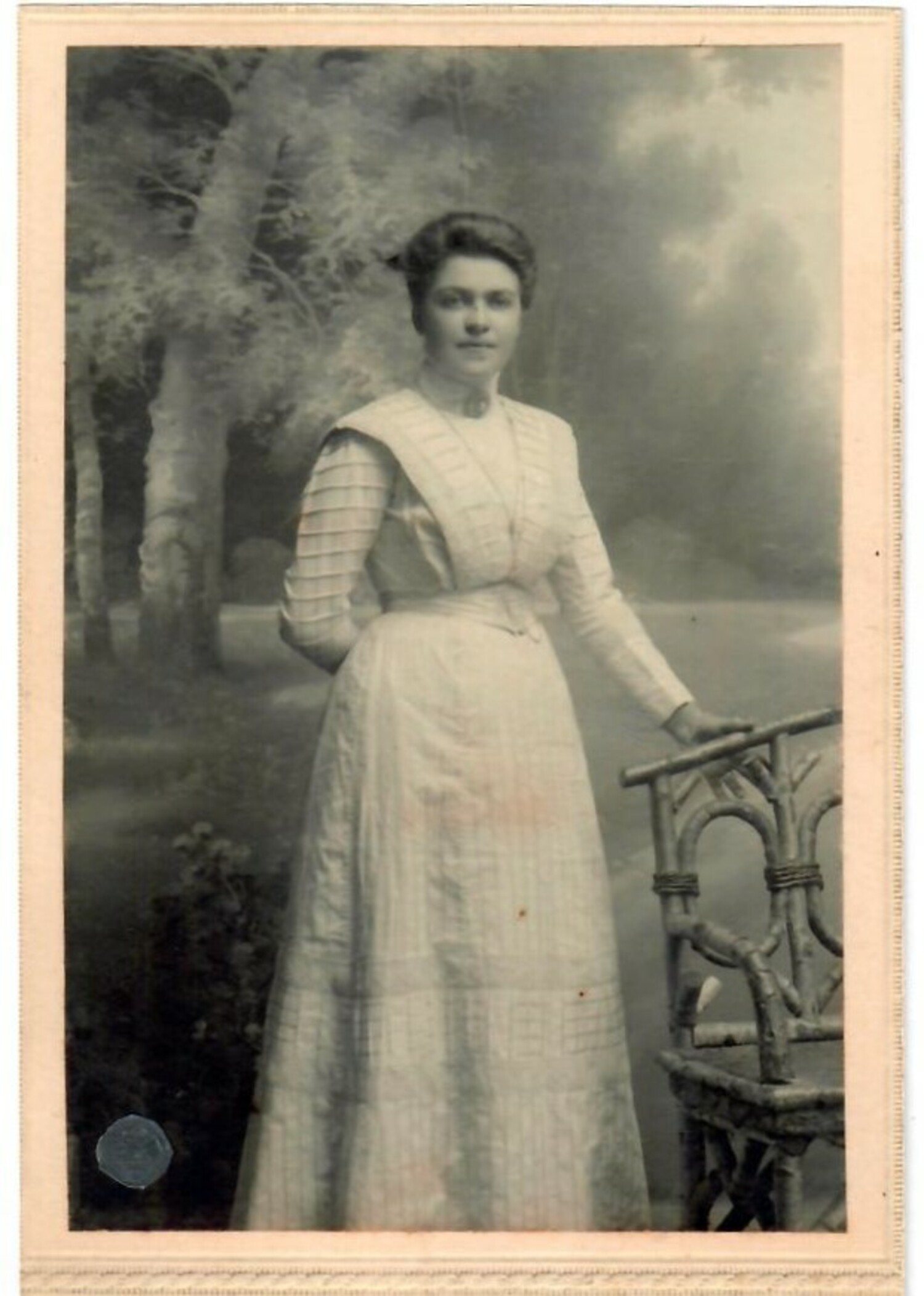
 Photograph dated c. 1914 of Anna Berendina Bennink (1890-1918) (TRC 2020.3535b), who made the 'pronkrol' (TRC 2020.3535a) and sadly died in the Spanish Flu pandemic of 1918-1919.A few days ago we were given a pronkstuk (also known as pronkrol; TRC 2020.3535a) that has opened up various discussions. As noted in an earlier TRC Blog, a pronkstuk is a long length of cloth, usually made up of smaller panels, that traces the needlework development of a schoolgirl. Such rolls were used as a form of diploma to show prospective employers that the girl could do a wide range of plain and decorative needlework.
This particular roll was donated to the TRC by Marjo Bennink, and it was originally made by her great-aunt, called Anna Berendina Bennink (1890-1918), who came from Brummen, near Arnhem, in the east of The Netherlands. The roll is dated to 1905 and 1906, indicating that she would have been 15-16 when she made it. It is currently 592 cm long and 26 cm wide, and unusually, part of it is double sided.
In another blog a few weeks ago we talked about the TRC’s collection of carte de visite photographs and how in these cases we had a photograph of a person, but no further details. The pronkstuk is different, because with this gift we were also given a photograph and further information about Anna Bennink, and we have added the photograph to the TRC Collection (TRC 2020.3535b). It is nice to have a face, name and an object relating to the same person.
 Dutch 'pronkstuk' needlework sampler (592 x 26 cm), made by Anna Berendina Bennink in 1905-1906 (TRC 2020.3535a).
On a sadder note, we also know what happened to her. She was married on 14th June 1918, but sadly soon after, on the 16th October 1918, she died. Not in child birth, as so often was the case with women of her age, instead she was one of the millions of victims of the Spanish Flu pandemic of 1918-1919, which coincided with the end of the First World War (1914-1918).
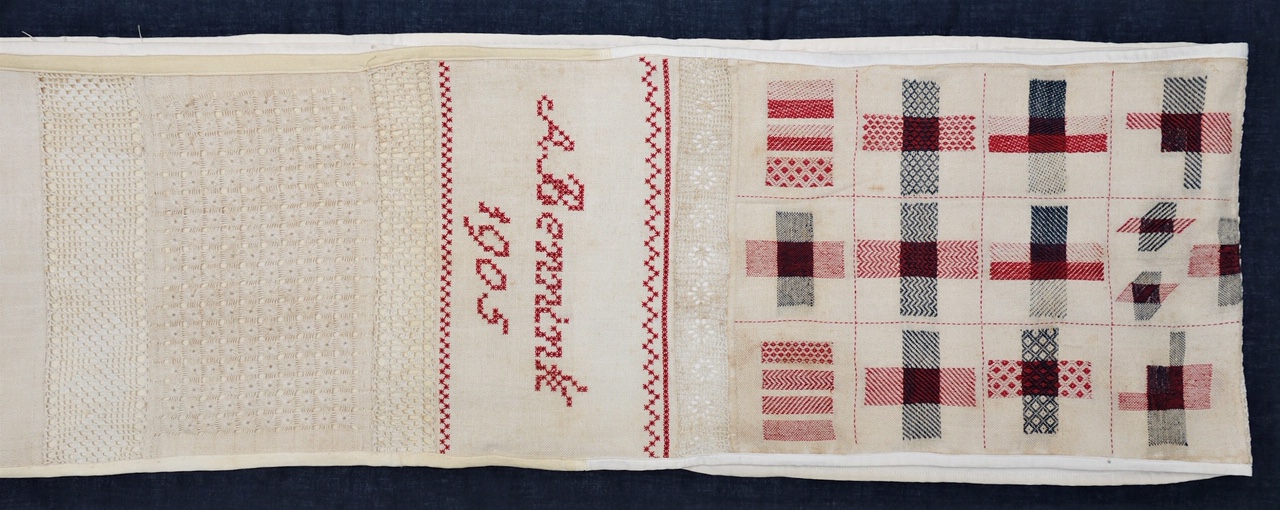 Detail with a date and the name of the embroiderer, of Dutch 'pronkstuk' needlework sampler (592 x 26 cm), made by Anna Berendina Bennink in 1905-1906 (TRC 2020.3535a).
We have a further question about the pronkstuk! At some point, someone in the family (and we do not know when or by whom), made it into a large circular construction, with some of the needlework on the inside and some on the outside. Yet closer inspection showed that actually we have two pronkstukken, one quite short and the other much longer. The two were stitched together, back to back, and made into the large wheel-like band. The shorter one has the initials A.B. (Anna Berendina) and includes a wide range of plain sewing samples (seams, hems, neck openings, etc). The decorative embroideries, dates and full name, are on the much longer piece.
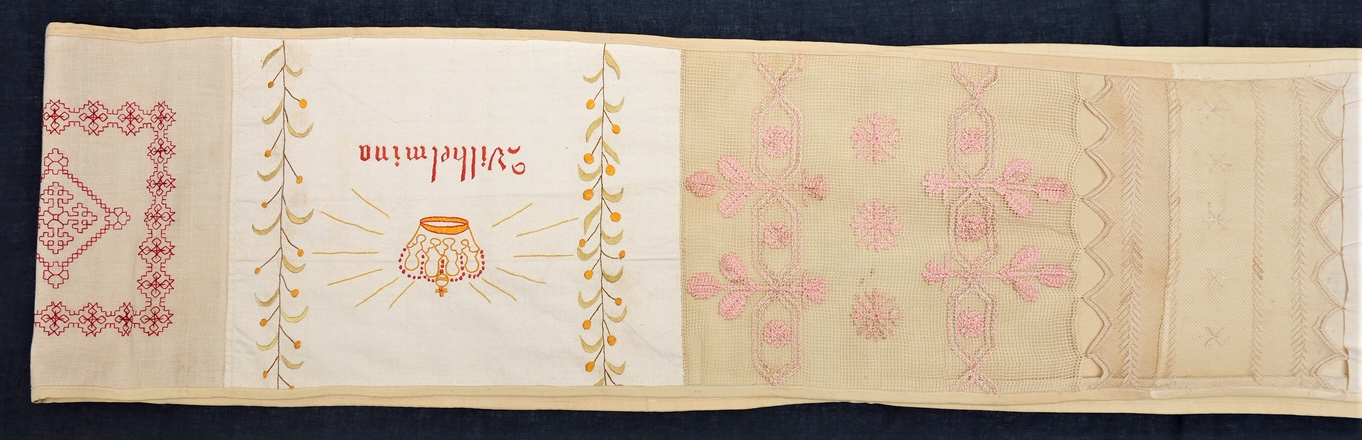 Detail of a Dutch 'pronkstuk' needlework sampler (592 x 26 cm), made by Anna Berendina Bennink in 1905-1906 (TRC 2020.3535a). The name of Wilhelmina is that of the Queen of The Netherlands from 1898-1948.
So what shall we do? Remove the later alterations and bring it back to two separate pronkstukken? This, admittedly, would be better for the two textiles in the long run and make it much easier to store the items safely. Or leave it as it is, as this construction is part of the history of the object? All too often in preservation it is necessary to destroy something in order to preserve the original object and obtain new knowledge, but is it right to destroy the nature of this roll? The curator in me says yes, the historian says no!!
Gillian Vogelsang, 26th July 2020.