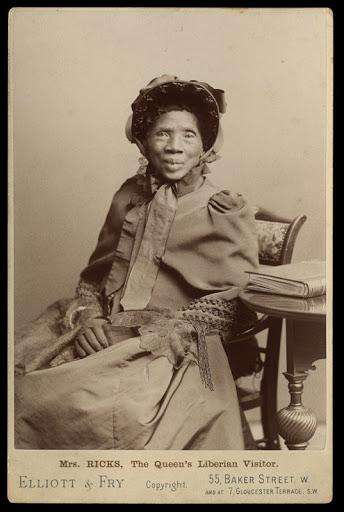
 Photograph of Martha Ann Ricks, July 1892, National Gallery, London.What are the links between an ex-slave called Martha Ricks, the British Queen Victoria (1819-1901) and an unsolved mystery? The answer is a hand-stitched white satin quilt that was personally presented by the quilter to the Queen at Windsor Castle, in July 1892.
This is a fascinating story that provides extra background to the ongoing American Quilts exhibition at the TRC in Leiden. The same story featured prominently in a 2017 BBC World Service documentary called “Looking for Aunt Martha’s Quilt”, which described the attempt by the family of the quilter, Martha Ricks, to trace the quilt that has long been lost. Here is the story:
Martha Ann Erskine Ricks (d. 1901) was born into slavery in the USA, around 1817. Her father worked to buy his, his wife’s and their seven children’s freedom. When Martha was 13 the family sailed to Liberia. Within a year only Martha and her two brothers remained alive. Martha married and helped manage a farm where she grew coffee, cacao, sugar cane and ginger.
In her 40s, she won a national prize for a pair of cotton silk socks she made from her own cotton and the fibre of the cotton silk tree. Throughout all this time she nourished a dream—to meet a woman she admired for her help to end slavery. Martha was mocked by neighbours and her husband alike, because the woman she wanted to meet was none other than the British monarch, Queen Victoria.
But Martha persisted. She saved pennies for the passage to England. She designed and made a stunning quilt as a gift to the Queen. The quilt featured a huge coffee tree, one of Liberia’s main cash crops. She cut and appliqued over 300 pointed green leaves and numerous red and green berries for the tree, whose trunk extended the entire length of the quilt. Sometime in the early 1890s, when Martha was 76 years old, the widow of Liberia’s first president saw the coffee tree quilt, and decided to help Martha fulfil her dream. And so it was that, on a warm summer afternoon, July 16th, 1892, Martha shook the hand of Queen Victoria, who said she was honoured that Martha had travelled so far to see her.
The meeting was front page news in England and Martha became a celebrity. When she returned to Liberia in August 1892, a newspaper reported that “a great concourse of people, men, women and children were at the wharf to greet … Martha, while Sunday school scholars sang a song of welcome.”
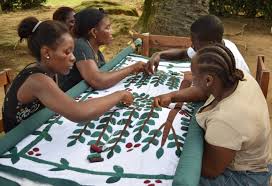 Liberian quilting collective works on a Coffee Tree quilt.And the unsolved mystery? The magnificent white satin Coffee Tree quilt is missing. It was last heard of at the World’s Colombian Exposition in Chicago (USA) in 1893, where the estimated 2.5 million visitors could see it in the Liberian exhibition.
Martha Ann Ricks’s legacy remains. In 2005, when Ellen Johnson Sirleaf became Liberia’s (and Africa’s) first female president, she revived the tradition of giving handmade quilts as diplomatic gifts to distinguished visitors.
Quilt historian Kyra E. Hicks has written extensively on Ricks’s life and work. Click here for an extensive article.
Shelley Anderson, 3rd August 2020.