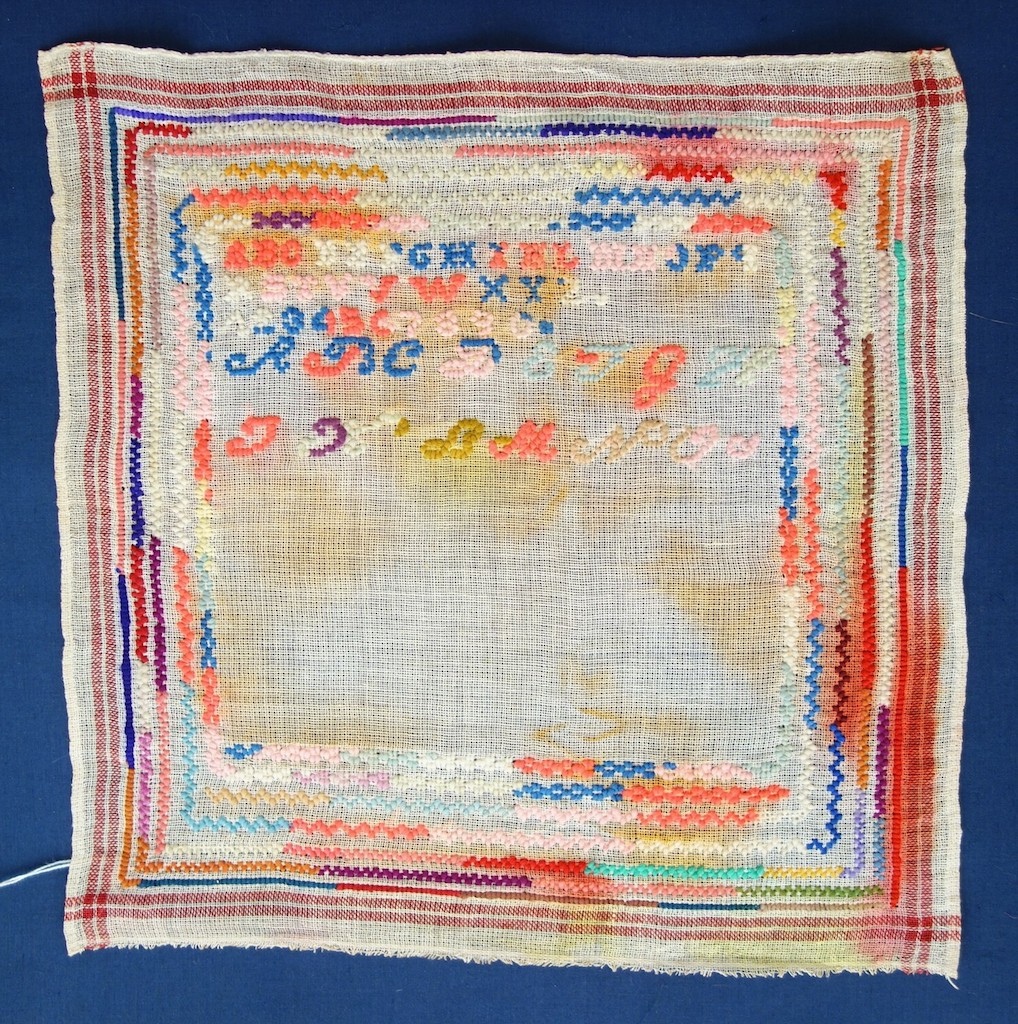
 Unfinished sampler from the late 19th century, with aniline dyed embroidery threads (TRC 2020.2396).Some objects you do not keep just because they are attractive, but because they have a story to tell. One particular sampler in the TRC collection (TRC 2020.2396) is unfinished, the colours are garish and they have bled. If there was ever anything beautiful about it, it has completely disappeared. But we can really be glad that it has not been thrown away, because there is quite a lot to see.
Samplers were often left unfinished. Sometimes the girl was taken from school because her parents could no longer pay the fees, or because she had to work, or because she had to come home to help. Some girls died before they could complete their samplers. That would be a reason for the family to keep the cloth. It was a reminder of the deceased.
In this case, another reason is conceivable, namely the colours of the embroidery threads. They stand out: fierce and unnatural, and extremely worn out. The woollen threads are coloured with aniline dyes. They came on the market from the mid-nineteenth century and in the following decades became widely available and cheap. They created bright colours, with which some girls went completely over the top. However, at first the colours were not very colourfast. The cloth may have got wet and was spoilt, and the girl may have lost interest in her work.
What you can also see in unfinished samplers, including this particular one, is the sequence of work. In this case, it is a very logical one, but it's nice to see this confirmed. The girl started with very simple borders, going around the four sides of the patch, from the outside inwards. A straight line, twice a small zig-zag, a larger zig-zag and another of connecting links.
After that she worked from top to bottom within that framework. An alphabet in capital letters and a row of numbers. A second alphabet in italicised capital letters, but it stops at the P. Is this the moment she gave up?
The sampler is undated and does not bear a name or initials. Because of the aniline colours, I think the sampler dates to the 1870s or slightly later.
Nelleke Ganzevoort, 26 August 2020