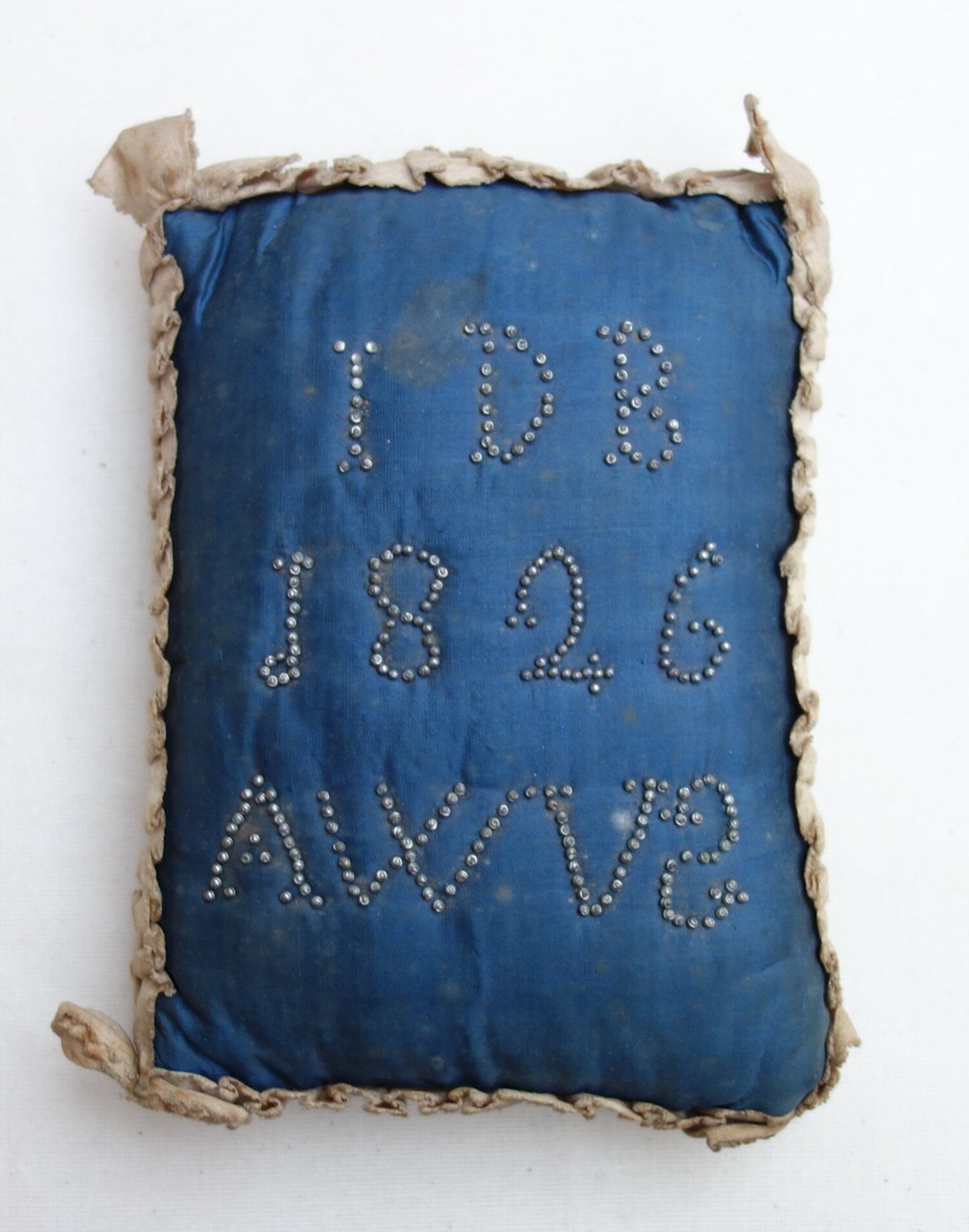
 Pin cushion dating from 1826 from the Gouda region in The Netherlands. Initials (of the married couple?) and the date are indicated by pin heads (TRC 2020.4732a).On the 13th October we published a blog about tomato pin cushions and since then we have had a couple more pin events at the TRC! We have recently, for example, been given various twentieth century pin cushions, including a tomato with strawberry (TRC 2020.4781) form and a long strawberry (TRC 2020.4782) filled with emery sand (to keep the pin sharp and prevent rusting).
Then this weekend we were sent a pin cushion (TRC 2020.4732a and 4732b) by Christa van Veersen. It dates to the early 19th century and it is made from blue silk and linen damask. It has a design, on the blue silk side, of a date and initials. More specifically, the series of initials and a date of 1826 are made out of pin heads with a spherical shape. The pin cushion came with a bag made from a blue and white checked linen cloth.
Pin cushions decorated in this manner were fashionable from the early 18th to the late 19th century and are often associated with a birthday and/or a marriage. It is believed that this particular pin cushion was owned by a member of the Blanken family, who lived in the Gouda region of the Netherlands. Exactly who owned it has yet to be determined, but the fact that there are two sets of initials suggests it was made to celebrate a marriage.
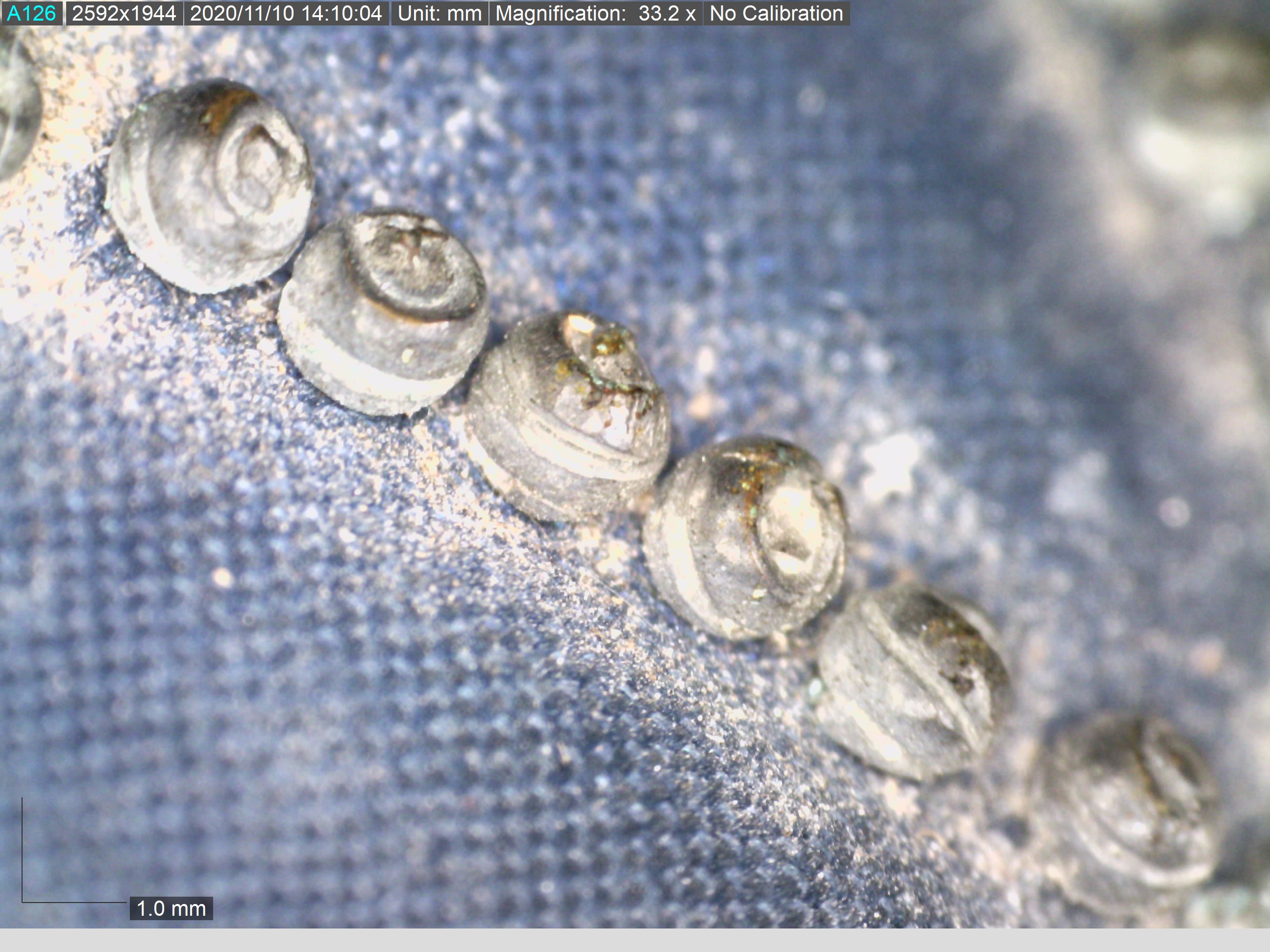 Image of a series of hand made, wrapped pin heads on a pin cushion dated 1826, magnification 33.2x (TRC 2020.4732a).
The pins used to make the initials and the date all have spherical heads. The pins were hand made, using a shank made from steel that was then coated with nickel. The pin's head was made from a narrow length of flattened wire (plate) that was wrapped three to five times around itself and attached to the blunt end of the shank. The image given in this blog was made using a Dino-lite microscope at a magnification of 33.2x. The way in which the plate was wrapped around itself can clearly be seen on the various pin heads of the 1826 pin cushion. This was the normal type of pin head in the 18th and early 19th centuries in Europe.
In fact, machine produced pins with heads and shanks in one, as we know them today, were not widely available until the 1860’s and not universal in the West until the 1880’s.
But we have a further pin story!
We published a few days ago a blog about a textile and a piece of paper recently given to the TRC Leiden (TRC 2020.4528) by Kees van der Zwan. The cloth is said to have been part of the pall that covered the coffin of Napoleon when his remains were moved from St. Helena to Paris in 1840. Under the Dino-lite microscope (57x magnification) the pin that was made to fasten the piece of cloth to the accompanying piece of paper turned out to be handmade and produced using two different pieces, the shank and the head. In addition, the shank is not rusty, which suggests that it was coated with a nickel alloy, as was relatively normal in the 18th and early 19th centuries. The head has a cone form and is made by wrapping a strip of metal around itself and fastening it to the shank, as in the case of the pin heads found in the 1826 pin cushion.
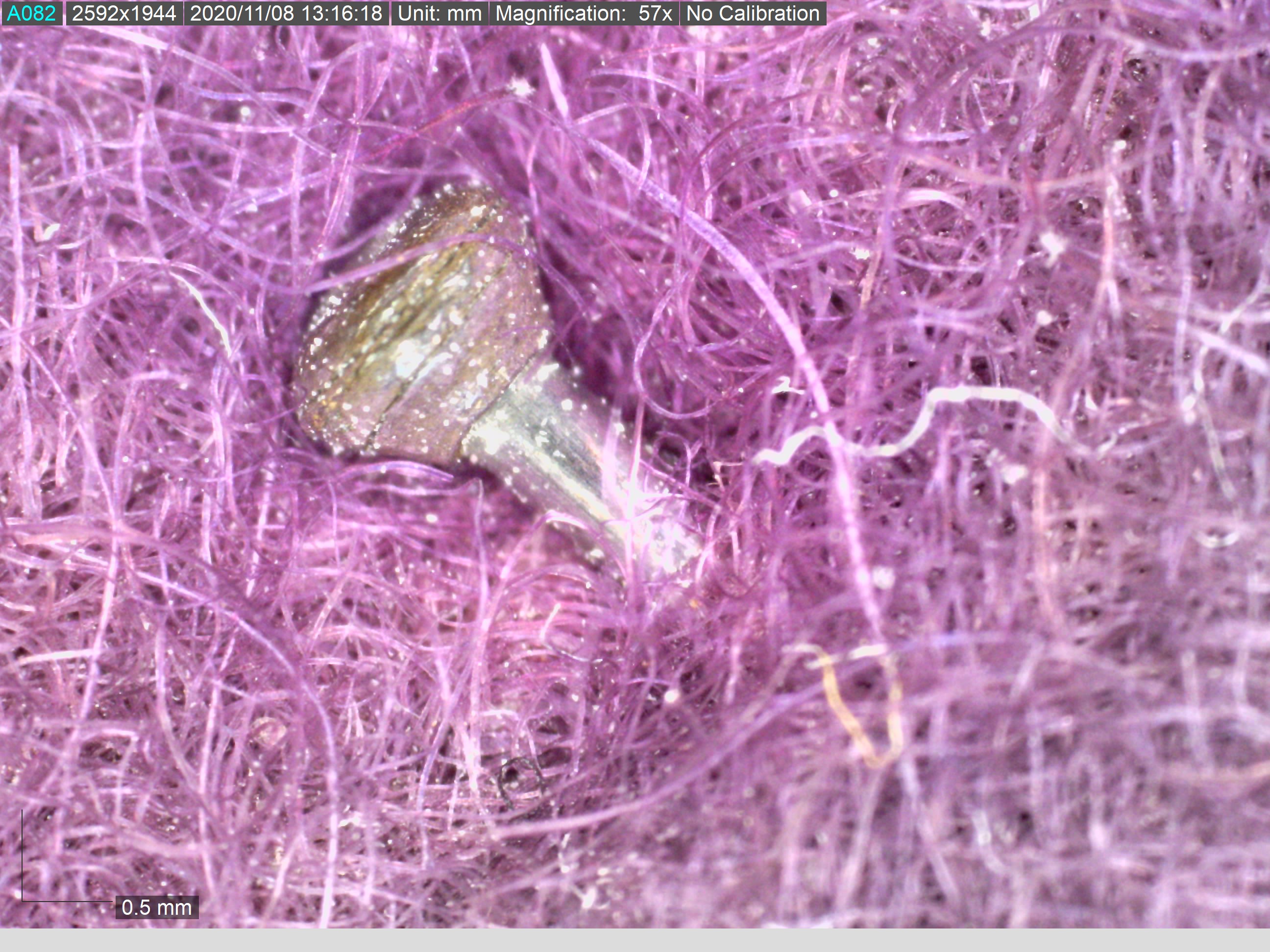 Detail of the hand made, wrapped pin head on an alleged broadcloth fragment of Napoleon's pall, magnification 57x (TRC 2020.4528).
The fact that the pin head is hand wrapped would indicate that it was made in the 18th or early 19th century. The pin is in a very good condition. As a generalisation, when pinning an item to a piece of paper people would use a new or a clean pin rather than a rusty one, so perhaps a date sometime in the early 19th century seems likely, thereby helping to confirm the date and perhaps the authenticity of the textile and its accompanying letter.
Gillian Vogelsang, 10 November 2020