Tapa is a non-woven cloth made from the inner bark of trees, especially the paper mulberry tree (Broussonetia papyrifera), or more occasionally from the wild fig or breadfruit tree. It’s most commonly found in Pacific Ocean island nations such as Tonga and Tahiti, but also in parts of South America and Africa. Tapa can be strong and long lasting, but it does have some disadvantages: producing tapa is very labour intensive, and it mildews and becomes weak when wet.
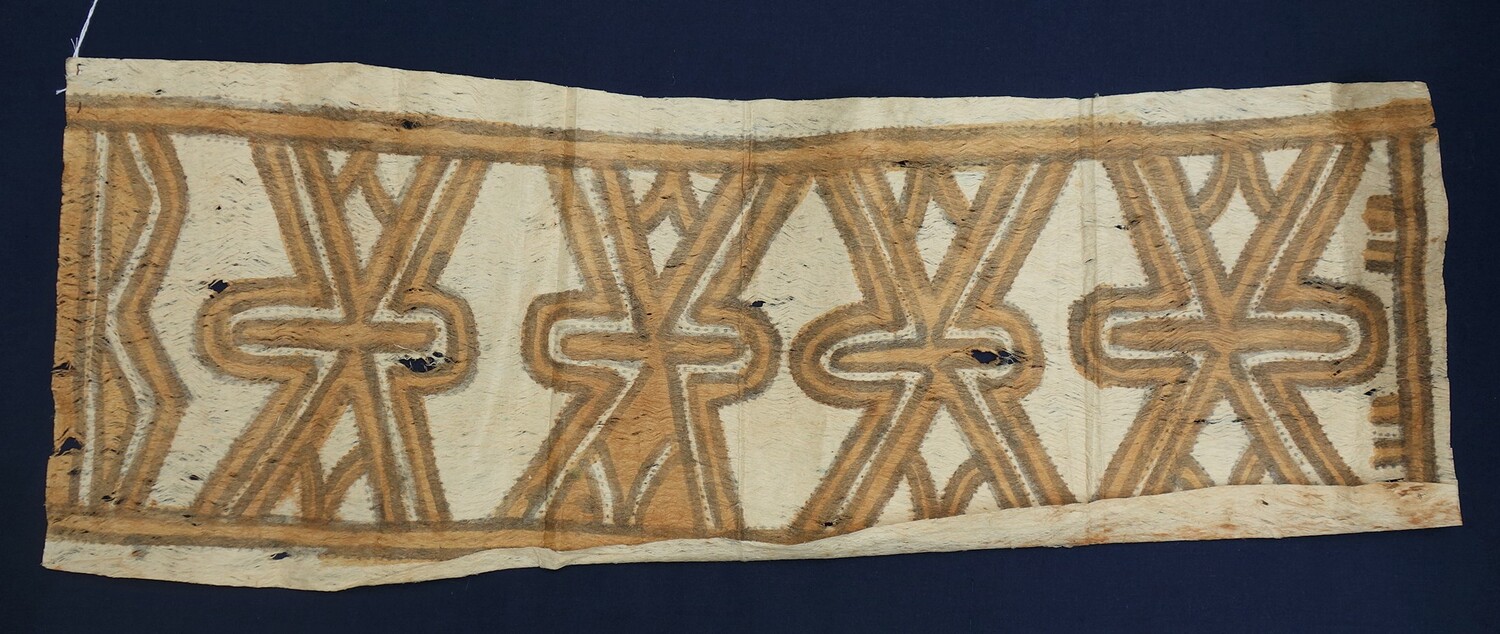 Bark cloth sample from Samoa, 1990's (TRC 2015.0070).
The tapa in the TRC collection (TRC 2015.0070) comes from Samoa. In Samoan, the word tapa refers to the uncoloured border of a sheet of bark cloth, and the word siapo is used for the finished cloth. Paper mulberry trees are planted specifically to make tapa and are carefully cultivated so that the saplings grow straight and without branches (which would create holes in the cloth).
When the young trees are about one year old, they are cut and the bark carefully peeled off. The soft inner bark (bast) is then separated from the rougher outer bark. The bast is placed on a sloping board, kept wet, and is scraped with a sea shell. This helps to soften and spread the fibres, plus clears away any remaining bits of bark. Different sheets of processed bast are then pounded together on a wooden anvil with wooden beaters.
The cloth can then be decorated, either by painting designs on it (colours include black, brown, yellow and red, made from materials such as turmeric roots, tree bark, seeds, nuts or red ochre), and/or by carving a design into wood and then rubbing or beating the cloth on the wood. Different techniques to make tapa have been developed in other Polynesian cultures (for a video on making Hawa’iian barkcloth see here).
The cloth can be used for everyday wear, or reserved for special occasions (including weddings and funerals). Tapa can be used to decorate or divide a room; or given away as a prestigious gift, or sold to tourists. Some tapas are precious family heirlooms, with each new generation of women adding to the cloth.
Whether new or hundreds of years old, it is a fascinating fabric with a story to be told.
Literature: Traditional Tapa Textiles of the Pacific, by Roger Neich and Mick Pendergraft (Thames & Hudson, 1997).
See also a story about tapa from Tonga.
By Shelley Anderson, 31 December 2020