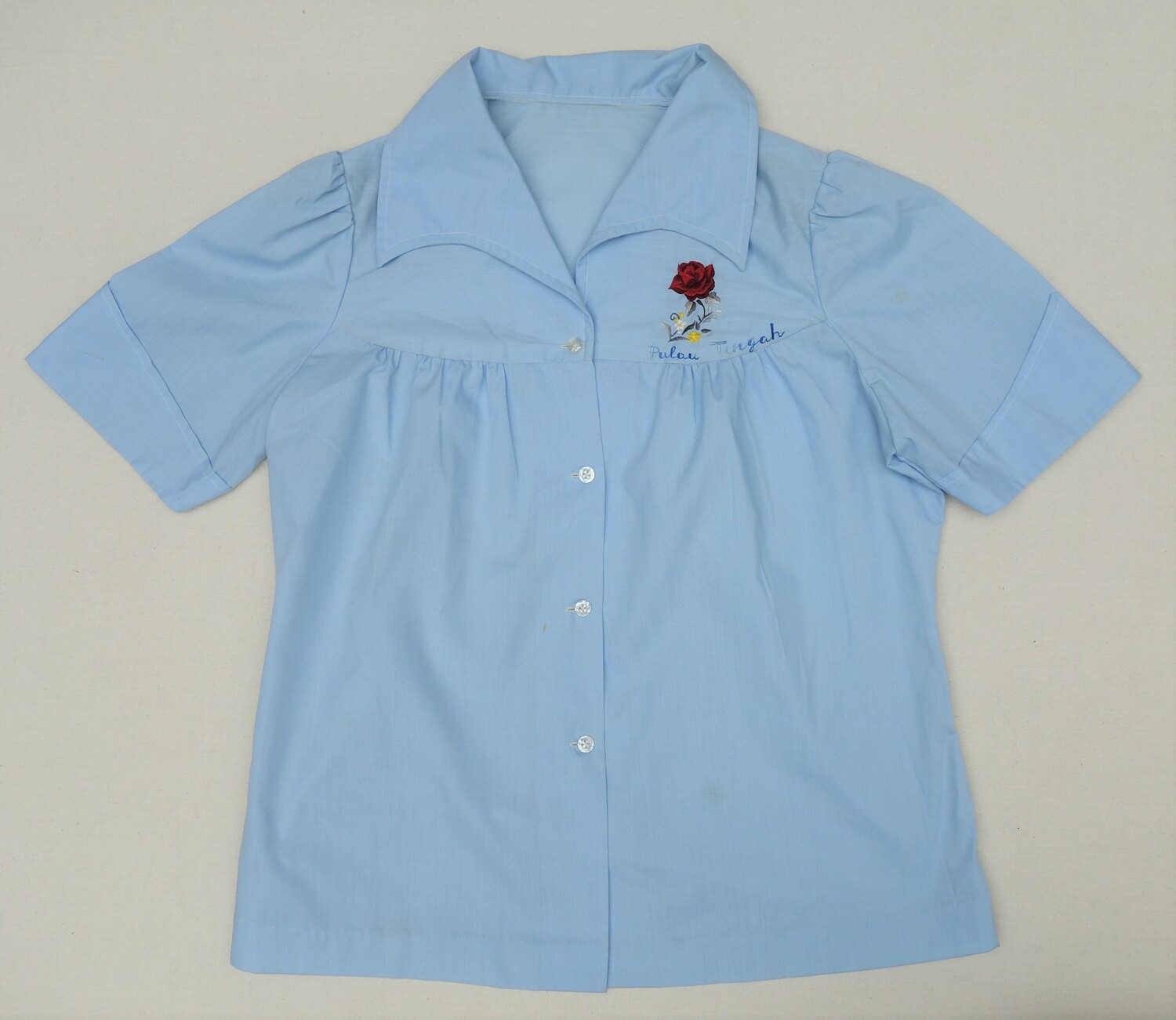
 Child's blouse with embroidered bunch of flowers and the name of the island and camp of Pulau Tengah, Malaysia, specially set up for Vietnamese boat people in 1975 (TRC 2021.0417).A few days ago we published a gentle blog about a group of garments (well, actually some bandeaus and bras) donated to TRC Leiden by Sonja Meijer-Beckman (Leiderdorp). In this blog we want to highlight some other garments from the collection, namely a child’s blouse (TRC 2021.0417) and a baby’s tunic and trousers (TRC 2021.0147a and 0147b). As with most of the clothes from the donation, these garments have a story behind them that is, sadly, still relevant to the present day.
In 1941 Mr Hans Beckman, Sonja’s father, who was a Dutch engineer, fled occupied Holland in an attempt to try and get to England. Unfortunately, he was picked up by the Germans on the French/Swiss border and was sent to the notorious concentration camp, Auschwitz/Birkenau, in Poland. He survived the camp and upon his return to Holland he immediately joined the Dutch army to fight the Japanese in Southeast Asia. Following his retirement from the Dutch armed forces in the late 1960's, among other jobs, he assisted the Red Cross and the UNHCR in Malaysia with finding facilities for another group hit by war and its consequences, namely the Vietnamese boat people, or simply, the boat people.
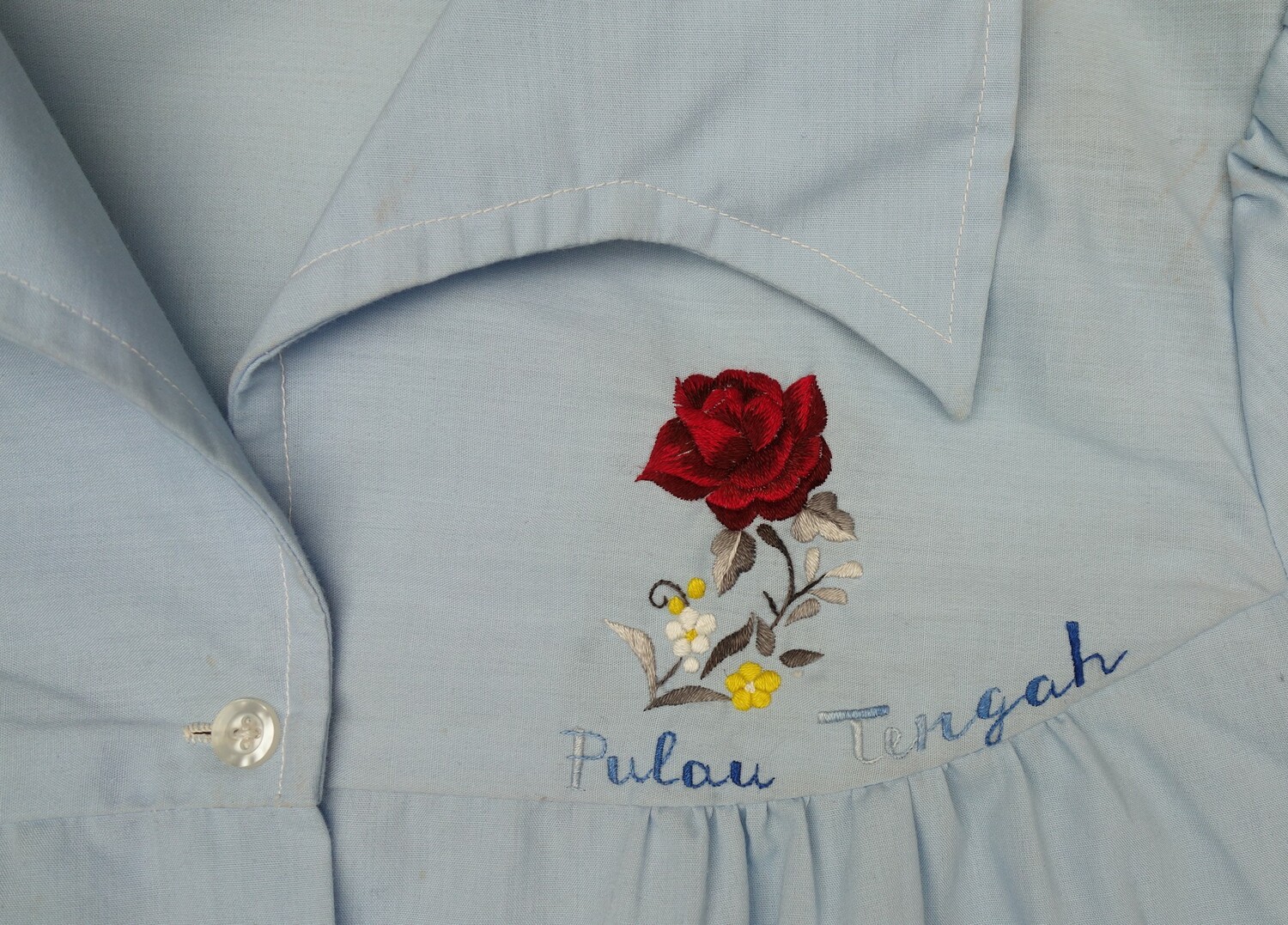 Detail of a child's blouse distributed among Vietnamese boat people that fled their country after 1975. The embroidery gives the name of the refugee camp on the Malaysian island of Pulau Tengah (TRC 2021.0417 2Following the end of the civil war in Vietnam in 1975, hundreds of thousands of men, women and children fled the country looking for new homes in China, Thailand, Malaysia and Indonesia. Many hoped to eventually resettle in countries such as Australia, Britain, France, West Germany, Canada, and of course the US.
The diaspora started in 1975 and reached a peak in 1978 and 1979, and gradually dropped in number until the early 1990’s. Many of the refugees fled Vietnam went overland, to countries such as China, but many more went in large and small boats to other parts of Southeast Asia. Exactly how many attempted the sea crossing is unknown, as literally thousands were drowned, as well as being murdered or abducted by pirates, or simply abandoned on small, off-shore islands.
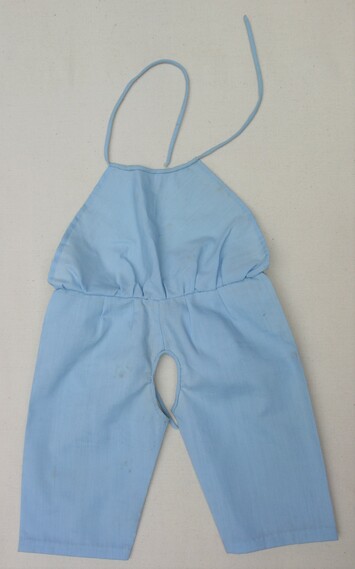 Pair of trousers with a bib, distributed among Vietnamese refugees on the island of Pulau Tengah, Malaysia, late 1970s (TRC 2021.0147b).Due to the sheer numbers of refugees, neighbouring Asian countries became overwhelmed and the situation was declared a humanitarian disaster. Thanks to international intervention by the UN, as well as groups such as the Red Cross, a number of special camps were set up in Thailand, Malaysia and Indonesia, where the surviving refugees were given basic necessities, including clothing. Later re-settlement lessons were given in languages, different cultures, etc. One of these camps was organised on the island of Pulau Tengah, just off the eastern coast of Malaysia.
But back to the garments mentioned above: Both the baby’s outfit and the child’s blouse are made from a simple, light blue polyester cotton material. The baby’s outfit is totally hand stitched, work that was apparently carried out in the refugee camps. The child’s blouse also has a small, machine embroidered, bunch of flowers and the name ‘Pulau Tengah’.
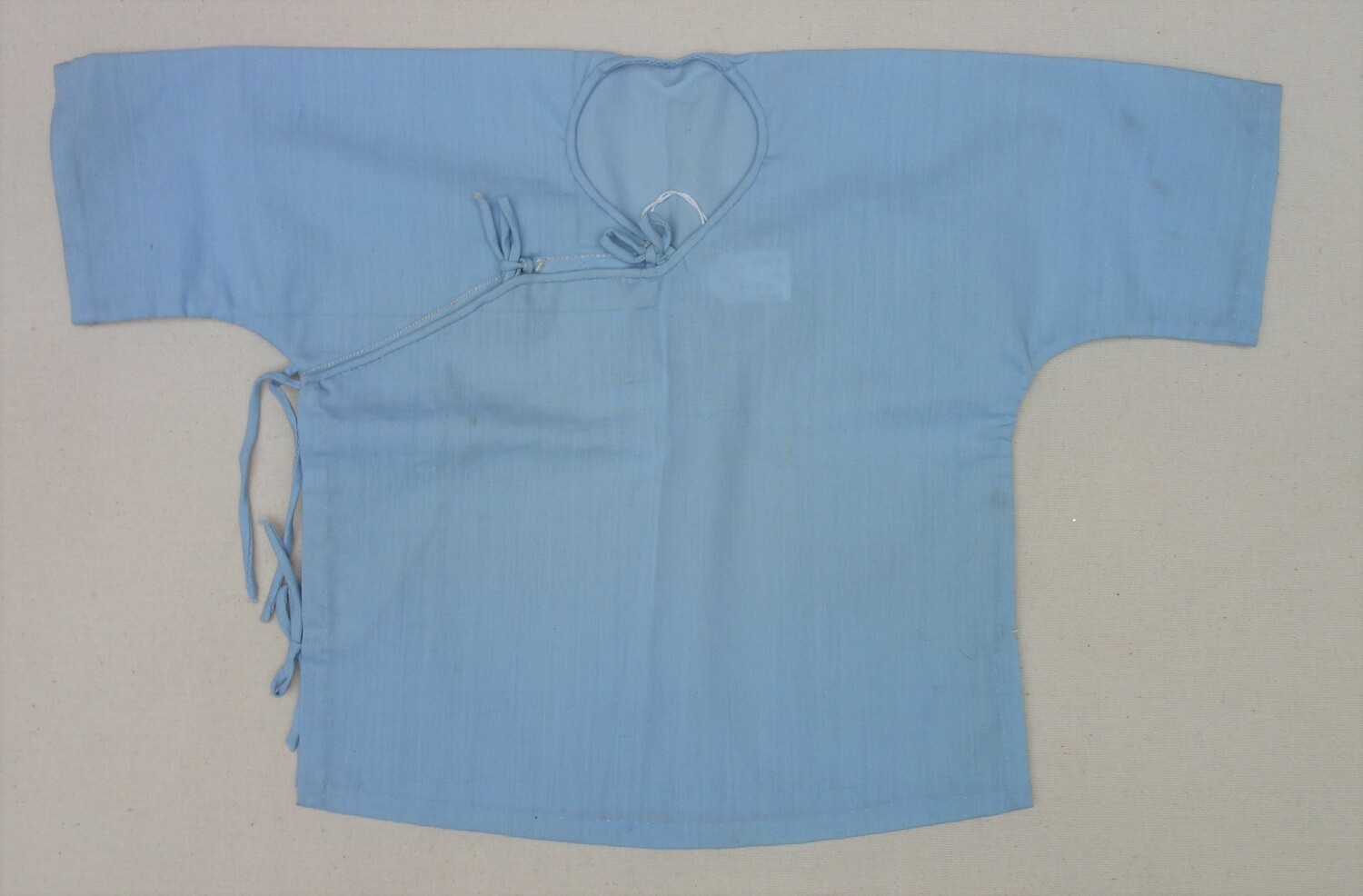 Small jacket for a baby, distributed among Vietnamese refugees on the island of Pulau Tengah, Malaysia, late 1970s (TRC 2021.0147a).The island of Pulau Tengah was used by the UN Refugee Council as a refugee camp between 1975 and 1981. It is also one of the camps that Hans Beckman was trying to help. Why he was given the garments and indeed why he kept them is unknown, but we are glad he did. The garments were probably made and/or distributed among the Vietnamese refugees on the island. They represent a humanitarian situation that has direct links to Hans Beckman's own experiences during the Second World War, as well as to more recent humanitarian disasters, such as in Syria, Myanmar, and now in Ethiopia, which so often result in thousands of refugees being forced to leave everything behind and seek shelter elsewhere.
For a personal account of the Vietnamese refugee crisis, click here.
Gillian Vogelsang, 27 February 2021.