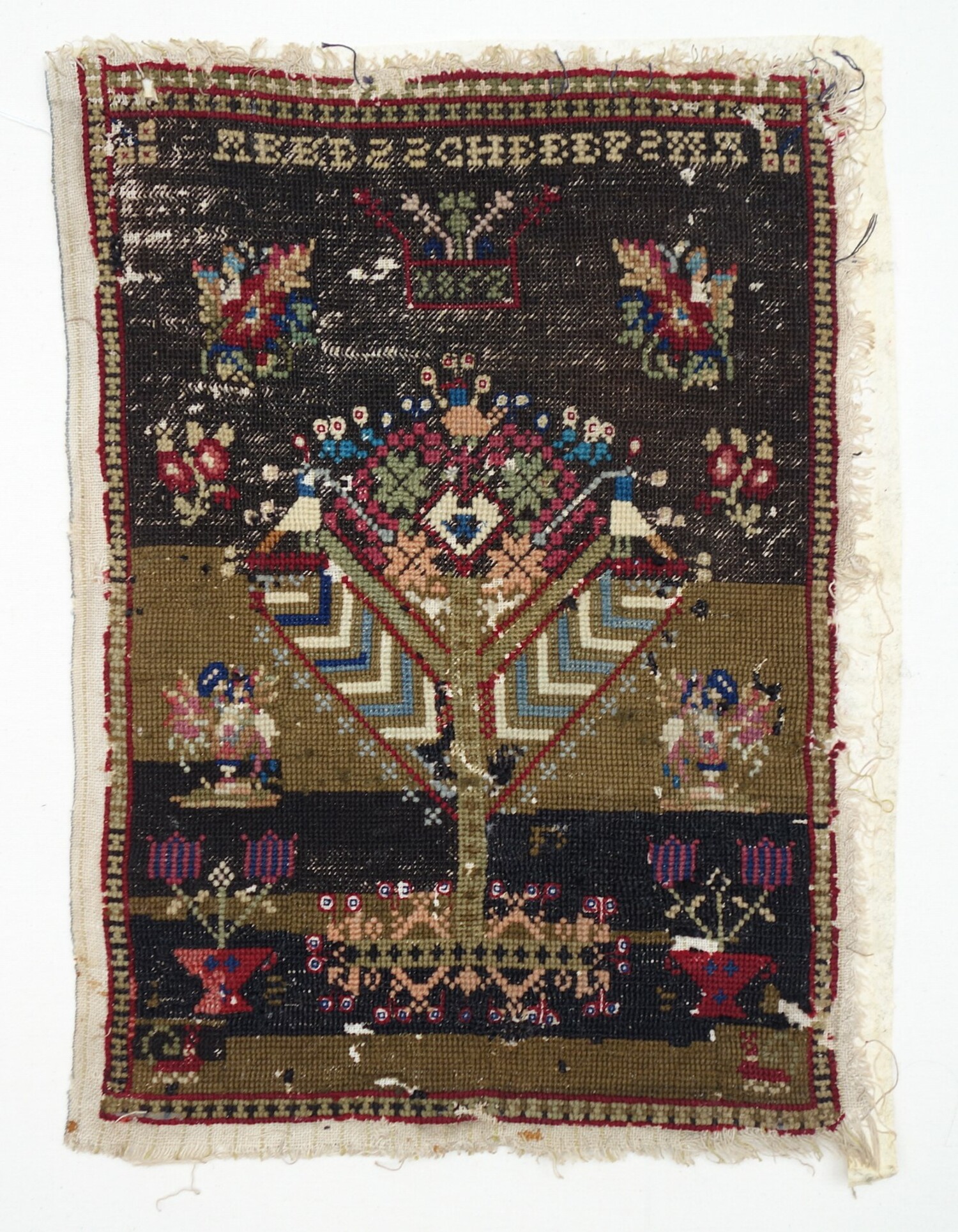
 Sampler made by Akke Scheepsma, aged 12 or 13, Schettens, Friesland, in 1852 (TRC 2021.1805).A few weeks ago the TRC Leiden welcomed 25 samplers of various types, from Belgium, Germany and the Netherlands, which date from the mid-19th to the early 20th century. One of the pieces caught our eye, namely TRC 2021.1805. It has a (partly faded) black ground. The colour black for the ground is generally associated with Friesland in the north of the Netherlands. The ground is made of linen and is embroidered with woollen yarns in cross stitch and double running stitch (Holbein stitch).
The central design is a stylised tree of life in the form of a decorative V-shape with a pair of small, stylised birds. The tree is surrounded by vases of flowers. Along the upper edge of the sampler there is the name AKKE S SCHEEEPSMA and the date of 1852. Akke, it should be added, is a traditional Frisian name for a girl or woman.
Who was she? A Google search led us to a woman with the same name who in the nineteenth century lived in the village of Schettens, Friesland. With the help of a local historian, André Buwalda, we subsequenly learnt more about the girl. She was known as Akke Simons Scheepsma. She was born in the village of Schettens, some 30 km southwest of Leeuwarden, on 1st October 1839 to a well-established farming family. Her father was Symon Klazes Scheepsma (1811-1857) and her mother was Gerbrig Wybrens' Scheepsma-Douwsma (1805-1886). Her parents married in 1835. They had six children, Akke being the third.
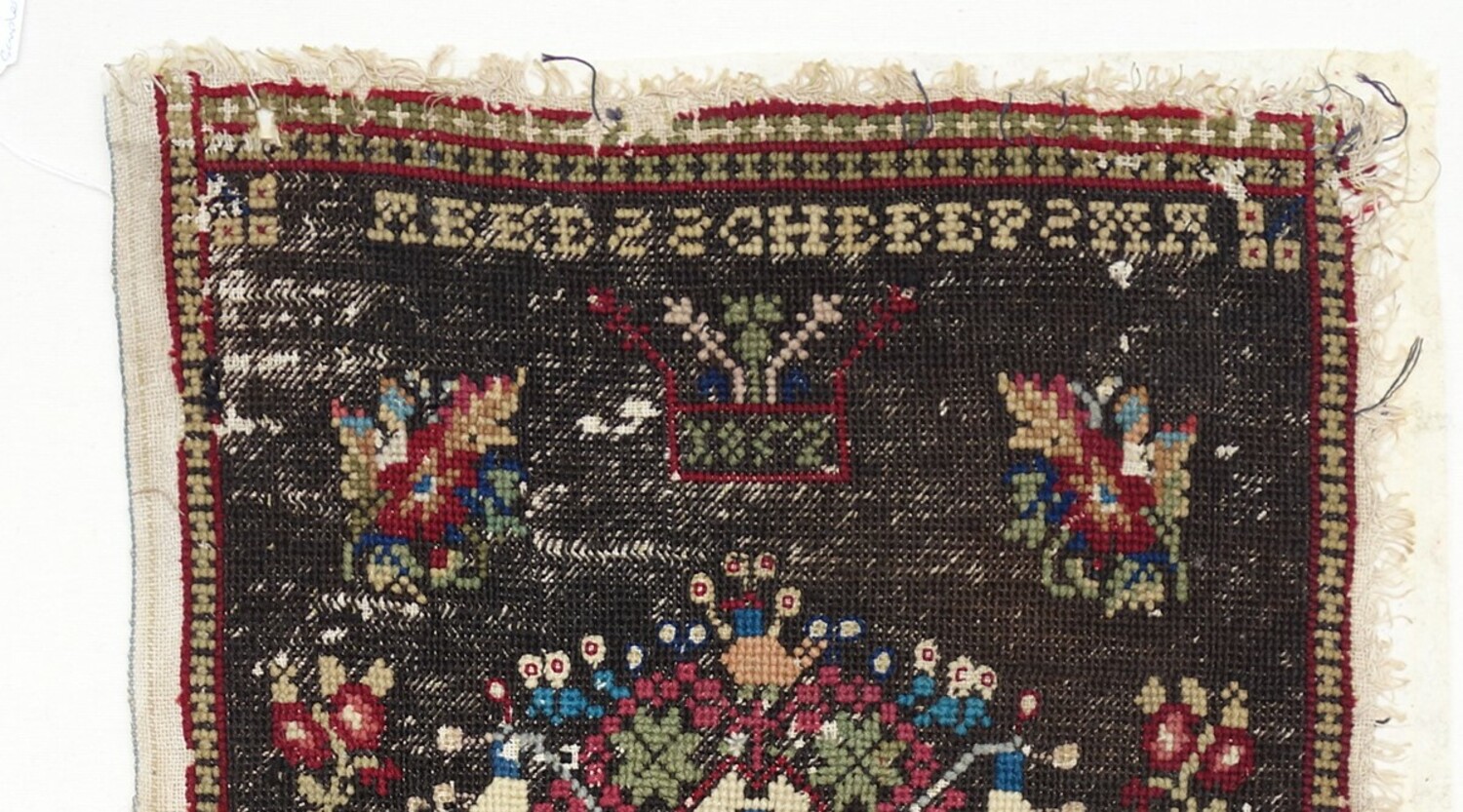 Detail of sampler made by Akke Scheepsma aged 12 or 13 in 1852, in Schettens, Friesland (TRC 2021.1805).But what else do we know about Akke? We are gradually finding out more details, and we soon hope to know much more with the help of André Buwalda and others. To date we know that Akke completed the sampler in 1852, when she was 13 years old. It is likely a piece worked at home; it lacks the lay-out associated with school samplers that were meant to show the girl's achievements. It is also, to be frank, not a brilliant piece of work for a thirteen year old girl, although the embroidery is certainly ambitious, with many designs and colour changes. Does all of this mean something? Why is her name spelt with three E's? And why are the two "S's inverted?
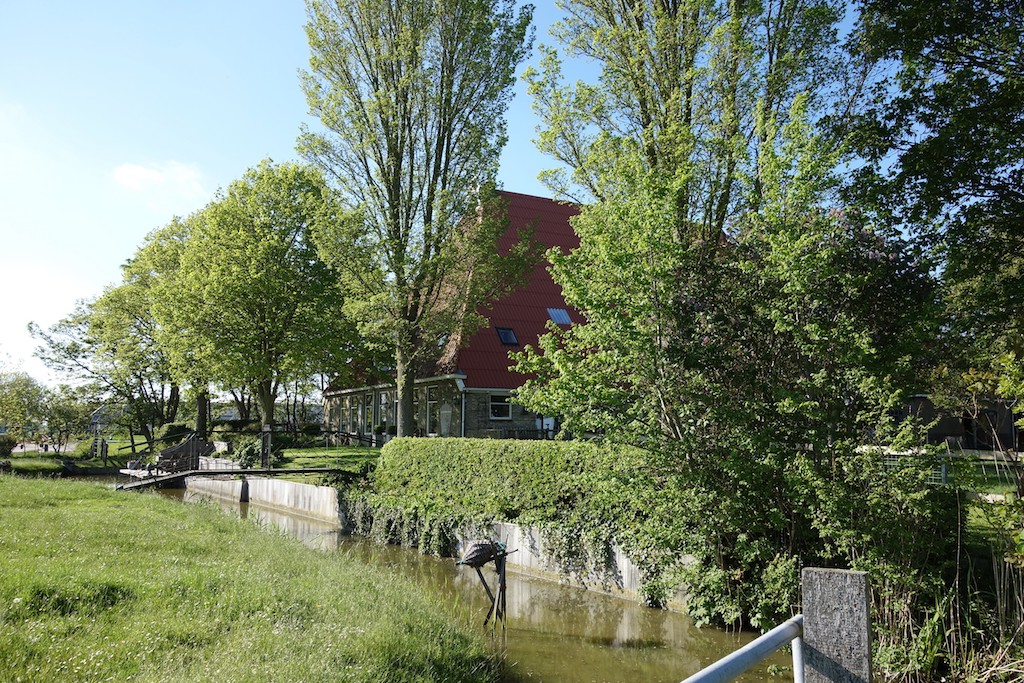 The farmhouse of the Scheepsma family in Schettens, built in 1856, when Akke was about 17 years old. Photograph by Gillian Vogelsang, 29 May 2021.The farm complex where she grew up is very old; her grandfather acquired it, so it seems, in 1796. It was rebuilt by 1856. The farm, and another farm nearby, are both located on an old terp, called the Bittens. The church of Schettens is built on another terp nearby (see photograph).
A few years after she completed the sampler the family moved into the new buildings. The ‘new’ house still exists and has a plaque next to the front door stating that the stone was laid by her youngest brother, Douwe Simons Scheepsma (1849-1931) on 26 March 1856 when he was six years old. We may assume Akke was present at the little ceremony; she must have been about 17 years old by then.
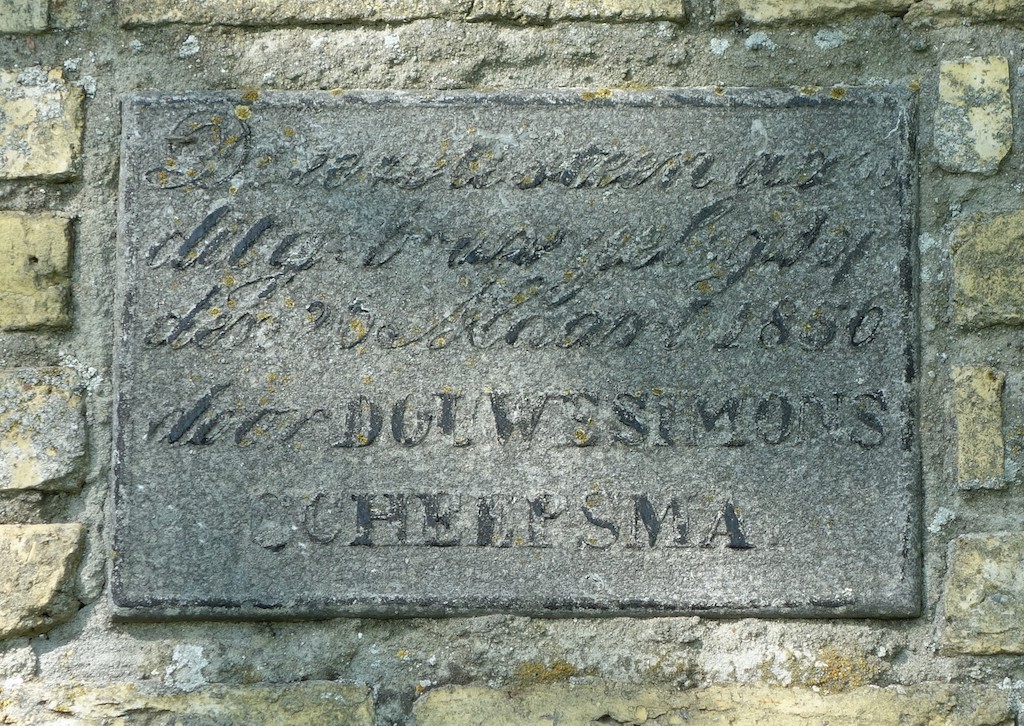 Commemorative stone inserted into the wall next to the front door of the new farmhouse of the Scheepsma family, dated 26 March 1856, with the name of Akke's youngest brother, Douwe Simons Scheepsma.The Scheepsma family played a leading role in the small village of Schettens (presently with some 300 inhabitants). Akke's mother helped to build a Protestant school in the village, and she became co-owner of its land and building. The school, completed in 1872, is still extant (see photograph), and is currently being used as a garage. Before that, the family was probably also involved in the building of a new Protestant church in the village, to replace an older, medieval church. The new church was completed in 1865; the adjoining tower dates to 1877 (see photograph).
The family also likely played a leading local role in the Protestant schism of 1886 (the so-called Doleantie), when the Nederlands Hervormde Kerk (Dutch Reformed Church) split and a new group was formed that became known as the Gereformeerde Kerken van Nederland. Apart from some doctrinal differences, the Gereformeerde Kerken were generally formed by the lower classes (the so-called kleine luyden), while the middle and higher classes maintained their affiliation to the Hervormde Kerk.
The schism tore many communities apart, and the same occurred in Schettens. What is at first sight remarkable is that the Scheepsma family, relatively rich farmers, joined the Gereformeerde Kerken. A new Gereformeerde church was built opposite the Protestant school in Schettens. It was completed in 1907. it has now been changed into living accomodation. The schism stopped with death; Hervormden and Gereformeerden continued to be buried at the cemetry around the main, by now the Hervormde church. Akke herself was probably also buried there after her death in 1900.
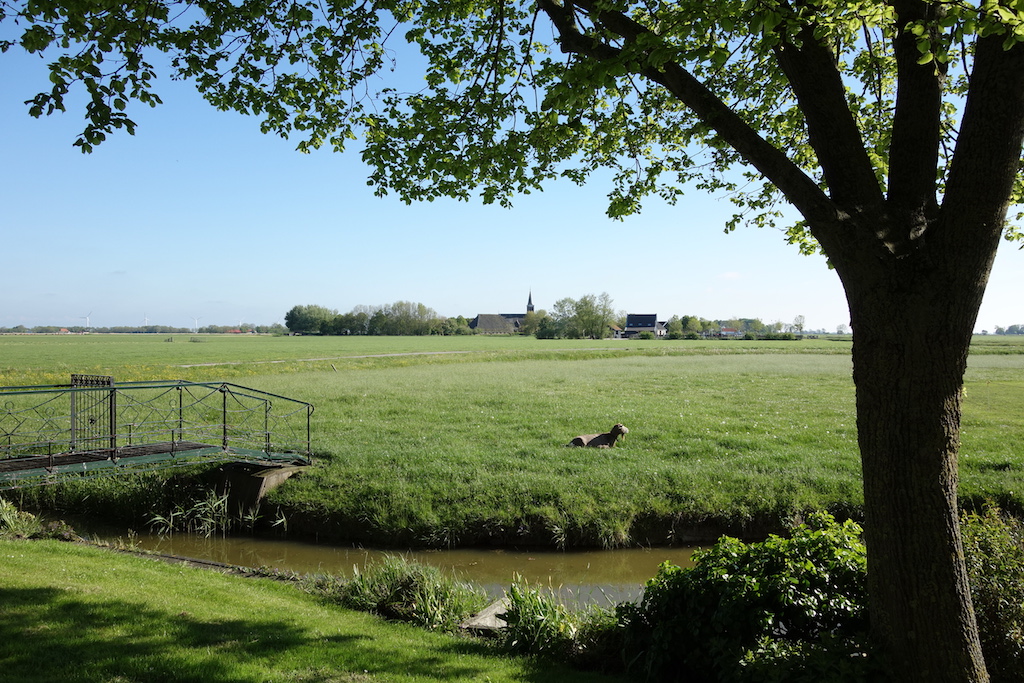 View of the village of Schettens from the farmhouse of the Scheepsma family. Akke would have seen the same view every day that she lived on the farm. Photograph by Gillian Vogelsang, 29 May 2021.
Long before the Doleantie, Akke had married Tjerk Sjoerds van 't Zet, on 20 May 1865. She was 25 years old. Her husband was a labourer. We are not clear yet how many children they had, but one of them was Tjerk Tjerks van 't Zet, who was born in 1880. There were other children, who were all born in different villages. This would indicate that Akke's husband was a local farm worker who was hired on a yearly basis at the local hiring fairs held in early May (shades of Thomas Hardy and The Mayor of Casterbridge). Once a contract was finished, they moved onto another farm in another village.
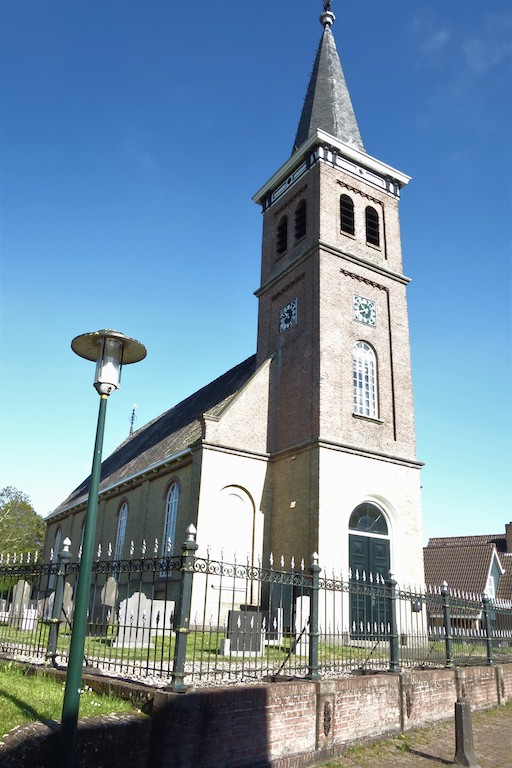 View of the main Protestant church of Schettens, completed in 1865. Photograph by Gillian Vogelsang, 29 May 2021.We suspect that for Akke this was a ‘step-down’ from how she was brought up, but we do not know exactly what happened. How was her relationship with her family in Schettens, and with her wealthy youngest brother on the family farm? We know that she died in 1900 in Schettens, so she may have returned to her family and to the farm where she lived as a girl, after the death of her husband in 1896.
On Saturday 29 May 2021 Willem and I went to the village of Schettens and we talked with André Buwalda and his wife about the Scheepsma family. André's family has lived in the village for many generations, and he is a keen local historian and a fount of information and knowledge. Much of what we are writing here is based on what he told us.
Afterwards we walked to the main church of the village (see photograph), had a look at the cemetery, and then we walked to the former Protestant village school and the former church of the Gereformeerde community, built after the Doleantie of 1886. Finally we went to the farm where Akke and her family used to live and where she may have died.
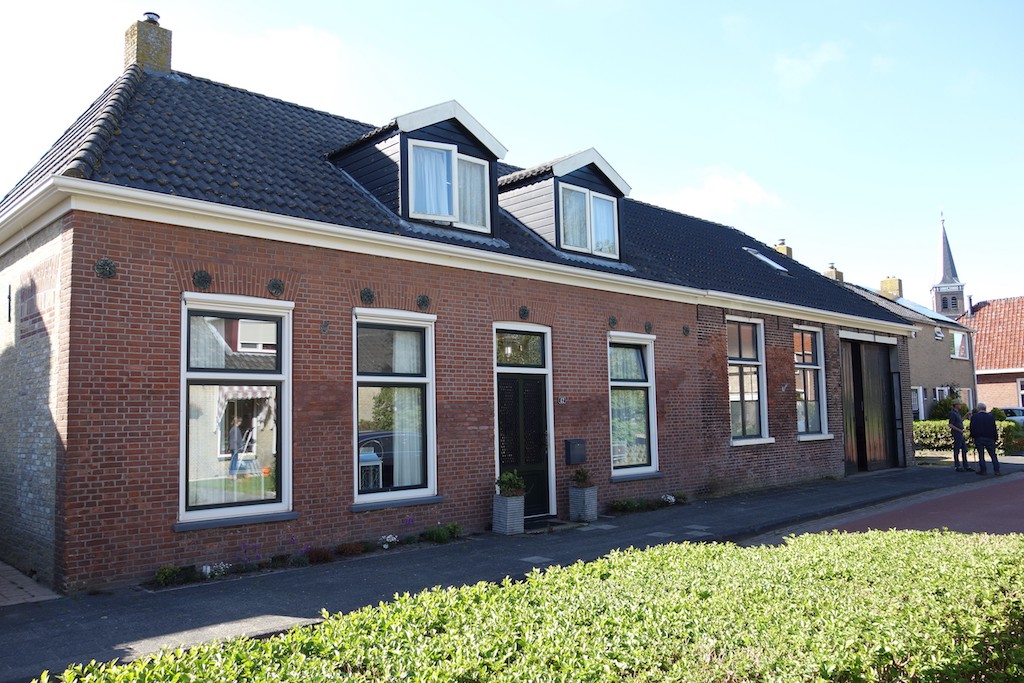 Former Protestant school (right) and school masters house (left), Schettens, Friesland, built with the financial support of Akke's mother, the widow Gerbrig Wybrens' Scheepsma-Douwsma. The school was built in 1872. Photograph by Gillian Vogelsang, 29 May 2021.We would very much like to get to know more about Akke and her family, and also about local dress in the mid-19th century. What did a woman like Akke wear? There is a particular type of lace cap associated with Friesland that was worn with a metal cap/band called an oorijzer that was originally for keeping the cap in place when it was windy, but eventually became an important, decorative element of Dutch regional dress.
There are several examples of Fries lace caps in the TRC Collection that date from c. 1860 to 1910. Could she afford this form of headdress? This and other questions will be explored over the next few months and we will present the results as a TRC mini-exhibition.
Those of you who want to read more about Schettens and the Scheepsma family history, please see one of André Buwalda's contributions. Further information about the village is by Ale Algra, before 1960 (download here).
Gillian and Willem Vogelsang, 31 May 2021