All archaeological textiles fascinate me, but there is one group that I find particularly interesting: old Coptic textiles. The embroidered images on these textiles seem so joyful to me, so full of love for life: dancing people, cherubs, early Christian symbols, fertile plants, gods and goddesses (including Bacchus, the god of wine and ecstasy). The human images usually have big eyes, and are chubby and always look a little lopsided to me. I think this indicates a fine disdain for perfectionism, despite the fact that the weavers, spinners and embroiderers involved were eminently skilful and accomplished. I also like the fact that these images represented a highly multicultural society, reflecting Egyptian, Greek, Roman, Byzantine and other influences from international trade.
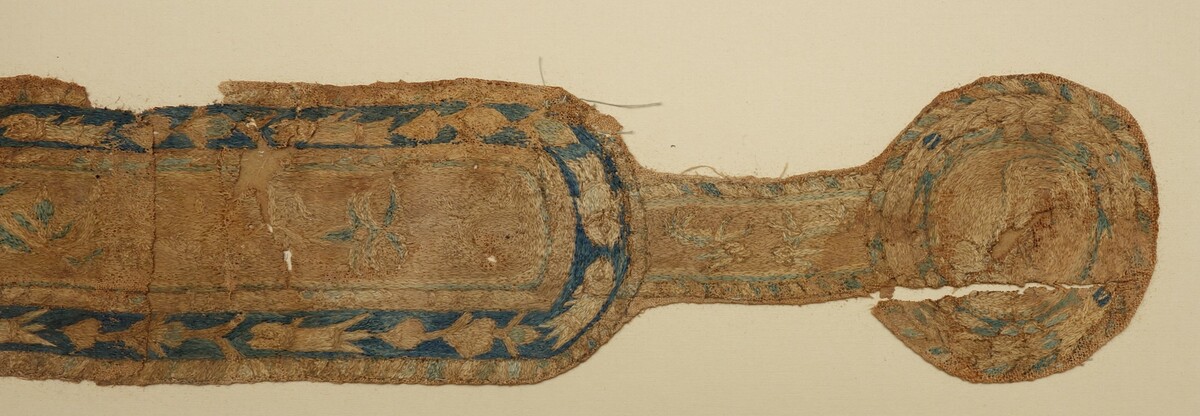 Fragment of a Coptic textile with an embroidered design of a clavus and a pendant, probably from a child's tunic. 6th-8th c. (TRC 2011.0460).
The word Coptic itself reflects a cosmopolitan world—it’s a European word, derived from the Arabic ‘qibt’, which is itself derived from an ancient Greek word for Egypt. Coptic generally refers in time to anywhere from the 3rd to the 7th century CE, roughly from the late Roman period to the Muslim conquest of Egypt. Dry conditions in Egypt meant that many Coptic textiles are preserved. The TRC has several examples in its collection—along with over one hundred 20th century textiles from modern, Coptic Christians in Egypt.
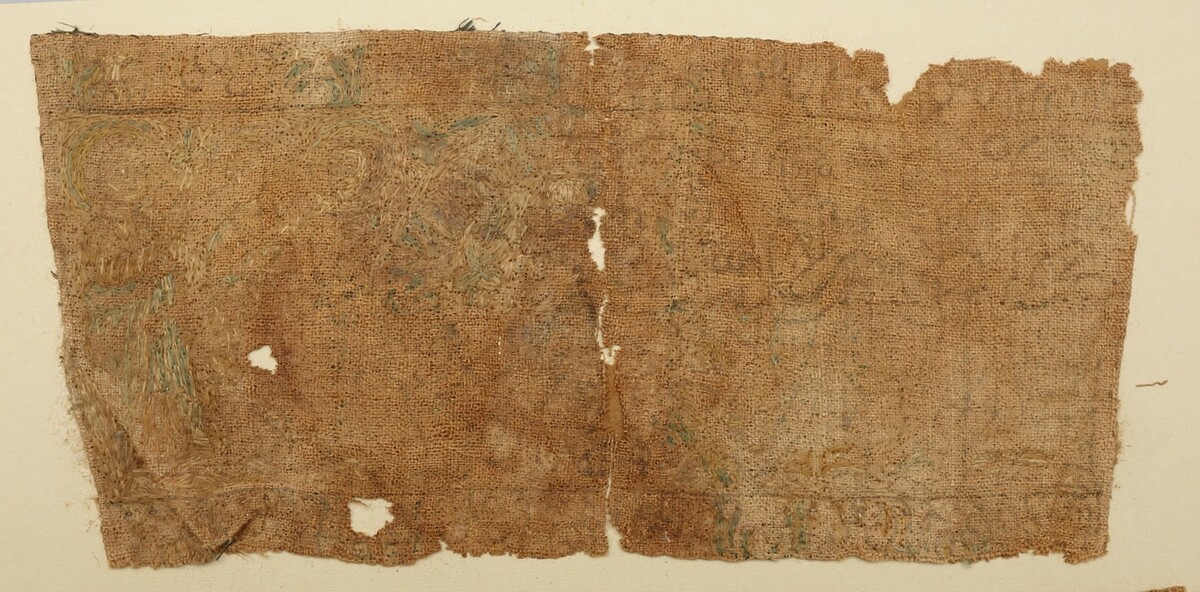 Fragment of a linen, Coptic textile, with inked designs of saints, some of which with extant silk embroidry threads. 6th-8th c (TRC 2011.0462).
While most Coptic embroidery was worked with different coloured wools on a linen background, the TRC has several worked in silk, from its Van Gerwen collection. TRC 2011.0460, for example, is a fragment, probably from a priest’s garment, dated to the 6th to 8th century. It is hand spun from flax, and features an embroidered design of a clavus and pendant. The embroidered design is based on fishes surrounding a floral centre. There are two hares in the connecting band, and what appears to be an ox with halo in the pendant section. TRC 2011.0461, also most likely from a priest’s garment, shows early Christian saints worked in coloured silks, and the figure of Lazarus on a bed. TRC 2011.0462 shows an inked design of more saints, some of them still embroidered with silk.
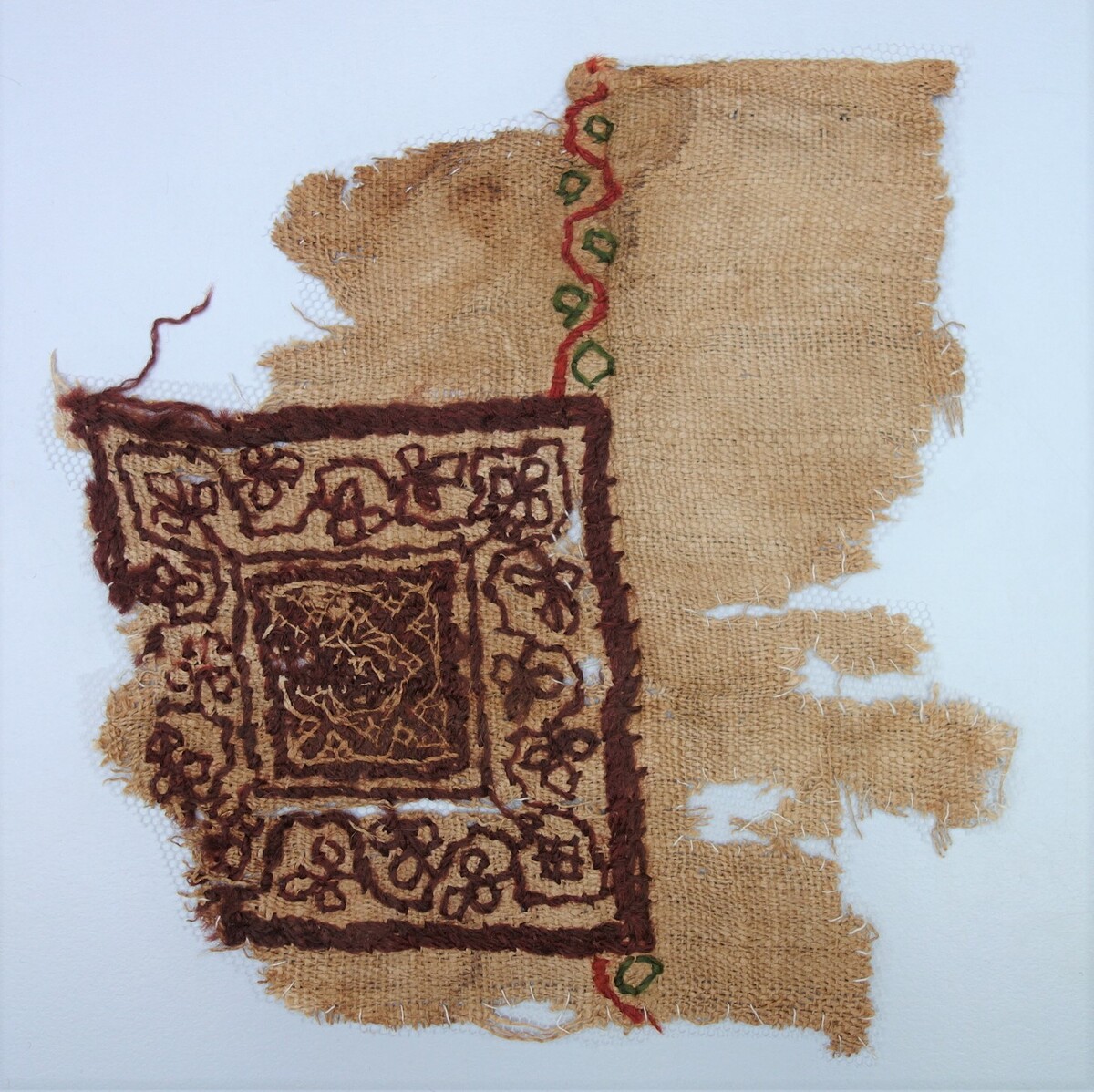 Fragment of woollen embroidery from Coptic Egypt with an embroidered design. 5th-6th c. (TRC 2000.0014).
My favourite Coptic fragment, however, is TRC 2000.0014. This is dated a little earlier, from the 5th to the 6 century CE, but again is from hand woven linen. This features an embroidered (couched) band in red and green wool, with a square in purple wool. The red colour probably came from madder and the purple from a woad-madder mix. The origin of the green dye is unknown—perhaps some yellow dye stuff mixed with woad. The band and square may have imitated woven bands and squares that were common in Coptic dress. The fragment is thought to have come from a child’s tunic. You can see these archaeological textiles, and much more, on the TRC’s on-line catalogue.
Shelley Anderson, 18 September 2021