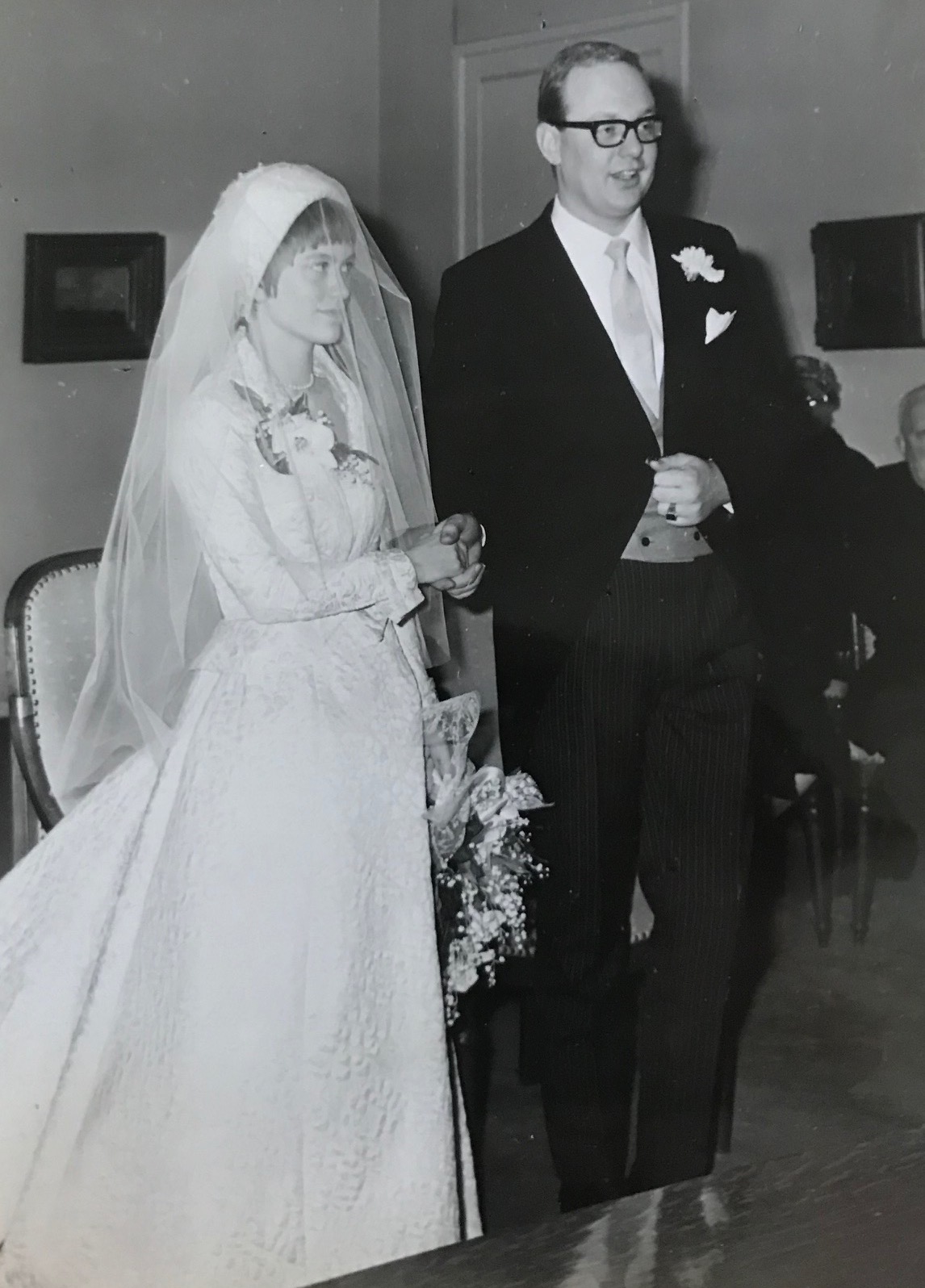
 Wedding photograph of Monica Hoogstraate and Wim Penders, 1966. The groom is wearing jacket TRC 2021.3360c.Often the biography of a garment is even more interesting than its material, decoration or technique.
A few months ago the TRC received a set of seven garments. They were donated by Monica Penders, daughter of the modern art dealer, Will Hoogstraate, who founded the Galerie D’Eendt in Amsterdam in 1960.
Monica’s husband, for their wedding in 1966, was given suitable clothing by an acquaintance, the son (Frans Wiegers) of the Dutch expressionist painter, Jan Wiegers (1893-1959). These are the clothes now in the TRC collection.
Wearing expensive clothing for one's wedding obtained from someone else seems to be a Dutch 'thing': I wore my father's jacket and waistcoat that he wore at his wedding in 1943, when I got married deep in the Dales of Yorkshire in 1985 (both garments now in the TRC Collection, TRC 2010.0078a)!
But back to the seven garments: they were already discussed in a previous TRC blog by Erica Prus, who focused on the tailoring house that made them in the mid-1930s, according to the labels sewn onto the clothing, namely the Maison Cumberland / F. Disslin, at 3, Rue Scribe and 66, Avenue Victor-Emmanuel III, in Paris.
All of this information set me off on a bit of detective work. Who was the first owner, and how did the clothes end up at a 1966 wedding in Amsterdam?
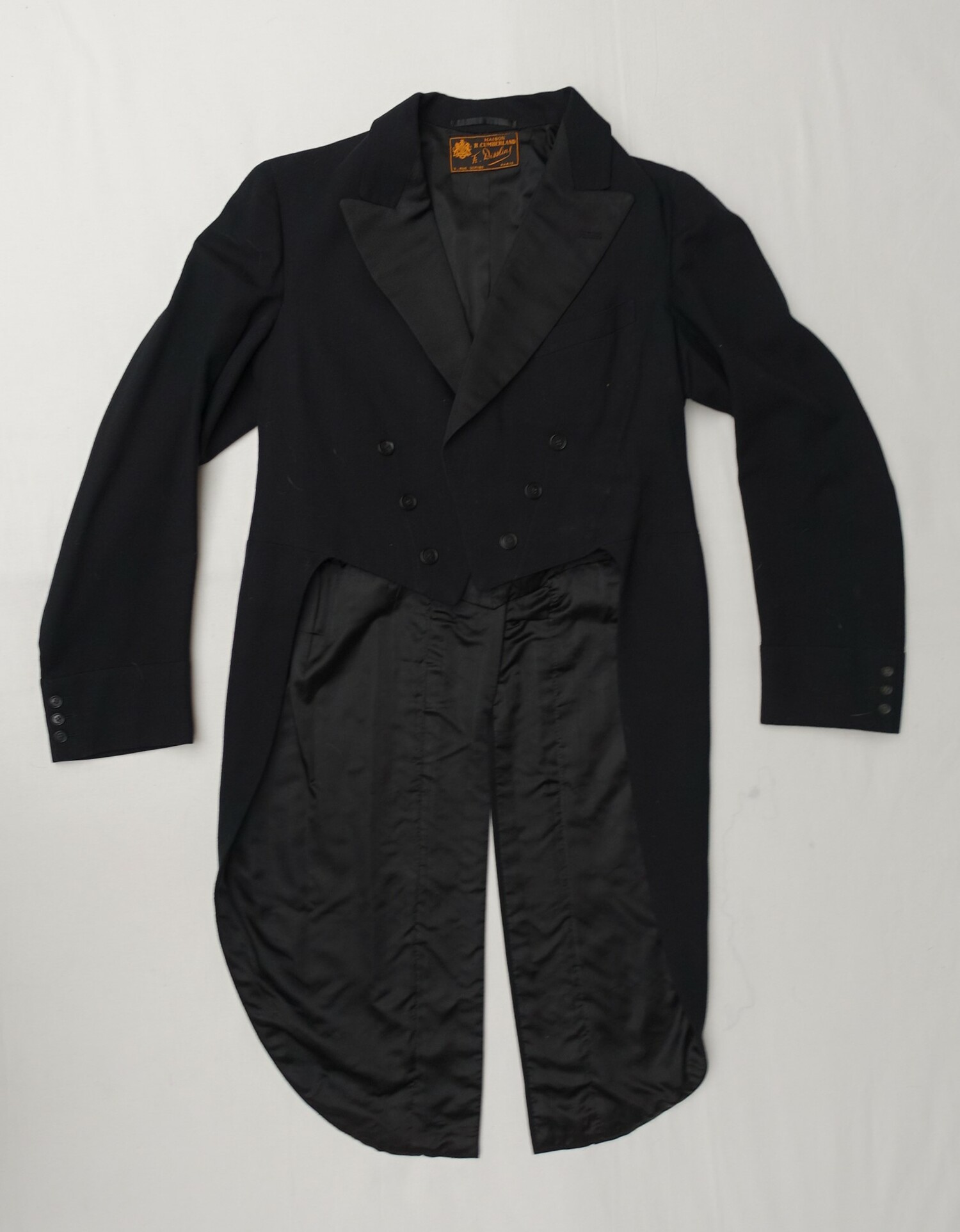 Jacket worn by Wim Penders at his wedding in 1966. The jacket was made by the prestigious Cumberland / Disslin tailoring house in Paris around 1935 for C.A. Wiessing (TRC 2021.3361a).One of the garments has a label with the date (16 May 1935), and the name of the client, C.A. Wiessing. The garments are of excellent quality, and that, combined with the prestige of the Cumberland firm, would indicate that Mr Wiessing was someone of some standing. And since the garments turned up in the Netherlands, it is more than likely that he was Dutch.
Some Google research led me to Mr C.A. (Kees) Wiessing, who was born in Vlissingen on 30 July 1879 and died on 18 March 1957. He was a lawyer by training, spent some of his younger years in the Dutch East Indies, and by 1936 was the director of BUMA, now merged with STEMRA, which is (still) a large organisation for songwriters, composers and publishers in the Netherlands. It by now collects the copyright fees for music for some 33,000 musicians and others. It was founded more than one hundred years ago. Certainly a prestigious organisation.
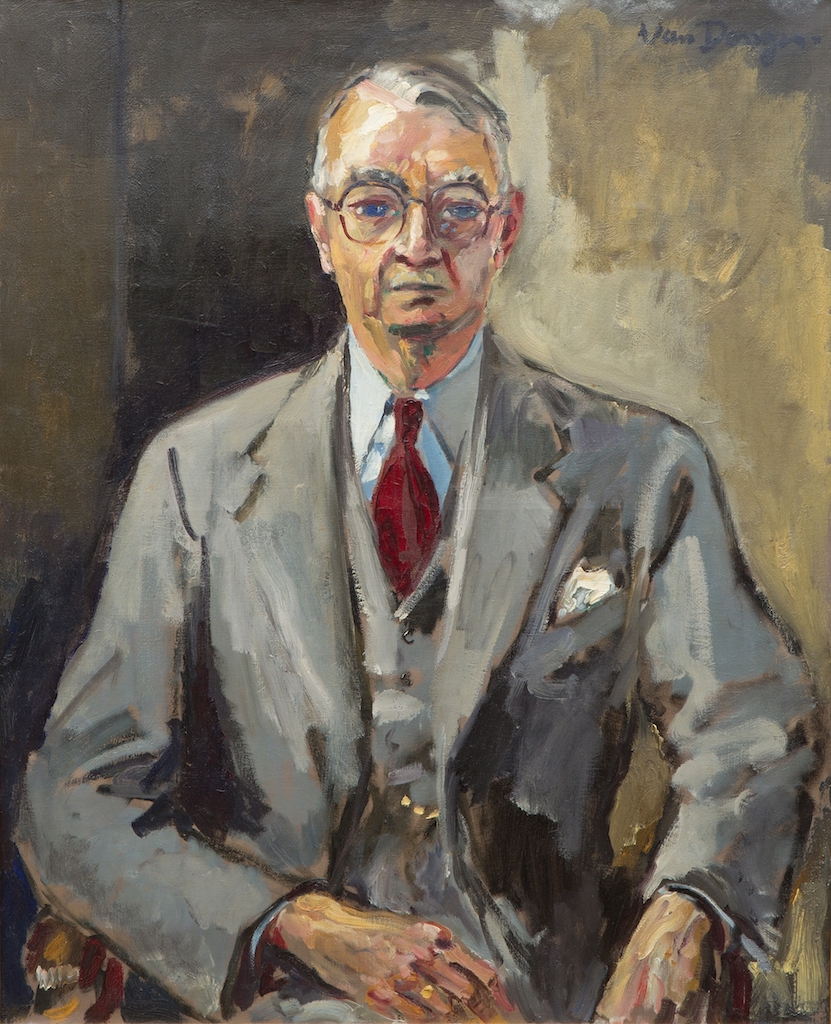 Portrait of Mr Cornelis (Kees) Wiessing, by Kees van Dongen, 1949.There is even a painting of Wiessing made by the famous Dutch/French painter, Kees van Dongen (1877-1968), which was presented to Wiessing on his 70th birthday, in 1949.
So how, if we are right, did some of the mid-1930s garments of Kees Wiessing, via Jan Wiegers and his son, Frans, end up with Wim Penders, the bridegroom in 1966?
Perhaps two of the paintings that Kees Wiessing left behind after his death offer a clue. They were painted by the Dutch expressionist painter, Leo Gestel (1881-1941). Leo Gestel, it so happens, was close to Kees Wiessing’s brother, the journalist (and staunch defender of the Soviet Union) Henri Wiessing (1878-1961). There is a telling photograph of Henri Wiessing and his wife, Annie, with Leo Gestel.
Before the war, Leo Gestel probably also met Jan Wiegers, also a painter. It is more than likely that Kees Wiessing, via his brother Henri, got into contact with the two Dutch expressionist painters.
The two artists and the Wiessing brothers probably moved in the same artistic circles in Amsterdam that after the war also included Will Hoogstraate, the dealer in modern art, who in 1960 would open his own modern art gallery and in 1966 would give away his daughter to the groom who, obviously with his father-in-law's help, was wearing expensive clothing made in 1935 in Paris, by an originally British firm, for Kees Wiessing, who spent part of his youth in the East Indies. Perhaps all of this is trivial, but isn't it wonderful to gather all these details from a single garment?
And what was his daughter Monica wearing at the wedding? It was a bridal dress designed by Max Heijmans (1918-1997), the famous Dutch couturier! Obviously another member of the artists' group. And yes, the bridal dress (TRC 2021.2184a) is now in the TRC Collection, thanks to the bride, Monica Penders, and will be the subject of another blog.
With many thanks to Monica Penders and her son, Jirka, for the garments and the fascinating stories hidden inside.
Willem Vogelsang, 5 January 2022