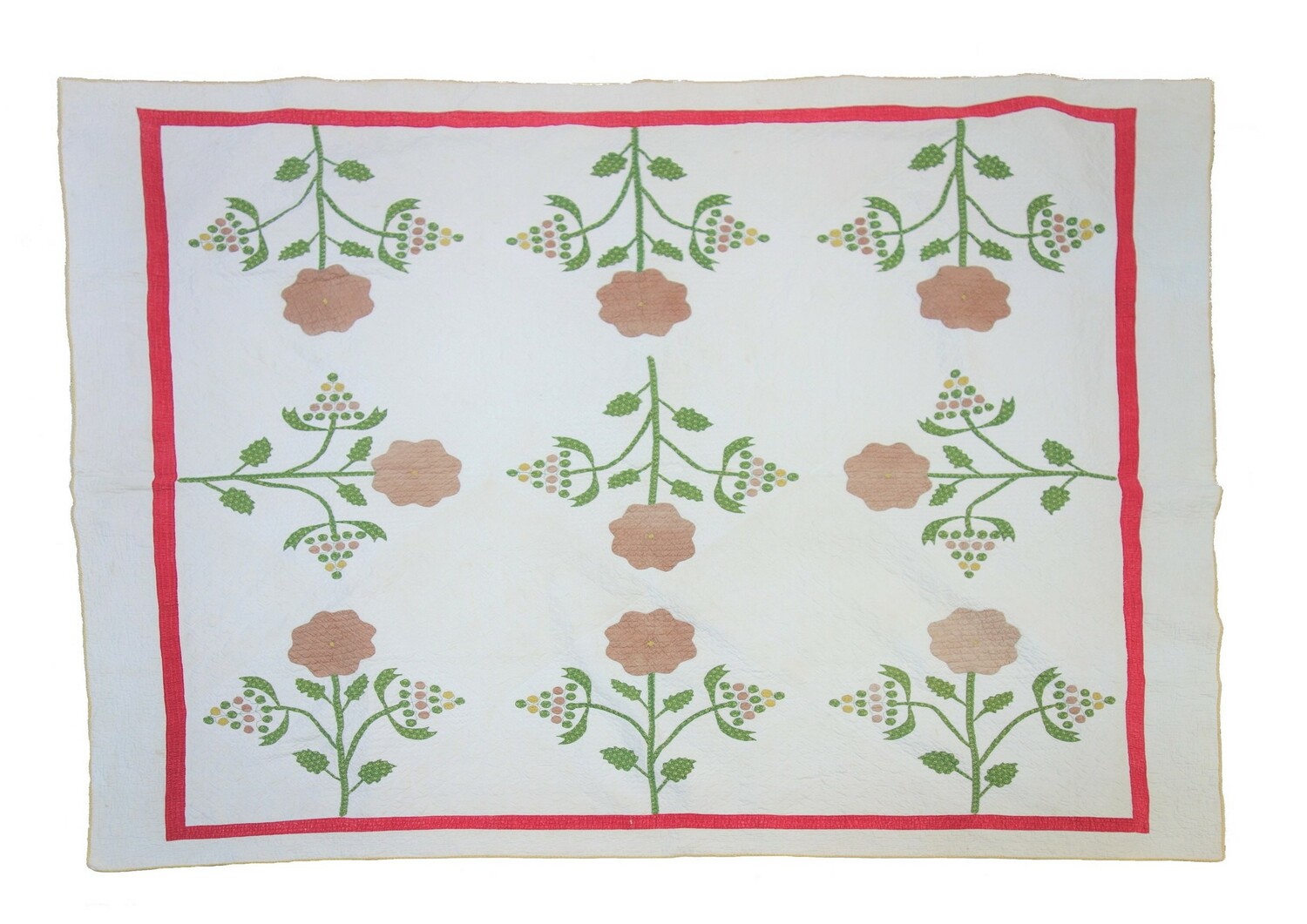
 Cotton quilt with a Flower and Berries motif, USA, 1850s (TRC 2019.2402).One of the oldest quilts (TRC 2019.2402) in the TRC collection dates to before the American Civil War (1861-1865). It’s a beautiful quilt in a Flowers and Berries motif, with nine large hand-appliquéd blocks, and is dated to c. 1850. In a blog article from 7 April 2020, TRC quilt specialists Susan Cave and Beverley Bennett argue that the quilt was very likely made by an enslaved woman, not for herself, but for the white family who owned her.
I have often wondered about this unknown woman. Was she proud of the beauty she created, of her obvious skill as a needle woman? Or did she hate this work as just one more task she was forced to do for a family not her own?
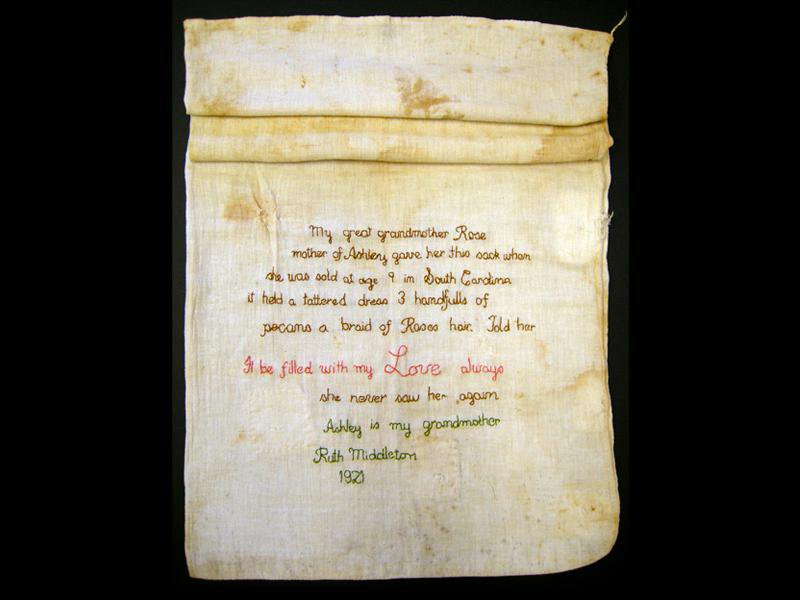 Cotton sack given by an enslaved woman called Rose to her nine-year old daughter Ashley who was to be sold and taken away. The sack remained for generations in Ashley's family, and embroidery was added by Ashley's granddaughter in 1921. The sack is now in the National Museum of African American History and Culture in Washington, DC.I wondered again about this unknown woman after reading Harvard University historian Tiya Miles’s latest book All That She Carried: The Journey of Ashley’s Sack, a Black Family Keepsake (Random House, New York, 2021). It is a reminder of how textiles tell stories, especially women’s stories, in this case the story of a mother’s love for her daughter.
In the 1850s in South Carolina (US), an enslaved woman named Rose learned that her nine-year-old daughter Ashley was going to be sold. She immediately filled a cotton seed sack with a tattered dress, three handfuls of pecan nuts and a braid of her own hair, and gave it to her daughter. Ashley was sold days later, and the two never saw each other again.
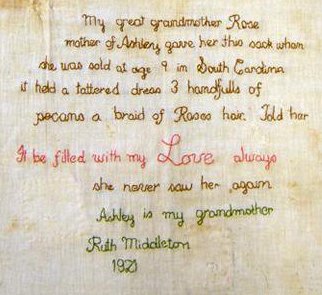 Detail of Rose and Ashley's sack, embroidered with a text by Ashley's granddaughter.The cotton sack (75 X 40 cm) became a treasured family heirloom. In 1921 Ruth Middleton, a granddaughter of Ashley, embroidered the story in red, brown and green thread on to the sack itself, adding that Rose told Ashley the sack “be filled with my Love always”. In 2007, a woman discovered the sack in a rag bin at a flea market, and bought it for USD 20. She gave it to the Middleton Place Plantation (South Carolina). Ashley’s sack is now on display, on long term loan, at the National Museum of African American History and Culture in Washington, DC.
This evocative book traces all the extensive research that has been done to find out more about Rose, Ashley and Ruth. Textile analysis, including DNA analysis, is being considered for the sack itself, in the hopes more can be learned. For now, it remains a testimony of love and resilience in the face of brutality.
Shelley Anderson, 11 January 2022