I am extremely grateful and excited to have taken part in the TRC’s “Textile Intensive Course” last week, from February 21st - 25th. After five full days of looking at and learning about textiles I can say I learned an incredible amount in a short period of time. My biggest takeaway is that the world of textiles is far larger, more complicated, more nuanced, and more interesting than you could ever imagine.
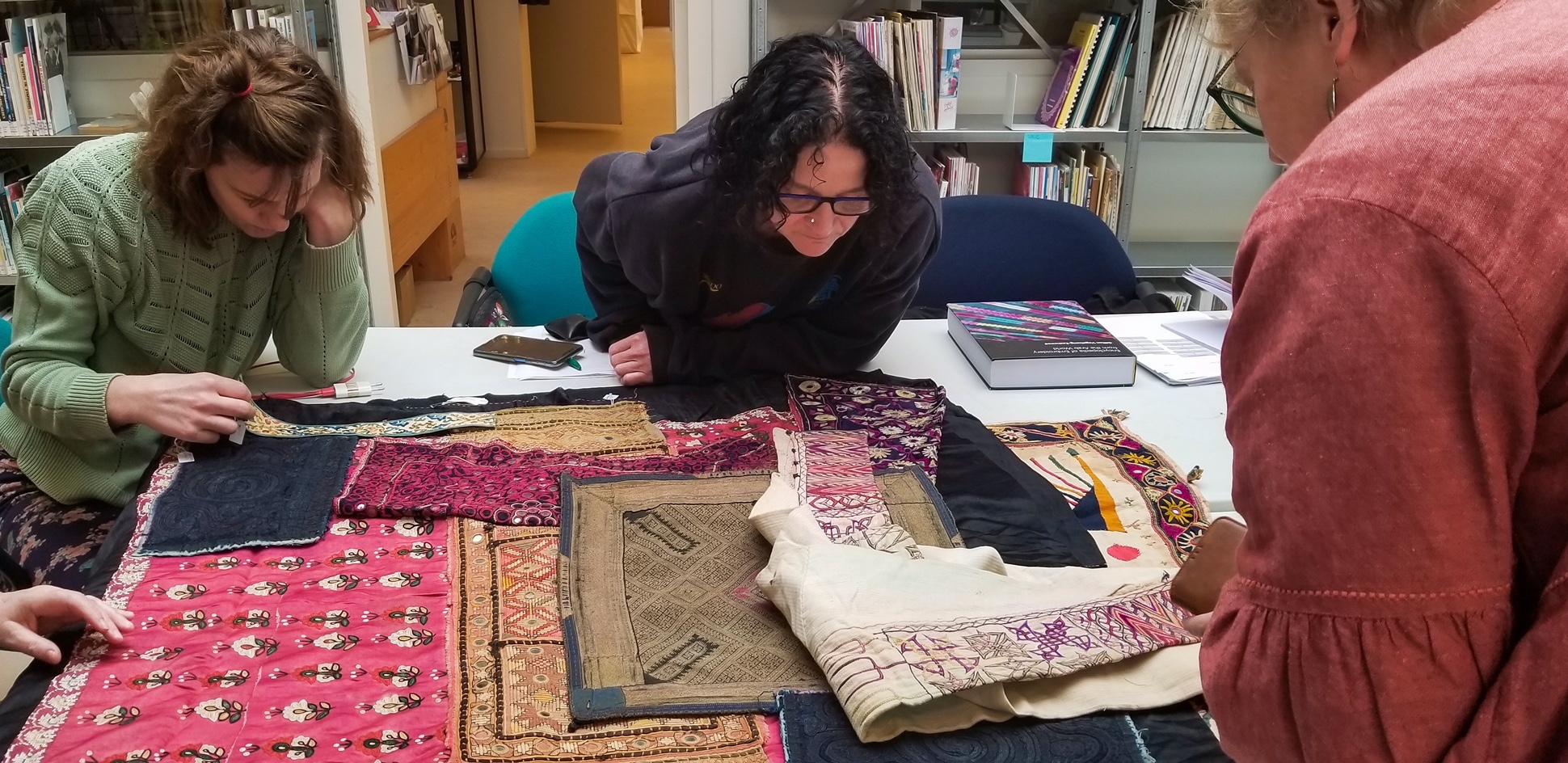 Participants of the February 2022 edition of the TRC Intensive Textile Course. Photograph by author.
Five others and I followed along with Dr. Gillian Vogelsang-Eastwood through every step of the production process of various textiles. First we looked at fibers, starting with the very basics of cotton, flax, wool, and silk. From there we expanded into a large world of fibers where we broke them down into categories to understand their origin, purpose, and qualities. Did you know it is possible to make a silky white fiber out of milk protein? I didn't before this course! Nor did I realize how many different types of sheep wool there are, or what the process for harvesting spider silk looks like. The best part was getting to sort through the bins of fibers Gillian had in order to start our sample book we eventually got to take home.
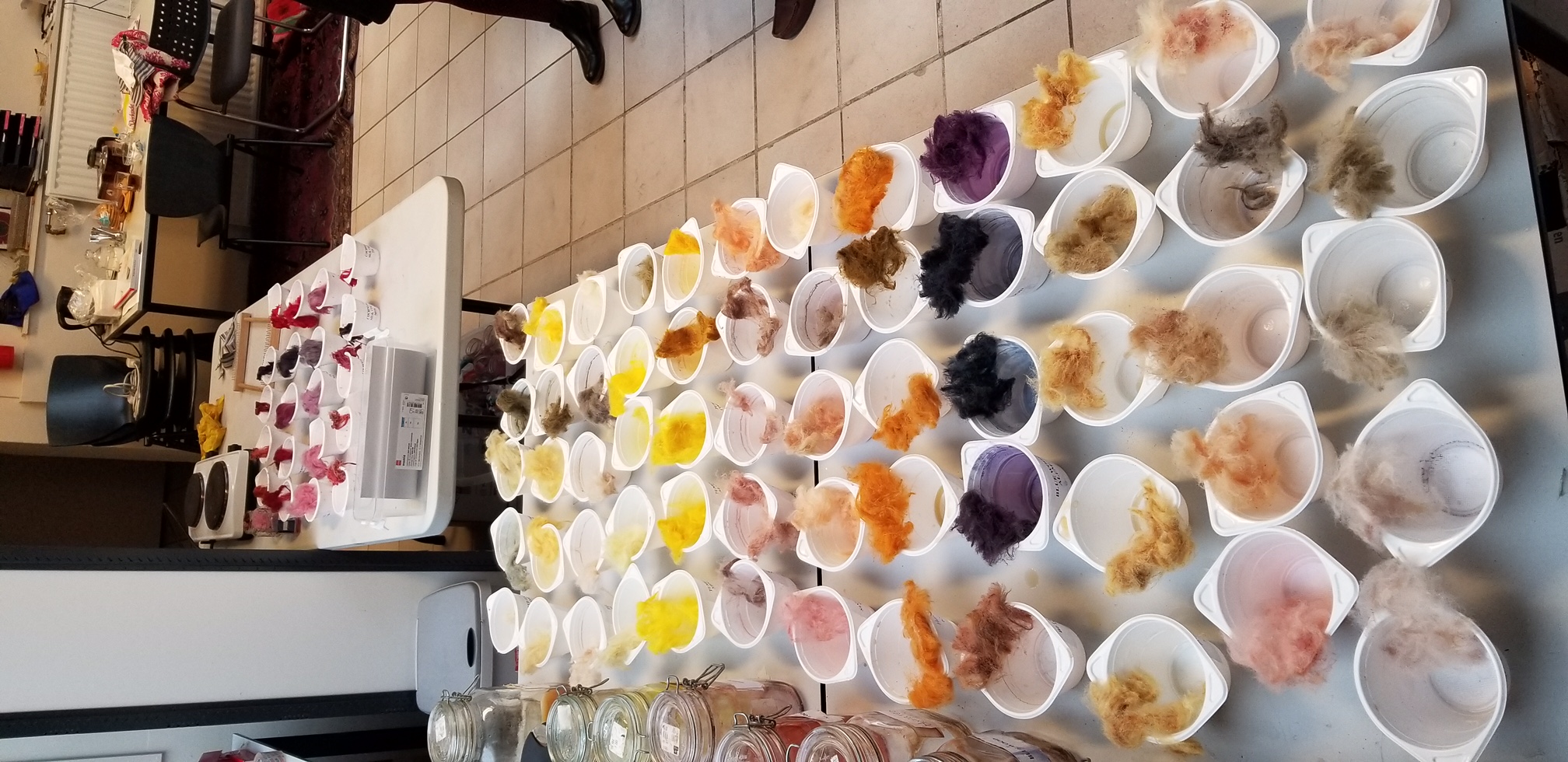 TRC Intensive Textile Course, February 2022: Experimenting with natural days. Photograph by author.
On the second day we asked the question “What is a thread?” to which I learned there is no exact answer. This is when I started to understand how important the biscuits and tea that were supplied really were! Not one to bore us with theory, Gillian allowed us to get right into learning how to spin yarn from wool. She made it look incredibly easy, and I think with some practice at home I could really get into it! Once I had a small bundle of thread I had spun myself I really started to feel accomplished. I now understood the properties of the material I was using as well as the techniques for getting a good quality thread.
Gillian always repeated how important it is to actually try making something yourself, because it truly is a better way to learn than simply reading about it. The pitfalls suddenly became clearer and we had a better grasp of the method. We had also prepped dye baths and learned about just a small number of materials you can use to dye fabrics with. One of the other students got to take home 2 kg of onions, after they had been peeled to use the skins in a dye bath, for her own cooking! We even brewed a strong pot of tea to use as a dye bath, which I think symbolizes the course and my experience very well!
On the third day I had class in the morning and unfortunately had to miss the introduction to weaving. I know the basics of different weave types and patterns were covered, and when I arrived at lunch time I jumped straight in to catch up with the group. The basic weave patterns they were trying on small personal looms were easy enough for someone who had never woven anything before to try immediately.
It was especially exciting to see a pattern start to form, and we were all enthusiastic about choosing colors and making designs. I loved the parts where we got to experiment with the tools after learning about the techniques, because it can be very difficult to get into craft making without the supplies. While not very expensive, it is difficult to know where to start and which tools are essential. Gillian provided us with everything we could have needed to start making basic materials. From the looms, to the yarn, needles, beads, dyes, and expertise, we were truly set up to succeed.
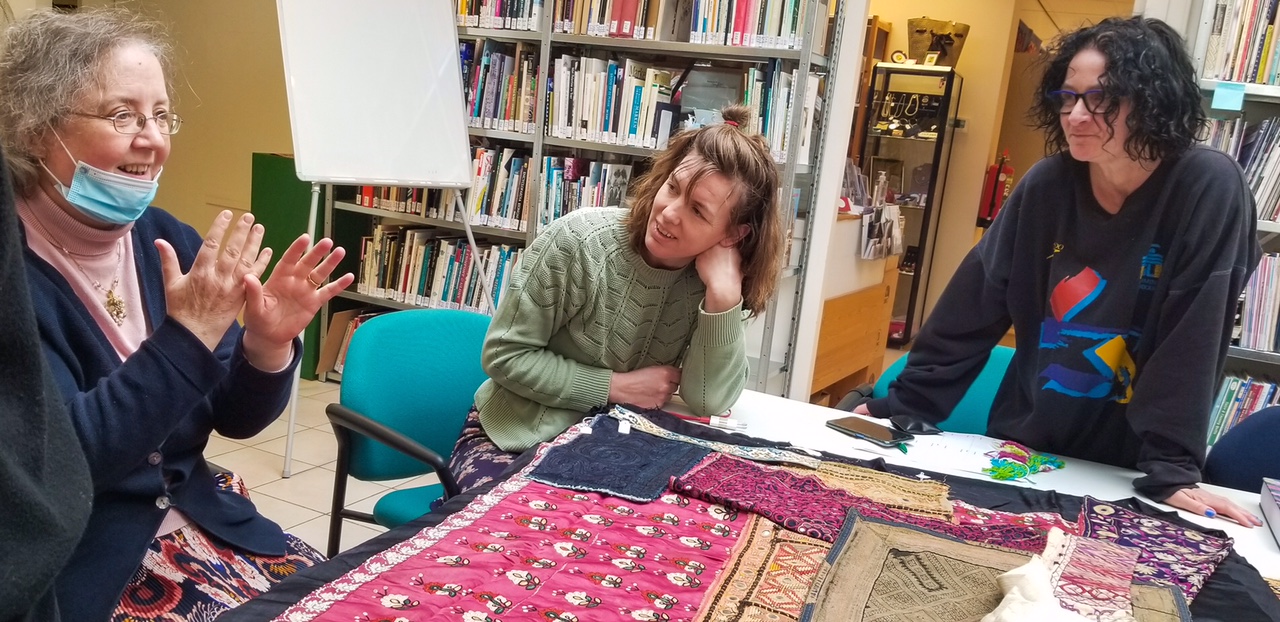 TRC Intensive Textile Course February 2022: Participants studying a variety of textiles, listening to Gillian Vogelsang. Photograph by author.
The course really got interesting for me on the fourth day when we started talking about velvet. I was interested to see why a whole day could be devoted to something like velvet in a course like this, and I was not disappointed! Of course we started immediately with making our own velvet. I had absolutely no clue how velvet was made but Gillian gave us all the instructions and off we went! Once we all had our small sections of velvet the rest was easy.
By this time in the course the other students and I were able to use some funky textile language in our vocabulary. Things like: voided velvet, pile, chenille, ground, weft and warp faced, selvedge, and many more! Gillian brought out some boxes from the depot which held incredible examples of some of the techniques we had been talking about. I think this is what our group was most interested in. We started looking closely at these textiles and identifying everything that we could. Some of the textiles were hundreds of years old!
I appreciated being able to actually understand these ancient pieces, as well as their makers who no doubt spent lifetimes perfecting their craft in order to make it. Once we understood the process of weaving or sewing some of these pieces, and spent an hour or two to produce a basic piece, the world of complicated patterns really opened up. Suddenly we could see that even basic looking patterns actually required serious skill and craftsmanship.
The last day was both happy and sad. We were all tired but amazed at how much we had learned, and eager to do more! We spent some more time looking at textiles from the collection, since the opportunity to spend such intimate time with objects like this is a unique opportunity. We covered a few more techniques such as embroidery, which also turned out to be a larger world than I ever thought.
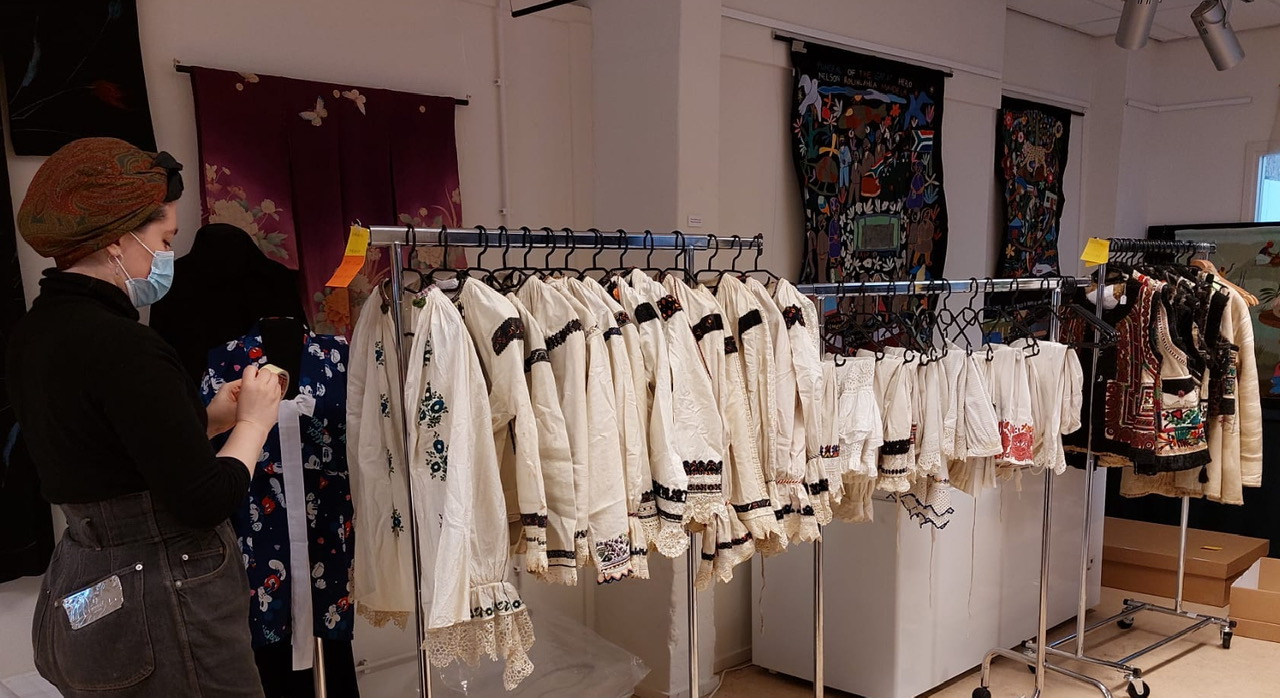 TRC volunteer Augusta de Gunzbourg processing the Amsel collection.
Conveniently the Amsel Collection had arrived earlier in the week, and other volunteers were working like crazy to archive the collection, so we got to browse some of the new pieces. Many of these new textiles are now available in the online collection for everyone to look at, with the rest coming soon!
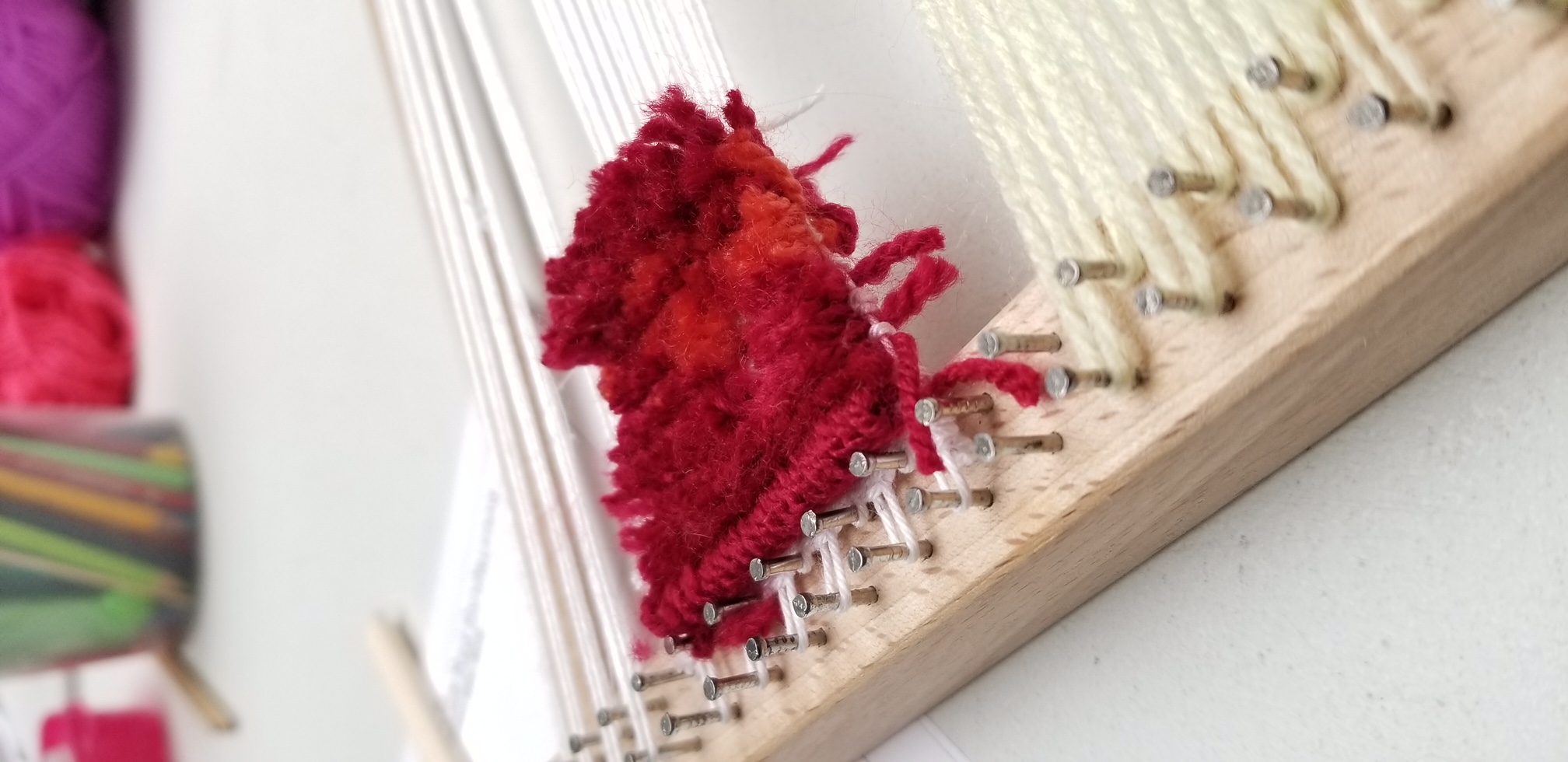 TRC Intensive Textile Course, February 2022. Learning about velvet making. Photograph by author.When I got home with my large book of samples after the last day, I felt exhausted but also extremely accomplished. This course provided me the most satisfying week of learning I have ever had, and thanks to Gillian I have the strongest basis for textile knowledge I could have ever asked for. We were allowed to touch, handle, experiment, and examine every aspect of a textile in ways that encouraged more questions than we had before. I was able to interact with objects I had only previously seen behind glass or in photos, which allowed me to grasp concepts far quicker.
Gillian was a wonderful teacher, who managed to stay focused on us even after receiving exciting news of a new grandchild! Only once or twice did we stump her with a question, otherwise she was eloquent in her answers and always seemed to have the answer ready at the tip of her tongue. We covered far more than what I can efficiently cover in a post like this one, but I can say that I loved everything and I would recommend anyone to take this course. I look forward to using what I have learned in the future of my internship at the TRC as well as improving my own closet now that I can tell good quality fabrics from the bad!
AJ Salter (Canada), MA student Museum and Collection Studies, Leiden University, 2 March 2022