Over the last few days the initial sorting, tagging and numbering of the Arizona collection has been taking place! The larger boxes with complete Albanian outfits have been opened and these marvelous items hung up on racks. The American quilts, part of the same donation, have brought forth cooing noises from Beverley Bennett, who is in charge of the TRC’s collection of quilts. Although one item did confuse some volunteers (including myself): a patchwork skirt in Christmas materials with a narrow waist. It turned out to be a Christmas tree skirt, i.e. a covering for around the lower part of a Christmas tree to hide the trunk and stand. Of course, what else…..?
Saturday saw another important step in building up the TRC’s European collection. When the Amsel Collection from Paris, with many Hungarian and Romanian garments, was first unpacked at the TRC a few weeks ago we had several ‘walk-in‘ visitors, one a Romanian Dutch couple, and a few hours later a Hungarian couple. We discussed with both of them our need for further information about objects, confirmation of provenance, and the need for the stories behind. And on Saturday (2 April) there was the first of several meetings.
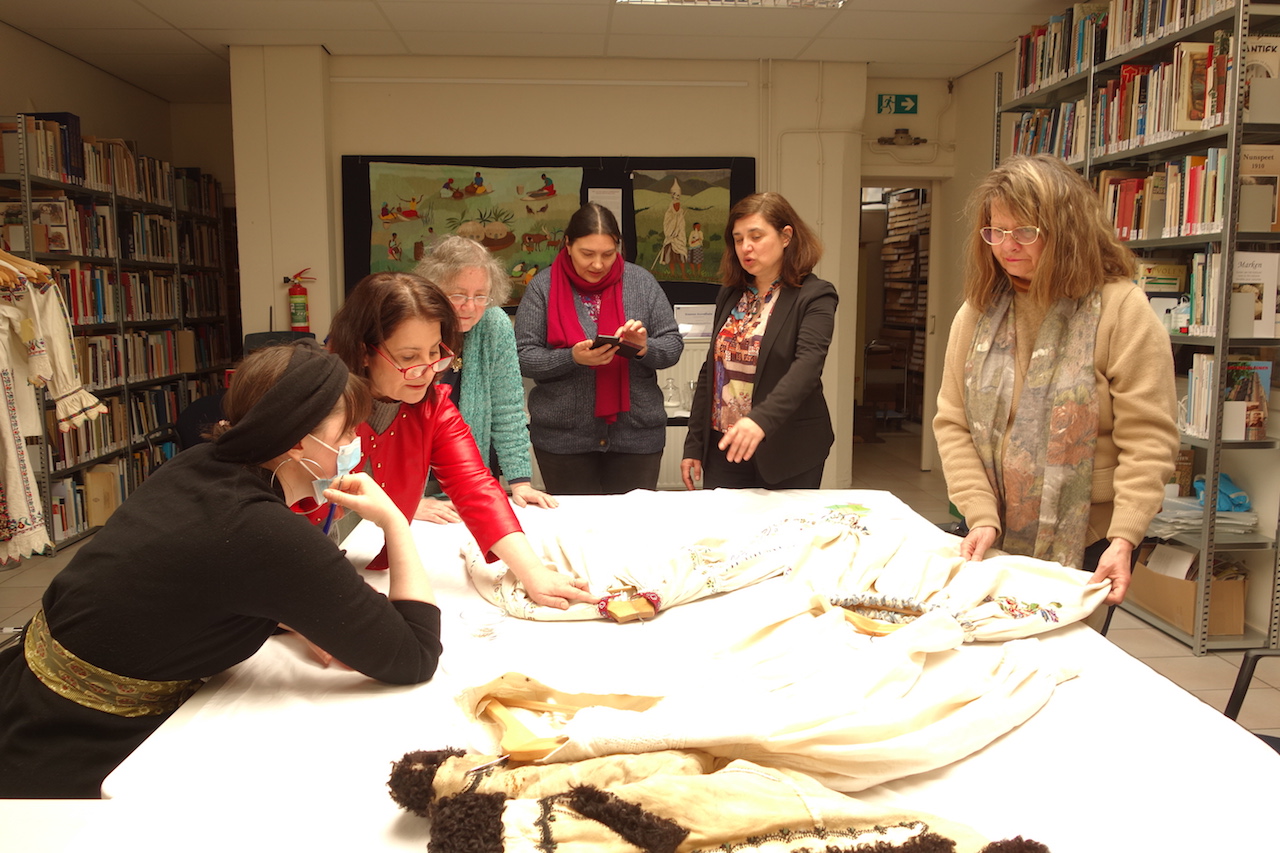 Discussing Romanian emboideries with a group of specialists, 2 April 2022 (photograph Maria Linkogle).
It was organised by one of the initial visitors, Liliane Birla, who kindly brought some Romanian friends, including Monica Brinza, who live in Amsterdam, Leiden and Utrecht, and who are involved in textiles, especially embroidery. We had a wonderful few hours discussing our problem pieces, firstly which group did the ‘unknown’ blouses and garments belong to? How were they worn, when and why. What did the motifs and colour combinations symbolise?
It was fascinating learning about the construction of the blouses, the different usage of colour (the minimal use of green in embroidery from Romania), the diverse social and cultural groups that create embroidery, but also the different interpretations. For some in the group the use of crochet bands on a blouse was an indication the maker/wearer of the blouse was a ‘lazy girl’, for others it meant it came from a different region.
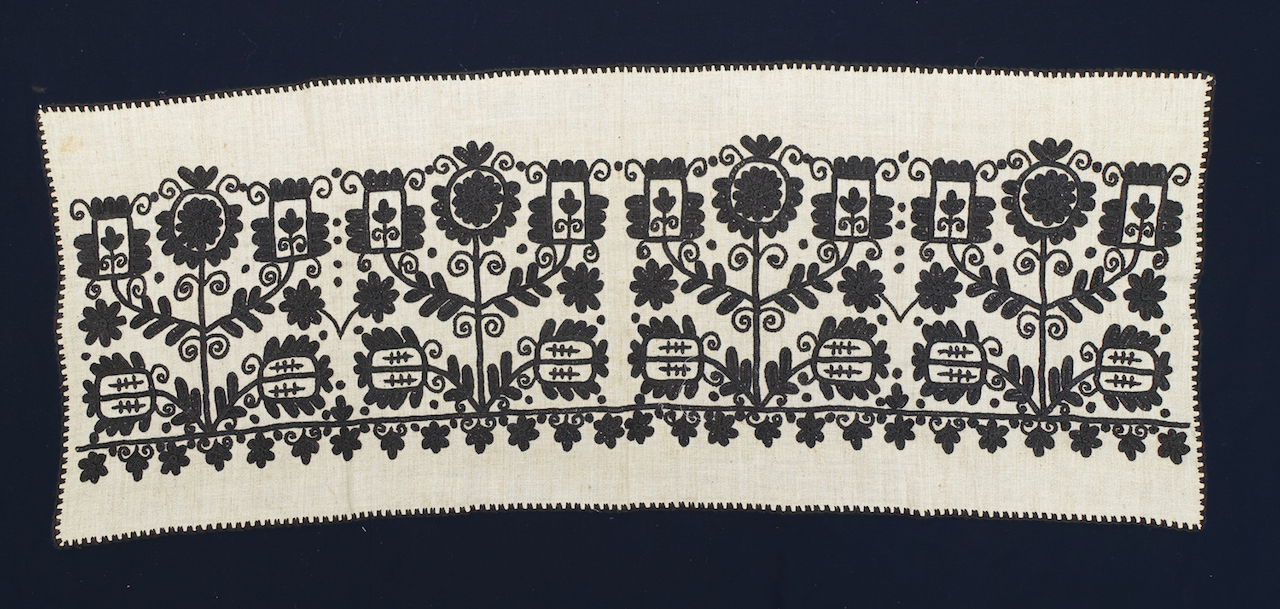 Embroidered cloth from Transylvania, Romania, 20th century (TRC 2022.0523).
Several members of the group have kindly offered to come back in May to add further details to the TRC Collection archive and database. In addition we are working on plans to have an exhibition next year on embroidered blouses from Romania. The exhibition may open on the 24th June, which is national Romanian blouse day!
All of which brings us back to plans for a European textile and dress centre as part of the work of the TRC Leiden. The Amsel and Arizona donations meant that in addition to what we already have (especially the German and Dutch items) the TRC now has one of the largest collections of European textiles and dress in Europe. The devastating situation in Ukraine is bringing Scandinavia, the Baltic States and the rest of Europe back together. It has also highlighted the need for the preservation of material culture and heritage for future generations.
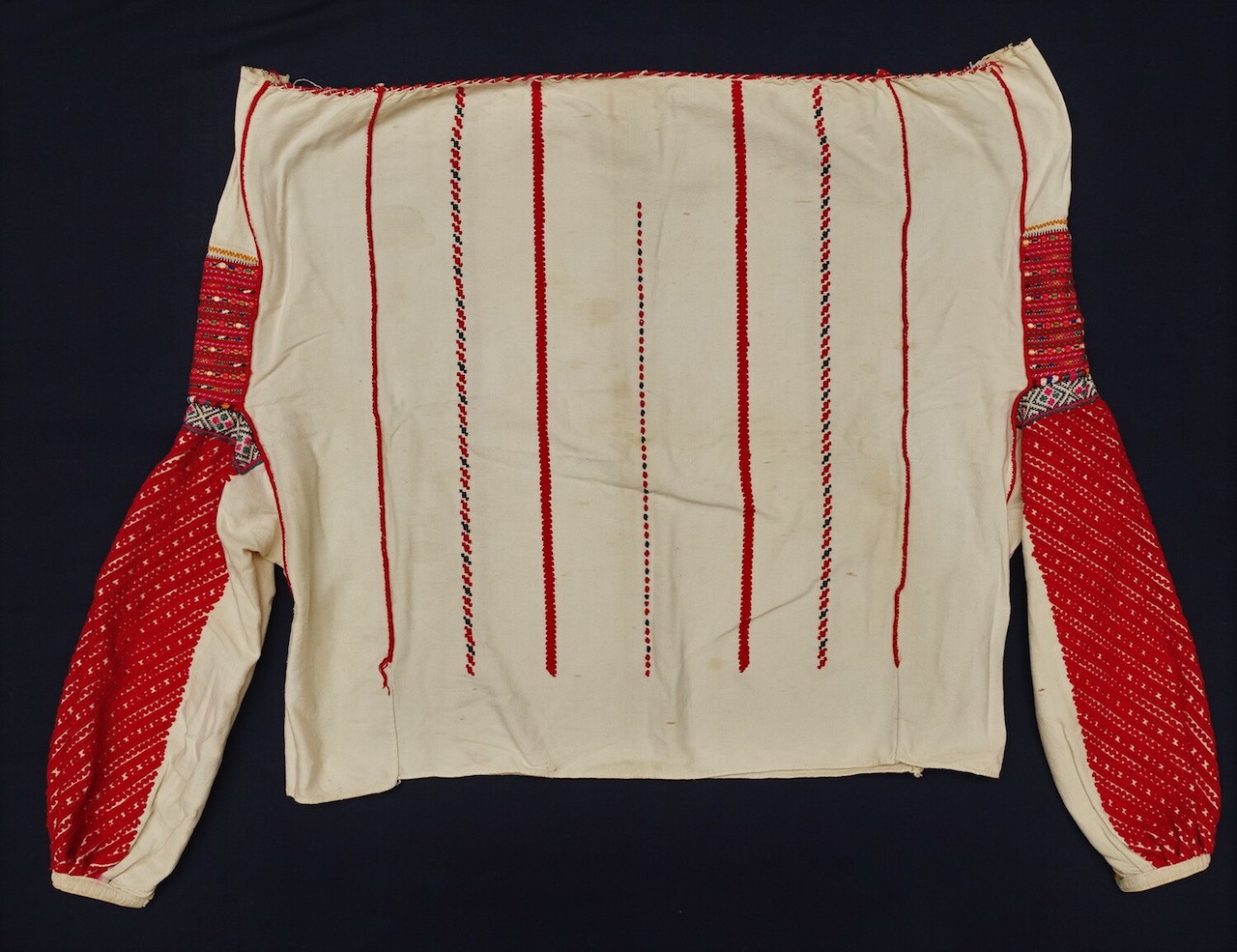 Hand embroidered, unfinished woman's blouse from Romania, 20th century (TRC 2022.0567).
The TRC cannot do much with respect to the war in the Ukraine, but we can help by making accessible more knowledge about textile techniques and European dress and identity, in the form of storing and publishing individual and groups of objects (in both actual form and online) and most importantly, teaching a wide range of textile skills to current and indeed future generations.
Gillian Vogelsang-Eastwood, 3 April 2022