Dr Monica Klasing Chen is assistant-professor in Chinese art history at Heidelberg University, Germany. She attended the 5-day TRC Intensive Textile Course in April. She wrote a blog about her experiences and how the course has affected her work and her interests in textiles. A second blog that she wrote about the course, and which will focus on her personal highlights during the week, will be published shortly.
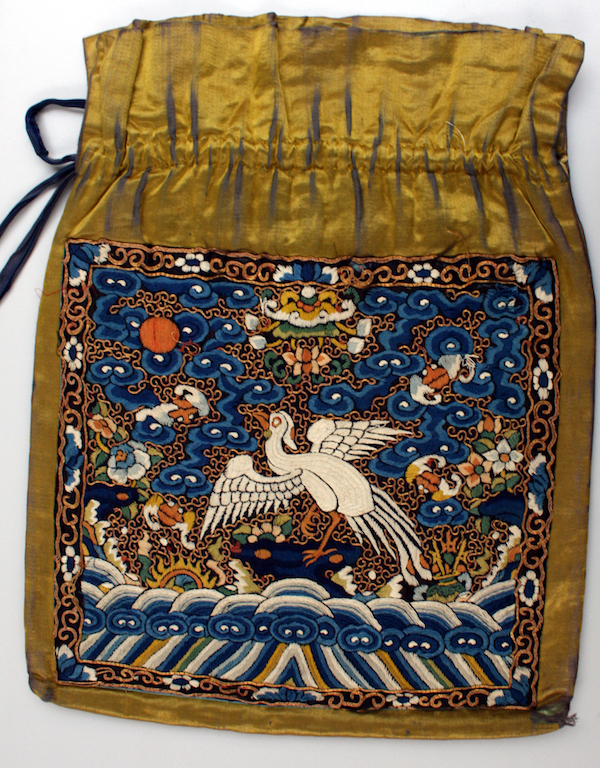 Satin bag, China, late 19th century (TRC 2010.0138).
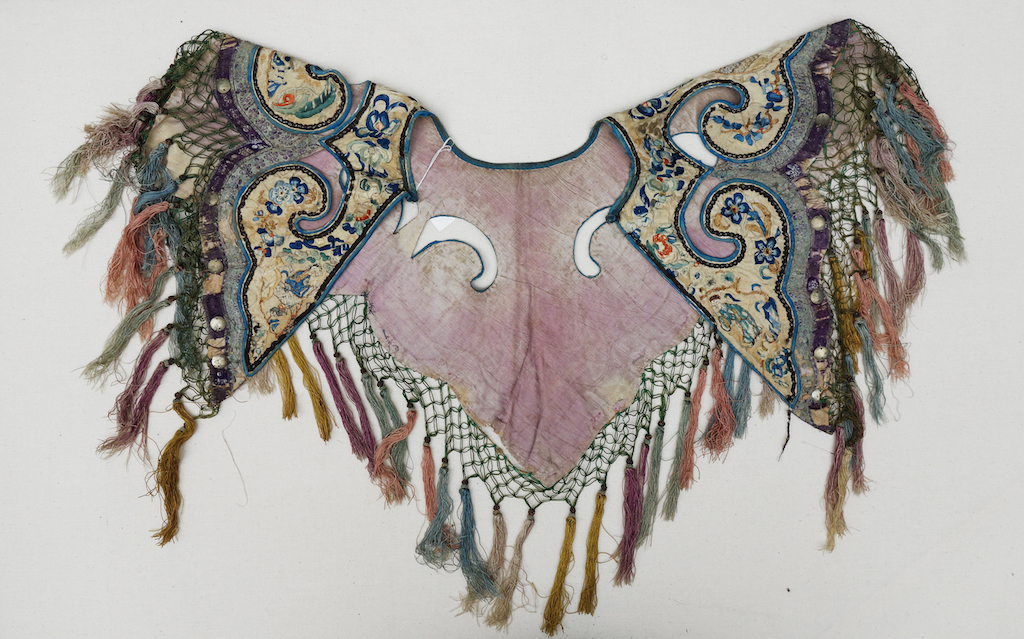 Large silk 'cloud' collar for a woman, with embroidered panels and open areas, China, early 20th century (TRC 2004.0108).
***
I first stepped into the TRC workshop room a month ago. I had read two reviews written by previous participants of the Intensive Textile Course before signing up, so I had a fairly good idea of what to expect: a week full of hands-on experiments in spinning, weaving, dyeing and a fair share of discussing and analyzing old (and very very old) fabrics. My initial expectations were all met, but what I took home from the course was much more than a folder full of notes and samples.
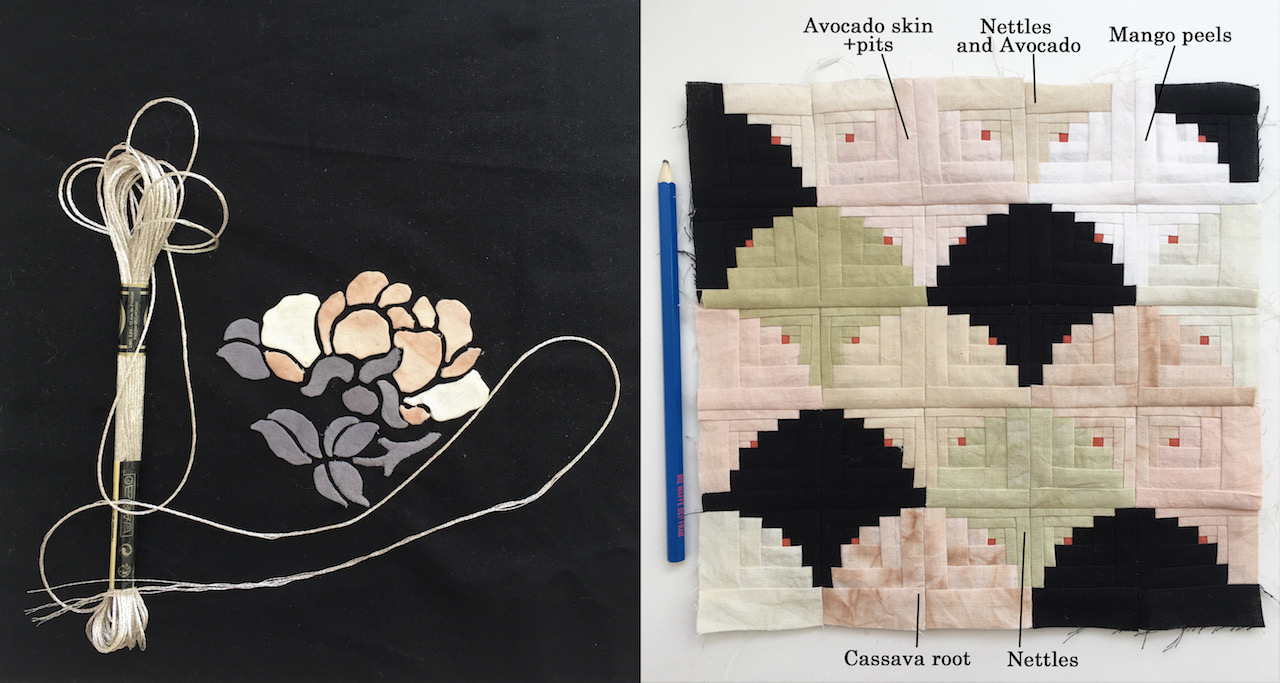 Left: Prepared appliqué pieces and silver thread for couching. Right: Pieced top for mini quilt made with dyed fabrics and two solids.
It is not a secret that scholars, including historians and art historians, develop habits that shape the way they conduct research and write about the past. In hindsight, the most valuable thing I learned during the TRC course, was to reassess my own practices and acquire some new habits.
Lesson one: “Getting your hands dirty”
The course instructor and director of the TRC, Dr Gillian Vogelsang-Eastwood, is incredibly skilled at explaining complicated processes in simple terms. The chemistry behind dyeing and the terminology for different weave patterns suddenly became intelligible topics within a single day, also thanks to the course’s perfect balance of theory and practice. Dr Vogelsang coached the group on several practices where we could get our hands dirty, letting us work our way through unprepared wool for spinning or crushing dry berries and peeling piles of onions for dye baths. My favourite quote from these activities: “Throw it on the ground and we will clean it up later.”
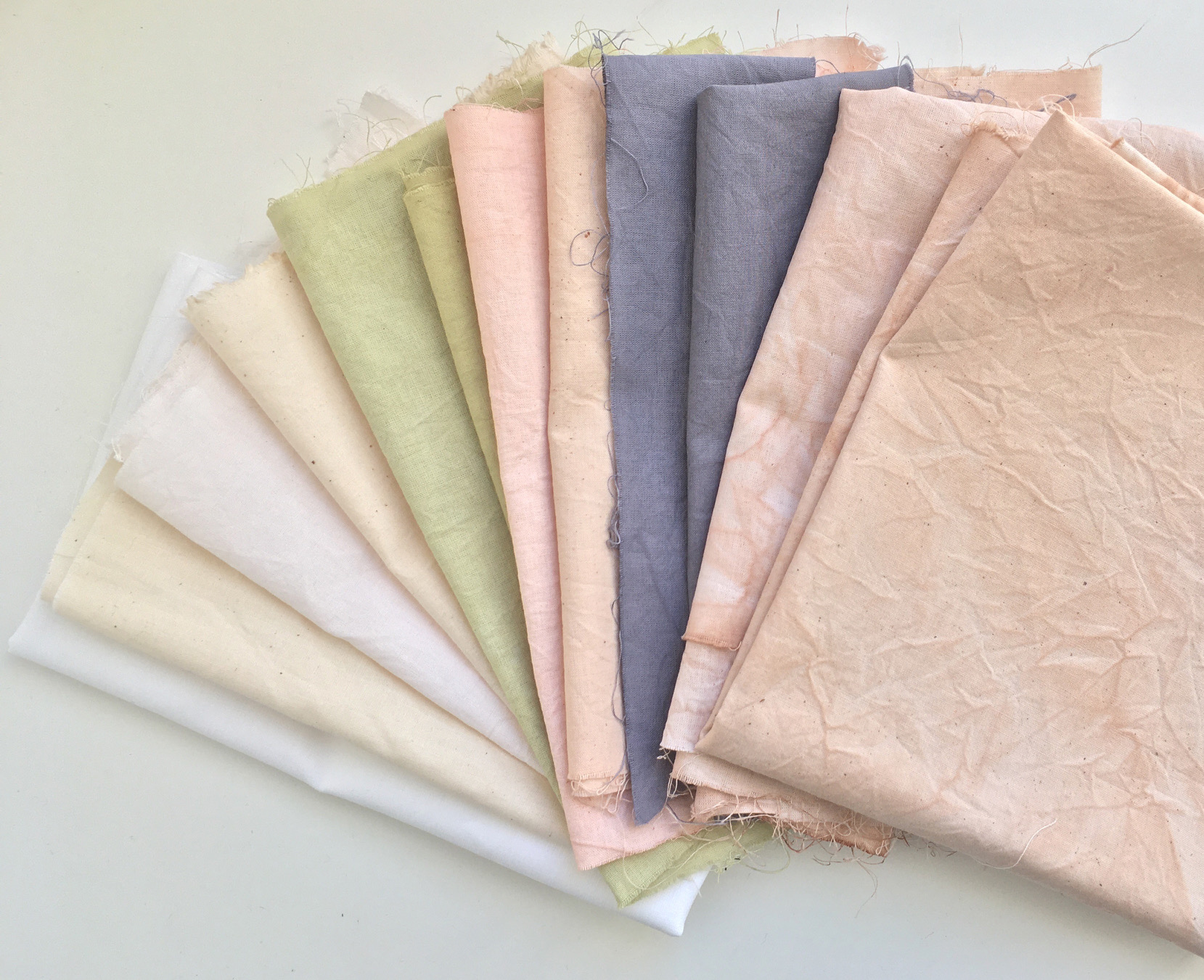 Natural and white cotton fabrics dyed with kitchen waste. From left to right: Original fabric colour, mango peels, nettles, Avocado skin and pits, black beans, cassava.This was the attitude I took home after one week of intensive practice at the TRC. Shortly after the course, I began using waste from my kitchen to dye fabrics. Using alum as mordant, with which we had experimented during the course, I dyed wool and cotton fabric at home. I began with the water used for soaking black beans, which produced a lovely dark, almost purple, blue. My husband was also pleased with the by-product: Brazilian bean stew.
Next, I soaked and boiled the peels of cassava roots, which created a subtle brown dye that left interesting texture patterns on cotton fabric due to the wax in the root peels. Husband was once again happy with the outcome of fried cassava. In the following days I made dyes with mango peels, avocado pits and skin, as well as nettles, which produced a light yellow, an intense pink and a bright green. Husband continued to rejoice in the opportunity to make punny remarks, such as “I bet you are dye-ing to see the results.” And I was.
I ended up sewing the dyed fabrics into a small patchwork sample, using foundation paper piecing to create tiny curved log cabins. I included two industrially dyed fabrics in the mix for comparison: the central square in terracotta and black. This will allow me to track how lightfast my home-brewed dyes are. I also copied a flower pattern from a Chinese embroidery and used dyed fabrics to recreate it in appliqué, setting the goal to coach silver thread around the appliqué and imitate a Chinese couching technique.
Lesson two: “Collecting scraps”
One of the points Dr Vogelsang highlighted during the course was that the fabric sample collection we were starting at the TRC should continue to grow after concluding the workshop. I took that advice to heart.
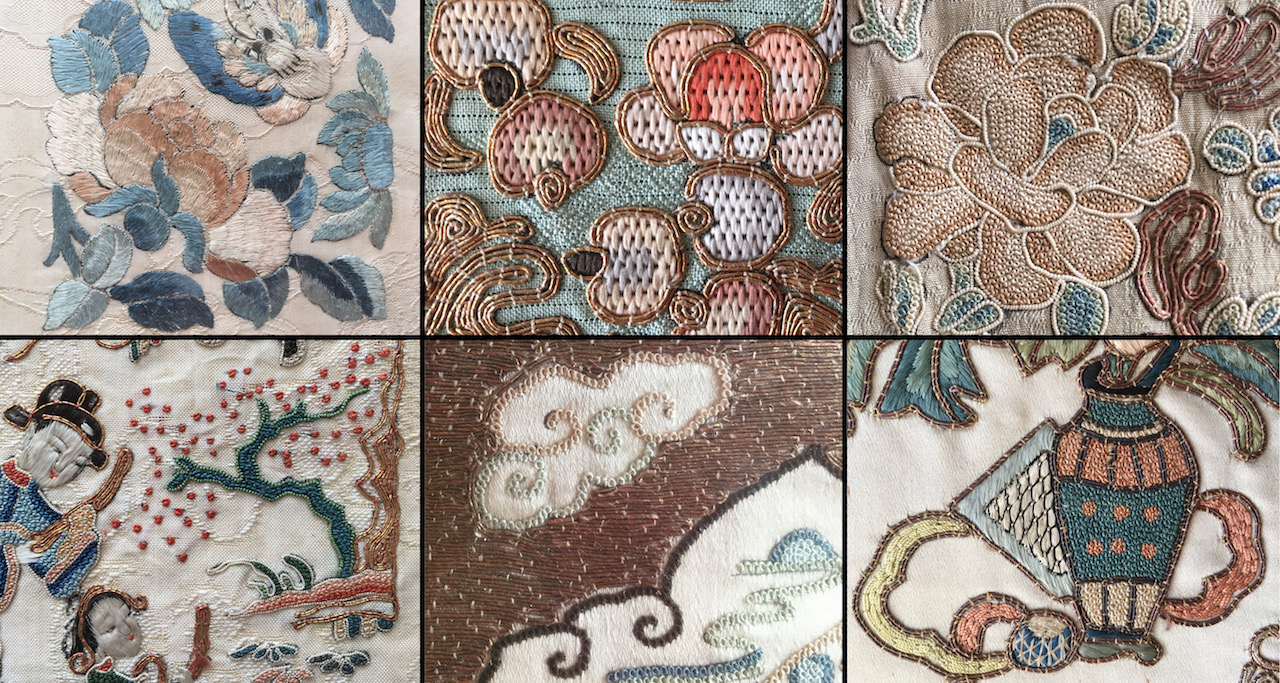 A variety of stitches and thread types used in garments from the 19th and early 20th century that survived only as scraps.
When browsing through books and visiting exhibitions, one is rarely allowed to take a close enough look at objects to see the fabric weave and to identify the stitches used in an embroidery. Since my main interest lies in Chinese textiles and embroidery, I began to collect scraps and repurposed embroideries to create my own reference collection—a collection I would be able to touch and look at closely. The good thing is that fabric scraps are usually not regarded as very valuable, unlike paper scraps of Chinese paintings and calligraphy, which Chinese collectors of the 18th century slowly began to hold in high regard, as confirmed by a statement by the scholar Lu Shihua 陸時化 (1714—1779):
“The pictures and autographs recorded in my catalogue are of a slightly different kind as those listed by former collectors. Those would immediately enter in their catalogues of famous scrolls handed down from one generation to another, renowned items which fetch high prices. Minor or incomplete items they did not bother about. But I pay ever more attention to fragmentary and incomplete scrolls. I was born in this late age, and famous scrolls are now rarely seen. […] But if minor items are not placed on record, I greatly fear that they will be lost forever." (Scrapbook for Chinese Collectors 書畫說鈴, paragraph II, translation by Robert van Gulik)
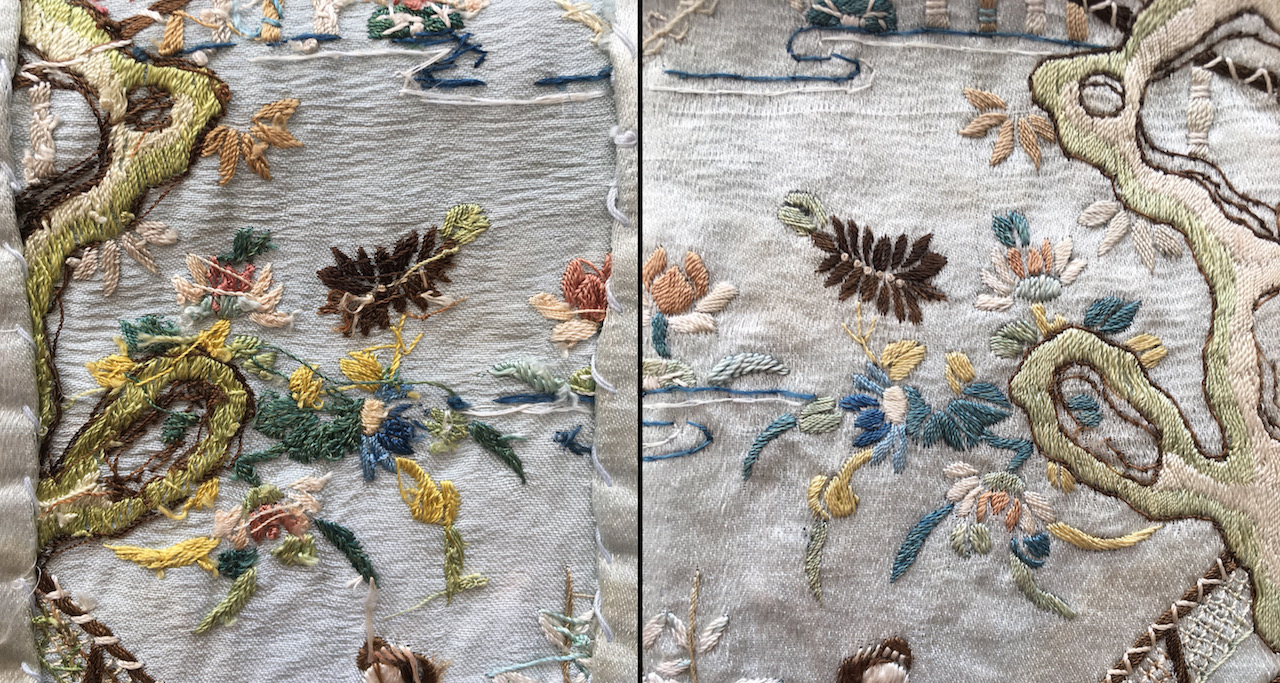 When looking at the back of this scrap (left) we see the vivid colours the embroidery once had.
In a similar vein, the TRC course reminded me to cherish scraps of fabric and their “incompleteness.” Even with the few embroidered scraps I gathered so far, it was possible to put together a modest sample of different stitches used during the late 19th and early 20th century. Not to mention that, unlike lined garments, scraps are great because they often expose the back of embroideries, revealing an array of knots, connections and even bits of paper or drawn-on patterns. I will continue collecting scraps and attempt to reproduce their techniques and stitches, not necessarily for fear that they will be lost forever, but so that they can be better enjoyed and understood in the present and future.
PS: The next editions of the TRC Intensive Textile Course are 23-27 May, 22-26 August, 10-14 October, and provisionally: 21-25 November. For more information, click here.
Monica Klasing Chen, 15 May 2022